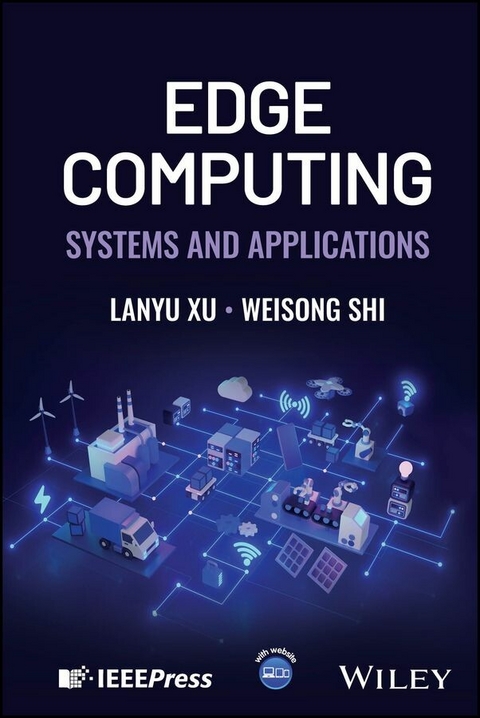
Edge Computing (eBook)
281 Seiten
Wiley-IEEE Press (Verlag)
978-1-394-28585-3 (ISBN)
Understand the computing technology that will power a connected future
The explosive growth of the Internet of Things (IoT) in recent years has revolutionized virtually every area of technology. It has also driven a drastically increased demand for computing power, as traditional cloud computing proved insufficient in terms of bandwidth, latency, and privacy. Edge computing, in which data is processed at the edge of the network, closer to where it's generated, has emerged as an alternative which meets the new data needs of an increasingly connected world.
Edge Computing offers a thorough but accessible overview of this cutting-edge technology. Beginning with the fundamentals of edge computing, including its history, key characteristics, and use cases, it describes the architecture and infrastructure of edge computing and the hardware that enables it. The book also explores edge intelligence, where artificial intelligence is integrated into edge computing to enable smaller, faster, and more autonomous decision-making. The result is an essential tool for any researcher looking to understand this increasingly ubiquitous method for processing data.
Edge Computing readers will also find:
- Real-world applications and case studies drawn from industries including healthcare and urban development
- Detailed discussion of topics including latency, security, privacy, and scalability
- A concluding summary of key findings and a look forward at an evolving computing landscape
Edge Computing is ideal for students, professionals, and enthusiasts looking to understand one of technology's most exciting new paradigms.
Lanyu Xu, PhD, is Assistant Professor in the Department of Computer Science and Engineering, Oakland University, Michigan, where she leads the Edge Intelligence System Laboratory. Her research intersects edge computing and deep learning, emphasizing the development of efficient edge intelligence systems. Her work explores optimization frameworks, intelligent systems, and AI applications to address challenges in efficiency and real-world applicability of edge systems across various domains.
Weisong Shi, PhD, is an Alumni Distinguished Professor and Chair of the Department of Computer and Information Sciences at the University of Delaware, where he leads the Connected and Autonomous Research Laboratory. He is an internationally renowned expert in edge computing, autonomous driving, and connected health. His pioneer paper, 'Edge Computing: Vision and Challenges,' has been cited more than 8000 times in eight years. He is an IEEE Fellow.
Understand the computing technology that will power a connected future The explosive growth of the Internet of Things (IoT) in recent years has revolutionized virtually every area of technology. It has also driven a drastically increased demand for computing power, as traditional cloud computing proved insufficient in terms of bandwidth, latency, and privacy. Edge computing, in which data is processed at the edge of the network, closer to where it s generated, has emerged as an alternative which meets the new data needs of an increasingly connected world. Edge Computing offers a thorough but accessible overview of this cutting-edge technology. Beginning with the fundamentals of edge computing, including its history, key characteristics, and use cases, it describes the architecture and infrastructure of edge computing and the hardware that enables it. The book also explores edge intelligence, where artificial intelligence is integrated into edge computing to enable smaller, faster, and more autonomous decision-making. The result is an essential tool for any researcher looking to understand this increasingly ubiquitous method for processing data. Edge Computing readers will also find: Real-world applications and case studies drawn from industries including healthcare and urban developmentDetailed discussion of topics including latency, security, privacy, and scalabilityA concluding summary of key findings and a look forward at an evolving computing landscape Edge Computing is ideal for students, professionals, and enthusiasts looking to understand one of technology s most exciting new paradigms.
| Erscheint lt. Verlag | 12.6.2025 |
|---|---|
| Sprache | englisch |
| Themenwelt | Mathematik / Informatik ► Informatik ► Netzwerke |
| Technik ► Elektrotechnik / Energietechnik | |
| Schlagworte | Artificial Intelligence • Autonomous Driving • Cloud Computing • Cloudlets • Connected Health • Data Security • Data sources • Deep learning • efficient edge intelligence • internet of things • latency • mec • privacy • Urban Development |
| ISBN-10 | 1-394-28585-X / 139428585X |
| ISBN-13 | 978-1-394-28585-3 / 9781394285853 |
| Informationen gemäß Produktsicherheitsverordnung (GPSR) | |
| Haben Sie eine Frage zum Produkt? |
 PDF (Adobe DRM)
Kopierschutz: Adobe-DRM
Adobe-DRM ist ein Kopierschutz, der das eBook vor Mißbrauch schützen soll. Dabei wird das eBook bereits beim Download auf Ihre persönliche Adobe-ID autorisiert. Lesen können Sie das eBook dann nur auf den Geräten, welche ebenfalls auf Ihre Adobe-ID registriert sind.
Details zum Adobe-DRM
Dateiformat: PDF (Portable Document Format)
Mit einem festen Seitenlayout eignet sich die PDF besonders für Fachbücher mit Spalten, Tabellen und Abbildungen. Eine PDF kann auf fast allen Geräten angezeigt werden, ist aber für kleine Displays (Smartphone, eReader) nur eingeschränkt geeignet.
Systemvoraussetzungen:
PC/Mac: Mit einem PC oder Mac können Sie dieses eBook lesen. Sie benötigen eine
eReader: Dieses eBook kann mit (fast) allen eBook-Readern gelesen werden. Mit dem amazon-Kindle ist es aber nicht kompatibel.
Smartphone/Tablet: Egal ob Apple oder Android, dieses eBook können Sie lesen. Sie benötigen eine
Geräteliste und zusätzliche Hinweise
Buying eBooks from abroad
For tax law reasons we can sell eBooks just within Germany and Switzerland. Regrettably we cannot fulfill eBook-orders from other countries.
aus dem Bereich