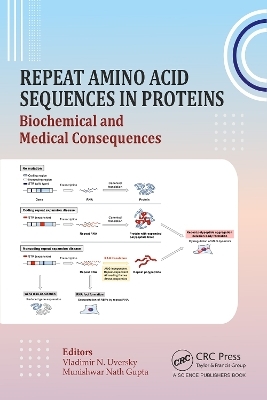
Repeat Amino Acid Sequences in Proteins
CRC Press (Verlag)
978-1-032-82445-1 (ISBN)
Repeat amino acid sequences are important in protein structure, disorder, function and evolution. Repeats of some amino acids exist in proteomes across species.
This volume highlights:
Which repeat sequences have pathogenic consequences and why?
Repeats which lead to surface hydrophobic clusters and their importance
Role of aromatic amino acid clusters in protein‐protein and protein‐drug interactions
Cell‐penetrating peptides and Elastin‐like peptides
Unusual phenomenon of fluorescence observed with repeats of some non‐aromatic amino acids
The use of residue cluster classes to represent protein structure and model structure‐function relationships.
Vladimir N. Uversky B.S., M.S., Ph.D., D.Sc., Professor at the Department of Molecular Medicine, Morsani College of Medicine, University of South Florida. He has a Ph.D. in physics and mathematics from Moscow Institute of Physics and Technology was followed by a D.Sc. in biophysics from the Institute of Experimental and Theoretical Biophysics, Russian Academy of Sciences. He is a fellow of the Royal Society of Biology, the Royal Society of Chemistry, the American Institute for Medical and Biological Engineering, and the American Association for the Advancement of Science. He has authored over 1,350 scientific publications and edited several books and book series on protein structure, function, folding and misfolding. He has an h‐index of 133. He has collaborated with more than 12,500 colleagues from more than 2,750 research organizations in 89 countries/territories. Munishwar Nath Gupta taught chemistry, biochemistry and biotechnology at IIT Delhi [1975‐2018]. He has a Ph.D. in biochemistry from IISc Bangalore was followed by post‐docs at the University of Minnesota, USA; MIT, USA; UTC, France and Lund University, Sweden. He is a fellow of NASI, Allahabad and INSA, New Delhi. He is currently Series Editor of Foundations and Frontiers in Enzymology, Elsevier. He has published over 300 scientific articles and edited 7 books so far. His current h‐index is 64.
Preface. 1. Pathogenic Role of Repeat Polypeptides in Repeat Expansion Diseases. 2. Pathologies Due to PolyQ Sequences. 3. Importance of Surface Hydrophobic Clusters in Proteins. 4. Residue Cluster Classes in Protein-Protein Interactions. 5. Aromatic Clusters in Proteins: Folding, Drug Interactions and Protein-Protein Complexes. 6. Cell Penetrating Peptides with Repeat Sequences of Amino Acids. 7. Recent Advances and Applications in Self-Assembling Short-Chain Elastin-Like Peptide Analogs. 8. Unconventional Fluorescence Properties of Non-aromatic Amino Acids: Material and Biological Applications. Index.
| Erscheinungsdatum | 22.07.2025 |
|---|---|
| Zusatzinfo | 11 Tables, black and white; 2 Line drawings, color; 5 Line drawings, black and white; 7 Halftones, color; 9 Halftones, black and white; 9 Illustrations, color; 14 Illustrations, black and white |
| Verlagsort | London |
| Sprache | englisch |
| Maße | 156 x 234 mm |
| Gewicht | 493 g |
| Themenwelt | Naturwissenschaften ► Biologie ► Biochemie |
| Technik ► Umwelttechnik / Biotechnologie | |
| ISBN-10 | 1-032-82445-X / 103282445X |
| ISBN-13 | 978-1-032-82445-1 / 9781032824451 |
| Zustand | Neuware |
| Informationen gemäß Produktsicherheitsverordnung (GPSR) | |
| Haben Sie eine Frage zum Produkt? |
aus dem Bereich