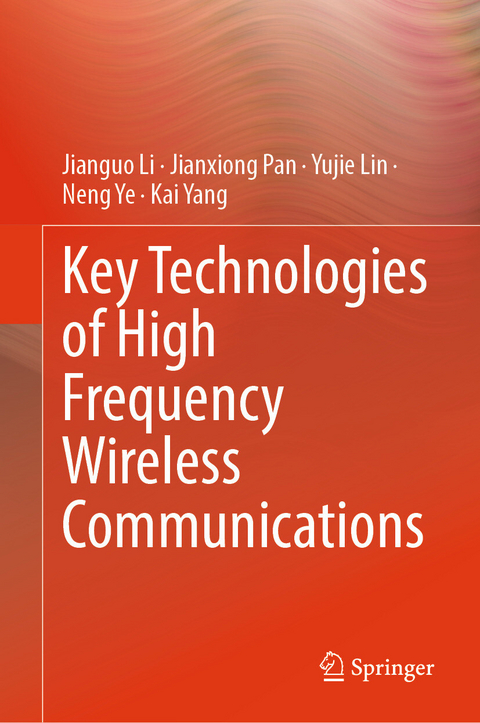
Key Technologies of High Frequency Wireless Communications (eBook)
182 Seiten
Springer Nature Singapore (Verlag)
978-981-96-5894-7 (ISBN)
This book provides solutions to some of the issues present in the physical layer of current high-frequency wireless communication systems. It reviews the development history of high-frequency wireless communication systems, pinpoints certain existing problems in contemporary high-frequency communication systems, and proposes solutions. The 6th Generation Mobile Networks (6G) is based on terrestrial cellular networks and integrates satellite communication, drone communication, and marine communication to form an integrated air-ground-sea network, providing comprehensive coverage, high speed, high security, and multifunctional communication solutions. High-frequency wireless communication, represented by millimeter-wave and terahertz communications, offers a wide available spectrum and high transmission rates, making it a highly promising broadband wireless access technology in 6G.
To achieve higher transmission rates (Tbps level), lower transmission latency (millisecond level), higher security performance (physical layer security), and stronger hardware integration (communication-sensing integration), high-frequency wireless transmission faces many challenges due to characteristics such as short wavelengths, high path loss, and weak components. These challenges include: Large link attenuation and poor coverage in high-frequency wireless communication systems, resulting in low spectrum efficiency for edge users.Low output power, poor linearity, and low efficiency of high-frequency power amplifiers, making it difficult to achieve long-distance transmission of wideband signals.High sidelobe energy in high-frequency multi-user secure transmission, leading to unfocused spatial regions and low transmission efficiency.Independent design functions and high information processing delay in high-frequency communication and sensing, causing wastage of spectrum resources and hardware resources.To address these challenges, the author has conducted innovative work aimed at improving the spectrum efficiency, power amplifier efficiency, transmission efficiency, and processing efficiency of high-frequency wireless transmission. The research findings have been published in high-impact journals such as IEEE Transactions on Vehicular Technology, Microwave Theory and Techniques, Broadcasting, IEEE Sensors Journal, and IEEE Wireless Communications Letters. Based on these foundations, this book is dedicated to discussing efficient transmission technology for high-frequency wireless communications with a focus on 6G. The book addresses fields such as signal processing, spectrum management, and high-efficiency sustainable communications. It is highly recommended for academic researchers, students, and engineers in wireless communication, terahertz communication, and electronic information fields.
This book provides solutions to some of the issues present in the physical layer of current high-frequency wireless communication systems. It reviews the development history of high-frequency wireless communication systems, pinpoints certain existing problems in contemporary high-frequency communication systems, and proposes solutions. The 6th Generation Mobile Networks (6G) is based on terrestrial cellular networks and integrates satellite communication, drone communication, and marine communication to form an integrated air-ground-sea network, providing comprehensive coverage, high speed, high security, and multifunctional communication solutions. High-frequency wireless communication, represented by millimeter-wave and terahertz communications, offers a wide available spectrum and high transmission rates, making it a highly promising broadband wireless access technology in 6G.To achieve higher transmission rates (Tbps level), lower transmission latency (millisecond level), higher security performance (physical layer security), and stronger hardware integration (communication-sensing integration), high-frequency wireless transmission faces many challenges due to characteristics such as short wavelengths, high path loss, and weak components. These challenges include: Large link attenuation and poor coverage in high-frequency wireless communication systems, resulting in low spectrum efficiency for edge users.Low output power, poor linearity, and low efficiency of high-frequency power amplifiers, making it difficult to achieve long-distance transmission of wideband signals.High sidelobe energy in high-frequency multi-user secure transmission, leading to unfocused spatial regions and low transmission efficiency.Independent design functions and high information processing delay in high-frequency communication and sensing, causing wastage of spectrum resources and hardware resources.To address these challenges, the author has conducted innovative work aimed at improving the spectrum efficiency, power amplifier efficiency, transmission efficiency, and processing efficiency of high-frequency wireless transmission. The research findings have been published in high-impact journals such as IEEE Transactions on Vehicular Technology, Microwave Theory and Techniques, Broadcasting, IEEE Sensors Journal, and IEEE Wireless Communications Letters. Based on these foundations, this book is dedicated to discussing efficient transmission technology for high-frequency wireless communications with a focus on 6G. The book addresses fields such as signal processing, spectrum management, and high-efficiency sustainable communications. It is highly recommended for academic researchers, students, and engineers in wireless communication, terahertz communication, and electronic information fields.
| Erscheint lt. Verlag | 10.6.2025 |
|---|---|
| Zusatzinfo | XV, 182 p. 100 illus., 93 illus. in color. |
| Sprache | englisch |
| Themenwelt | Mathematik / Informatik ► Informatik ► Netzwerke |
| Technik ► Elektrotechnik / Energietechnik | |
| Technik ► Nachrichtentechnik | |
| Schlagworte | Communication and ranging integration • High-frequency wireless communication • hybrid beamforming • Low-Density Parity-Check • Non-orthogonalmultiple access • OFDM Radar • Physical-Layer Security • Reconfigurable Intelligent Surface |
| ISBN-10 | 981-96-5894-2 / 9819658942 |
| ISBN-13 | 978-981-96-5894-7 / 9789819658947 |
| Informationen gemäß Produktsicherheitsverordnung (GPSR) | |
| Haben Sie eine Frage zum Produkt? |
 PDF (Wasserzeichen)
DRM: Digitales Wasserzeichen
Dieses eBook enthält ein digitales Wasserzeichen und ist damit für Sie personalisiert. Bei einer missbräuchlichen Weitergabe des eBooks an Dritte ist eine Rückverfolgung an die Quelle möglich.
Dateiformat: PDF (Portable Document Format)
Mit einem festen Seitenlayout eignet sich die PDF besonders für Fachbücher mit Spalten, Tabellen und Abbildungen. Eine PDF kann auf fast allen Geräten angezeigt werden, ist aber für kleine Displays (Smartphone, eReader) nur eingeschränkt geeignet.
Systemvoraussetzungen:
PC/Mac: Mit einem PC oder Mac können Sie dieses eBook lesen. Sie benötigen dafür einen PDF-Viewer - z.B. den Adobe Reader oder Adobe Digital Editions.
eReader: Dieses eBook kann mit (fast) allen eBook-Readern gelesen werden. Mit dem amazon-Kindle ist es aber nicht kompatibel.
Smartphone/Tablet: Egal ob Apple oder Android, dieses eBook können Sie lesen. Sie benötigen dafür einen PDF-Viewer - z.B. die kostenlose Adobe Digital Editions-App.
Buying eBooks from abroad
For tax law reasons we can sell eBooks just within Germany and Switzerland. Regrettably we cannot fulfill eBook-orders from other countries.
aus dem Bereich