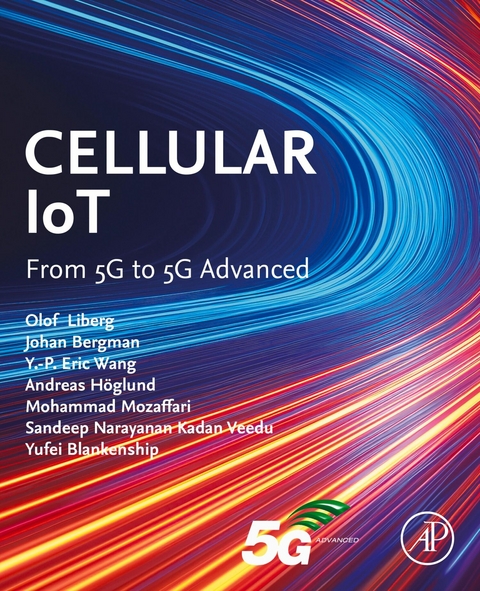
Cellular IoT (eBook)
325 Seiten
Elsevier Science (Verlag)
978-0-443-21569-8 (ISBN)
Olof Liberg is a Line and Program Manager at Ericsson's department for Standards & Technologies. Olof joined Ericsson in 2008 and has specialized in the design and standardization of cellular radio access technologies. He is currently leading a team focused on radio and spectrum standardization and Ericsson's 3GPP radio access network standardization program. Olof holds a Bachelor's degree in Business and Economics and a Master's degree in Engineering Physics, both from Uppsala University. He has actively participated in the work of several standardization bodies, such as 3GPP, ITU-R, and ETSI. He was the Chairman of 3GPP TSG GERAN and its Working Group 1, during the 3GPP study on new radio-access technologies for the Internet of Things leading up to the specification of Narrowband IoT (NB-IoT). Olof is one of the authors behind the first and second edition of the book Cellular Internet of Things (Elsevier) and has coauthored several academic publications and contributed to more than 100 US patents.
Cellular IoT: From 5G to 5G Advanced gives an accessible and insightful explanation of 5G IoT technologies and standards. After an introduction to 5G and 5G Advanced, this book in detail goes through the 5G features that are vital for the support of IoT use cases. It describes how the 5G New Radio (NR) access technology has been adapted to provide cost- and energy-efficient connectivity for massive IoT and broadband IoT, as well as providing high data rates, ultra-reliability, and low latency to support immersive experience and time-critical communications. This book also discusses adaptations to support satellite communication, the future of massive IoT and how 3GPP is about to extend its support to near zero-energy and low-complexity devices and use cases. These forward-looking features will help evolve 5G and 5G Advanced toward realizing 6G visions such as a connected, sustainable, digitalized, and programmable physical world. - Explains how 5G NR is designed to support IoT- Shows the reasoning behind different design choices- Presents the 5G NR features that address different IoT use cases
| Erscheint lt. Verlag | 9.6.2025 |
|---|---|
| Sprache | englisch |
| Themenwelt | Technik ► Nachrichtentechnik |
| ISBN-10 | 0-443-21569-3 / 0443215693 |
| ISBN-13 | 978-0-443-21569-8 / 9780443215698 |
| Informationen gemäß Produktsicherheitsverordnung (GPSR) | |
| Haben Sie eine Frage zum Produkt? |
 EPUB (Adobe DRM)
Kopierschutz: Adobe-DRM
Adobe-DRM ist ein Kopierschutz, der das eBook vor Mißbrauch schützen soll. Dabei wird das eBook bereits beim Download auf Ihre persönliche Adobe-ID autorisiert. Lesen können Sie das eBook dann nur auf den Geräten, welche ebenfalls auf Ihre Adobe-ID registriert sind.
Details zum Adobe-DRM
Dateiformat: EPUB (Electronic Publication)
EPUB ist ein offener Standard für eBooks und eignet sich besonders zur Darstellung von Belletristik und Sachbüchern. Der Fließtext wird dynamisch an die Display- und Schriftgröße angepasst. Auch für mobile Lesegeräte ist EPUB daher gut geeignet.
Systemvoraussetzungen:
PC/Mac: Mit einem PC oder Mac können Sie dieses eBook lesen. Sie benötigen eine
eReader: Dieses eBook kann mit (fast) allen eBook-Readern gelesen werden. Mit dem amazon-Kindle ist es aber nicht kompatibel.
Smartphone/Tablet: Egal ob Apple oder Android, dieses eBook können Sie lesen. Sie benötigen eine
Geräteliste und zusätzliche Hinweise
Buying eBooks from abroad
For tax law reasons we can sell eBooks just within Germany and Switzerland. Regrettably we cannot fulfill eBook-orders from other countries.
aus dem Bereich