


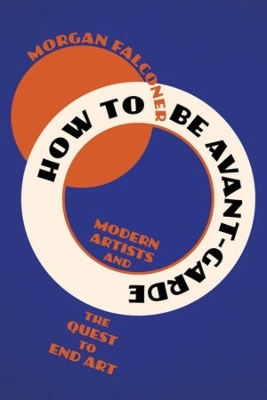
How to Be Avant-Garde
Modern Artists and the Quest to End Art
Seiten
2026
WW Norton & Co (Verlag)
978-1-324-12333-0 (ISBN)
WW Norton & Co (Verlag)
978-1-324-12333-0 (ISBN)
- Noch nicht erschienen (ca. März 2026)
- Portofrei ab CHF 40
- Auch auf Rechnung
- Artikel merken
The strange story of the twentieth-century artists who sought to destroy art by transforming it into the substance of everyday life
“Art has poisoned our life”, proclaimed De Stijl co-founder Theo van Doesburg. Reacting to the tumultuous crises of the twentieth century, especially the horrors of the First World War, from Paris to New York, from Zurich to Moscow and Berlin, avant-gardists challenged the confines of the definition of art along with the confines of the canvas itself. Morgan Falconer starts with the dynamic Futurist founder Filippo Tommaso Marinetti, whose manifesto extolling speed, destruction and modernity seeded avant-gardes across Europe. In turn, Dadaists Hugo Ball and Emmy Hennings sought to replace art with political cabaret and the Surrealists tried to exchange it for tools to plumb the unconscious. Falconer goes on to guide us through the Russian Constructivists and then De Stijl, the Bauhaus and finally, the Situationists.
How to Be Avant-Garde is a journey through the interlocking networks of richly creative lives, their sometimes sympathetic but often strange and turbulent conversations, and their objects and writings that defied categorisation.
“Art has poisoned our life”, proclaimed De Stijl co-founder Theo van Doesburg. Reacting to the tumultuous crises of the twentieth century, especially the horrors of the First World War, from Paris to New York, from Zurich to Moscow and Berlin, avant-gardists challenged the confines of the definition of art along with the confines of the canvas itself. Morgan Falconer starts with the dynamic Futurist founder Filippo Tommaso Marinetti, whose manifesto extolling speed, destruction and modernity seeded avant-gardes across Europe. In turn, Dadaists Hugo Ball and Emmy Hennings sought to replace art with political cabaret and the Surrealists tried to exchange it for tools to plumb the unconscious. Falconer goes on to guide us through the Russian Constructivists and then De Stijl, the Bauhaus and finally, the Situationists.
How to Be Avant-Garde is a journey through the interlocking networks of richly creative lives, their sometimes sympathetic but often strange and turbulent conversations, and their objects and writings that defied categorisation.
Morgan Falconer, a critic and art historian, teaches at Sotheby’s Institute of Art. He is the author of Painting Beyond Pollock and has written for publications including the Economist, the Times (UK), Art in America, and Frieze. He lives in Queens, New York.
| Erscheint lt. Verlag | 13.3.2026 |
|---|---|
| Zusatzinfo | 13 black-and-white illustrations |
| Verlagsort | New York |
| Sprache | englisch |
| Maße | 140 x 211 mm |
| Gewicht | 255 g |
| Themenwelt | Literatur ► Biografien / Erfahrungsberichte |
| Kunst / Musik / Theater ► Kunstgeschichte / Kunststile | |
| Technik ► Architektur | |
| ISBN-10 | 1-324-12333-8 / 1324123338 |
| ISBN-13 | 978-1-324-12333-0 / 9781324123330 |
| Zustand | Neuware |
| Informationen gemäß Produktsicherheitsverordnung (GPSR) | |
| Haben Sie eine Frage zum Produkt? |
Mehr entdecken
aus dem Bereich



aus dem Bereich
unser Eingliederungsversuch in eine geschlossene Gesellschaft
Buch | Softcover (2025)
Knaur (Verlag)
CHF 25,20


