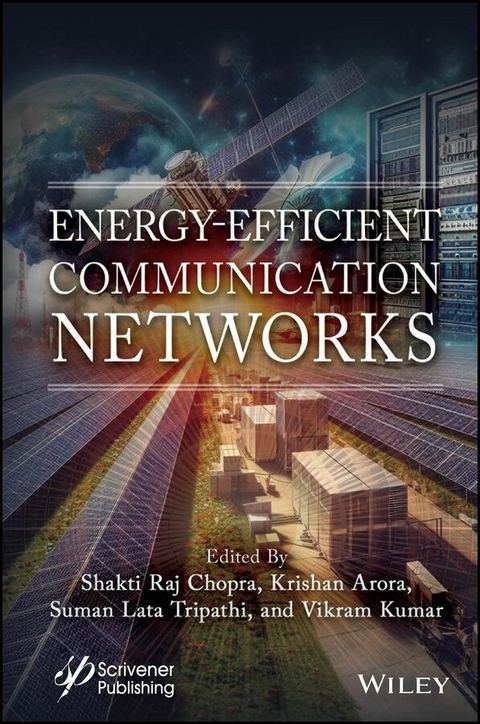
Energy-Efficient Communication Networks (eBook)
261 Seiten
Wiley-Scrivener (Verlag)
978-1-394-27167-2 (ISBN)
Energy-Efficient Communication Networks is essential for anyone looking to understand and implement cutting-edge energy optimization strategies for communication systems, ensuring they meet growing energy demands while seamlessly integrating renewable energy sources and enhancing battery life in embedded applications.
Renewable energy, including solar, wind, and geothermal energy, for communication networks is a key area of exploration for meeting the demands of their increasing energy requirements. Scheduling and power cycle optimization are instrumental in deciding the effectiveness of these networks. Apart from communication, embedded systems running on batteries designed for data processing applications also face restrictions in terms of battery life-targeting low-energy consumption-based systems is particularly important here. The increased usage of sensor networks for personal and commercial applications has resulted in a surge of development to create energy-aware protocols and algorithms.
This book introduces energy optimization concepts for current and future communication networks and explains how to optimize electricity for wireless sensor networks and incorporate renewable energy sources into conventional communication networks. It gives readers a better understanding of the difficulties, limitations, and possible bottlenecks that may occur while developing a communication system under power constraints, as well as insights into the traditional and recently developed communication systems from an energy optimization point of view.
Shakti Raj Chopra, PhD is an associate professor at Lovely Professional University with over 18 years of academic experience. He has published over 45 research papers in international journals and conferences. Additionally, he has worked on several consultancy projects and participated in over 20 national and international webinars. His areas of interest include cognitive radio, blockchain, artificial intelligence, and machine learning.
Krishan Arora, PhD is an associate professor and Head of the Department of Power Systems in the School of Electronics and Engineering at Lovely Professional University with over 16 years of academic experience. He has published over 70 research papers in international journals and conferences, organized several workshops, internships, and lectures, and participated in over 20 national and international webinars. His areas of research include electrical machines, non-conventional energy sources, load frequency control, and automatic generation control.
Suman Lata Tripathi, PhD is a professor at Lovely Professional University with more than 20 years of academic experience. She has published over 74 research papers in international journals, 13 patents, two copyrights, and has authored and edited over 17 books. She also serves as a session chair, conference-steering committee member, editorial board member, and peer reviewer for international journals. Her areas of interest include microelectronics device modeling and characterization, low-power VLSI circuit design, and embedded system design.
Vikram Kumar, PhD is a post-doctoral researcher and guest lecturer at the University of Calgary, Canada. He has published 82 research papers in international journals, three patents, and four copyrights. Additionally, he has presented research work in over two dozen national and international conferences and serves as an editorial board member of several journals. His areas of interest include multidisciplinary design and optimization, artificial intelligence and machine learning for numerical and engineering optimization, and information and communication technology for smart grid applications.
Energy-Efficient Communication Networks is essential for anyone looking to understand and implement cutting-edge energy optimization strategies for communication systems, ensuring they meet growing energy demands while seamlessly integrating renewable energy sources and enhancing battery life in embedded applications. Renewable energy, including solar, wind, and geothermal energy, for communication networks is a key area of exploration for meeting the demands of their increasing energy requirements. Scheduling and power cycle optimization are instrumental in deciding the effectiveness of these networks. Apart from communication, embedded systems running on batteries designed for data processing applications also face restrictions in terms of battery life targeting low-energy consumption-based systems is particularly important here. The increased usage of sensor networks for personal and commercial applications has resulted in a surge of development to create energy-aware protocols and algorithms. This book introduces energy optimization concepts for current and future communication networks and explains how to optimize electricity for wireless sensor networks and incorporate renewable energy sources into conventional communication networks. It gives readers a better understanding of the difficulties, limitations, and possible bottlenecks that may occur while developing a communication system under power constraints, as well as insights into the traditional and recently developed communication systems from an energy optimization point of view.
| Erscheint lt. Verlag | 4.6.2025 |
|---|---|
| Sprache | englisch |
| Themenwelt | Technik ► Elektrotechnik / Energietechnik |
| Schlagworte | Artificial Intelligence • FDSS • Human to Machine (H2M) • Internet of Thing • lans • machine learning • Machine to Machine (M2M) • MAC layer • Massive MIMO • MIMO • NOMA • Remote Sensing • renewable energy • Spectral Efficiency • UAV |
| ISBN-10 | 1-394-27167-0 / 1394271670 |
| ISBN-13 | 978-1-394-27167-2 / 9781394271672 |
| Informationen gemäß Produktsicherheitsverordnung (GPSR) | |
| Haben Sie eine Frage zum Produkt? |
 PDF (Adobe DRM)
Kopierschutz: Adobe-DRM
Adobe-DRM ist ein Kopierschutz, der das eBook vor Mißbrauch schützen soll. Dabei wird das eBook bereits beim Download auf Ihre persönliche Adobe-ID autorisiert. Lesen können Sie das eBook dann nur auf den Geräten, welche ebenfalls auf Ihre Adobe-ID registriert sind.
Details zum Adobe-DRM
Dateiformat: PDF (Portable Document Format)
Mit einem festen Seitenlayout eignet sich die PDF besonders für Fachbücher mit Spalten, Tabellen und Abbildungen. Eine PDF kann auf fast allen Geräten angezeigt werden, ist aber für kleine Displays (Smartphone, eReader) nur eingeschränkt geeignet.
Systemvoraussetzungen:
PC/Mac: Mit einem PC oder Mac können Sie dieses eBook lesen. Sie benötigen eine
eReader: Dieses eBook kann mit (fast) allen eBook-Readern gelesen werden. Mit dem amazon-Kindle ist es aber nicht kompatibel.
Smartphone/Tablet: Egal ob Apple oder Android, dieses eBook können Sie lesen. Sie benötigen eine
Geräteliste und zusätzliche Hinweise
Buying eBooks from abroad
For tax law reasons we can sell eBooks just within Germany and Switzerland. Regrettably we cannot fulfill eBook-orders from other countries.
aus dem Bereich