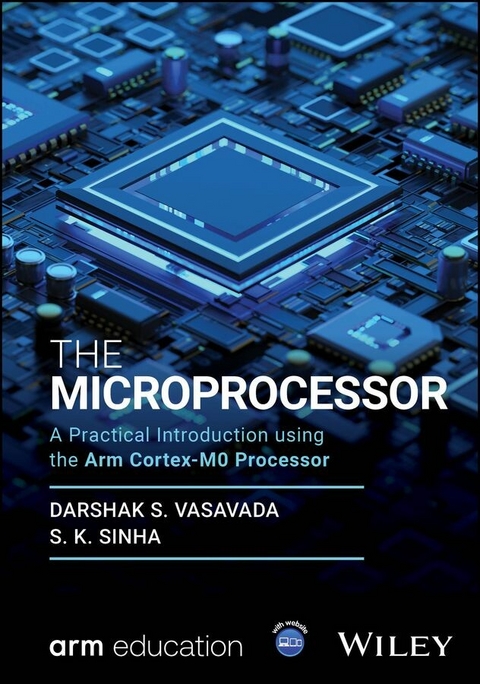
The Microprocessor (eBook)
864 Seiten
Wiley (Verlag)
978-1-394-24530-7 (ISBN)
Provides a comprehensive introduction to microprocessor architecture and programming concepts, using the Arm® Cortex®-M0 processor as an example
The Microprocessor offers a supremely accessible and user-friendly introduction to microprocessor basics: instruction set, the exception model, system architecture and microcontroller programming. Explaining the working principles with simplified models, this first-level book builds the base for all onward courses at intermediate and advanced levels.
Filled with exercises that can be executed on the free version of Keil® ?Vision® MDK without any hardware, the book explains the essential aspects of microprocessor architecture with simple programming examples in assembly and C. By blending conceptual knowledge with practical exercises, the book offers valuable insights that equip readers to engage with real-world applications in the fields of microprocessor architecture and embedded systems.
Darshak S. Vasavada has extensive corporate as well as teaching experience in embedded DSP and multimedia systems. At present, he teaches real-time embedded system design at Robert Bosch Center for Cyber-Physical Systems at Indian Institute of Science, Bangalore.
S. K. Sinha, retired from Department of Electronic Systems Engineering (DESE, earlier known as CEDT), Indian Institute of Science, Bangalore, set up the first embedded systems lab at CEDT and has helped introduce MTech courses in several colleges in India. At present, he is Chief Architect at Lab To Market Innovations, specializing in reliable IIoT systems.
The authors have contributed to several workshops on embedded systems for teachers and students in various colleges, which have been the source of motivation behind this book.
Provides a comprehensive introduction to microprocessor architecture and programming concepts, using the Arm Cortex -M0 processor as an example The Microprocessor offers a supremely accessible and user-friendly introduction to microprocessor basics: instruction set, the exception model, system architecture and microcontroller programming. Explaining the working principles with simplified models, this first-level book builds the base for all onward courses at intermediate and advanced levels. Filled with exercises that can be executed on the free version of Keil Vision MDK without any hardware, the book explains the essential aspects of microprocessor architecture with simple programming examples in assembly and C. By blending conceptual knowledge with practical exercises, the book offers valuable insights that equip readers to engage with real-world applications in the fields of microprocessor architecture and embedded systems.
Introduction
Let us begin by asking:
What is a microprocessor?
Intel, which is credited with the first microprocessor (4004, in 1971), answers this question thus: “The microprocessor, also known as the central processing unit (CPU), is the brain of all computers.”
This comparison of microprocessor with the human brain is quite apt. In a human mind–body system, the brain receives inputs from sensory organs (eyes, ears, skin), processes the information received and takes decisions. To the outside world, the decisions taken by our brain are reflected in what we speak, how we walk, etc.
We do not see our brain. And we do not see the microprocessor in a computer system – it is hidden inside the system and not directly accessible to the user. What we get to work with are the inputs and outputs of the system.
However, this comparison ends here! We have a very limited understanding of our brain. But we understand microprocessors very well. By the time we complete our journey, you will know much more about microprocessors than you do about your brain!
1 MICROPROCESSOR SYSTEM
Figure I.1 shows a diagram of a microprocessor system, simplified for the purpose of learning.
Figure I.1 A simplified microprocessor system
As shown in the figure, a microprocessor system receives inputs and produces outputs. An input device can be as simple as a push button, or very complex as a video camera. Similarly, an output device can be a simple two-lead LED, or a far more complex LCD screen. Processor may also interact with electro-mechanical devices, for example, motors in a robotic system. Such systems may involve inputs from a variety of sensors: distance, speed, acceleration, etc. Many systems use communication devices such as Universal Serial Bus (USB) or Ethernet for exchanging information with the external world. To interact with an input/output (IO) device, a microprocessor uses an IO port, which acts as a bridge between the processor and an IO device.
A microprocessor system processes the inputs and generates the outputs according to a program stored in the memory. A program could be an algorithm, a set of equations, or logical statements, typically written in a high-level language such as C or C++. Since the microprocessor can ‘understand’ only binary language, we convert a C/C++ program into binary machine codes using a software tool called a compiler. Just as our brain uses memory cells to remember various algorithms (for example, how to speak) and related data (various words that we speak), the microprocessor system uses memory devices to store the program instructions and the associated data.
Apart from being used in desktop and mobile computers, microprocessors are used in a large number of systems where they are embedded deep within the system. Examples of embedded applications are numerous, such as playing music or displaying pictures, controlling air-fuel mixture in a car's engine, managing the autopilot mode of an aeroplane, processing a variety of biomedical signals such as in an ECG or a blood-pressure monitor, processing camera information to drive motors in a robot, processing pressure and temperature in an industrial control system, processing enormous amounts of data on the servers – the list is endless.
Depending on the applications in which they are used, microprocessors vary in their capabilities. For example, a microprocessor that controls mixing air and fuel in a car engine has to be a lot more powerful than a microprocessor in a digital thermometer, but at the same time, it does not require capability to process audio, video and image data like the ones in our mobile phones do.
To understand this spectrum of microprocessors, ranging from a tiny microcontroller inside a remote control to the one powering a cloud server, let us divide them into three broad categories:
- Microcontroller processors
- Real-time processors
- Application processors
Let us discuss each briefly.
2 MICROCONTROLLER PROCESSORS
Microcontrollers deploy the simplest form of microprocessors. They are used in many everyday devices such as remote controllers, digital thermometers, wearable devices and home appliances.
2.1 Hardware
Microcontrollers are designed for compact and power-efficient applications. They integrate a processor, memory and IO interfaces on a single chip. Microcontrollers are implemented as Systems-on-Chip (SoCs), reducing the overall system complexity and cost, and, at the same time, improving hardware reliability. Their small size and low power consumption make them ideal for applications where space and energy are at a premium.
2.2 Software
Microcontrollers are typically used in dedicated systems that perform specific tasks. Simple systems carry out repetitive activities running in a loop. Often known as ‘bare-metal’ systems, these are standalone systems without an operating system (OS). More complex systems deploy a real-time operating system (RTOS) to implement multitasking applications.
Power-sensitive systems go into a sleep state after completing their task, exploiting power-saving modes available in microcontrollers, and wake up again when new inputs are available.
2.3 Applications
Microcontroller processors are characterized by low software complexity, high power efficiency and small silicon area on the chip. They are tiny little brains that run numerous devices in automotive, industrial, medical, building automation and many more segments. Let us take a few examples:
Tens of microcontrollers are used inside a car, to carry out various tasks, such as checking seat-belt status, measuring tire pressure, controlling door lock, winding up window glass etc.
Microcontrollers are used extensively in home appliances. For example, microwave ovens use microcontrollers for on/off and timing control. Washing machines use them to control the speed and timings of their motors and operate water inlet and outlet valves.
Microcontrollers also proliferate medical equipment such as digital thermometers, blood-pressure meters, pulse-oximeters and so on, measuring various body parameters and displaying them on a small display.
Finally, microcontrollers play a major role in enabling the last leg of Internet of Things (IoT) systems. They provide the interface between the digital world and the physical sensors and actuators, enabling real-time data collection, processing and control in a variety of interconnected devices.
3 REAL-TIME PROCESSORS
Moving up the complexity scale, next in the series are the real-time processors. They are used in time-critical systems, where a significant amount of data needs to be processed within a specific deadline, such as an aircraft landing system or performing a robotic surgery. Often characterised as the systems where ‘a late answer is a wrong answer’, real-time processors are critically important in automotive, industrial, networking and many other systems.
3.1 Hardware
Real-time data-processing systems require significantly more computation power to process large volumes of data within a specific time frame. Hence, these processors run at a higher clock frequency compared to the microcontroller processors.
Real-time processors are accompanied by on-chip memories to store time-critical data and code. However, the on-chip memories are limited in size, and hence, such systems typically need a storage device (such as an SD card or a solid-state drive) to store the program, and a large external memory (RAM) to run the program. Since external memories are slow in speed, many systems also deploy on-chip cache memory that stores frequently accessed code and data to improve system performance.
3.2 Software
A real-time application is implemented as multiple threads running concurrently. Such systems use an RTOS that schedules threads according to their priorities to meet the deadlines. An RTOS is a very lightweight OS that provides multi-tasking capability to a system. Since it has little overheads, an RTOS is significantly more responsive to external inputs compared to a desktop OS, and hence, well-suited to meet real-time requirements.
Such systems often use a boot-loader code that loads the program from the storage device to the memory. Bootloaders often have the capability to upgrade the program for bug fixes and feature enhancements.
3.3 Applications
Real-time processors are used where time is of essence. These processors are designed to perform tasks within very strict time constraints, often requiring precision down to nanoseconds. Here are some examples of systems implemented using a real-time processor.
A power-train control module, also known as an engine control unit (ECU), processes signals from numerous sensors, including those measuring air and fuel intake, oxygen levels in the exhaust, and various shaft positions in the engine. It uses this data to control air and fuel injection and ignition timings, ensuring precise operations that result in high fuel efficiency, even at high vehicle speeds.
A wireless modem in a mobile phone converts digital data into radio signals for transmission and vice versa at very high data rates. It runs sophisticated algorithms to improve reliability in the presence of interference and noise. Since the same medium is used by multiple devices for communication, these...
| Erscheint lt. Verlag | 3.6.2025 |
|---|---|
| Reihe/Serie | Wiley-Arm Professional Computing and Electrical Engineering Series |
| Sprache | englisch |
| Themenwelt | Technik ► Elektrotechnik / Energietechnik |
| Schlagworte | arithmetic and logic operations • Assembly Programming • branches and subroutines • computer organization • exception model • instruction-set architecture • load-store operations • memory model • Processor architecture • RISC concepts • stack operations |
| ISBN-10 | 1-394-24530-0 / 1394245300 |
| ISBN-13 | 978-1-394-24530-7 / 9781394245307 |
| Informationen gemäß Produktsicherheitsverordnung (GPSR) | |
| Haben Sie eine Frage zum Produkt? |
 EPUB (Adobe DRM)
Kopierschutz: Adobe-DRM
Adobe-DRM ist ein Kopierschutz, der das eBook vor Mißbrauch schützen soll. Dabei wird das eBook bereits beim Download auf Ihre persönliche Adobe-ID autorisiert. Lesen können Sie das eBook dann nur auf den Geräten, welche ebenfalls auf Ihre Adobe-ID registriert sind.
Details zum Adobe-DRM
Dateiformat: EPUB (Electronic Publication)
EPUB ist ein offener Standard für eBooks und eignet sich besonders zur Darstellung von Belletristik und Sachbüchern. Der Fließtext wird dynamisch an die Display- und Schriftgröße angepasst. Auch für mobile Lesegeräte ist EPUB daher gut geeignet.
Systemvoraussetzungen:
PC/Mac: Mit einem PC oder Mac können Sie dieses eBook lesen. Sie benötigen eine
eReader: Dieses eBook kann mit (fast) allen eBook-Readern gelesen werden. Mit dem amazon-Kindle ist es aber nicht kompatibel.
Smartphone/Tablet: Egal ob Apple oder Android, dieses eBook können Sie lesen. Sie benötigen eine
Geräteliste und zusätzliche Hinweise
Buying eBooks from abroad
For tax law reasons we can sell eBooks just within Germany and Switzerland. Regrettably we cannot fulfill eBook-orders from other countries.
aus dem Bereich