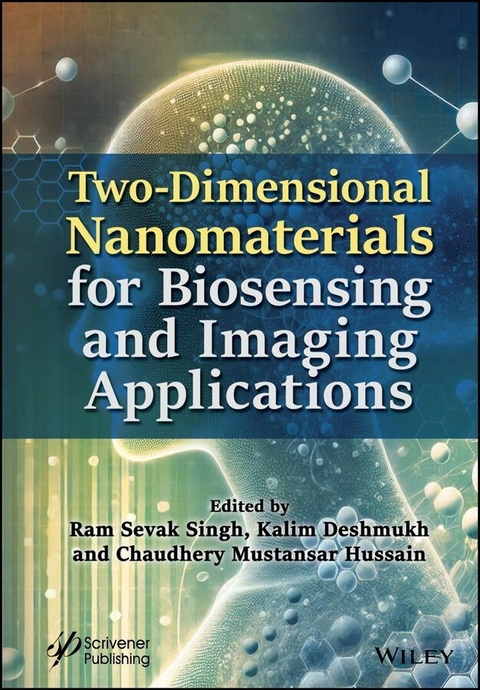
Two-Dimensional Nanomaterials for Biosensing and Imaging Applications (eBook)
1142 Seiten
Wiley-Scrivener (Verlag)
978-1-394-20035-1 (ISBN)
The book is essential for anyone eager to understand the transformative potential of 2D nanomaterials in biotechnology and medical science, offering in-depth insights into their unique properties, synthesis methods, and practical applications in an ever-evolving field.
Nanotechnology is pivotal in advancing biotechnology and medical science. Nanomaterials, essential components of this technology, showcase unique and superior physicochemical properties when compared to their bulk equivalents. Since the groundbreaking discovery of graphene in 2004, two-dimensional (2D) nanomaterials have garnered immense attention for their potential in a wide range of applications across multiple industries including biochemistry, biophysics, and engineering. Two-Dimensional Nanomaterials for Biosensing and Imaging Applications examines the current state and new challenges associated with the development of 2D nanomaterials for biosensing and imaging applications. This volume focuses on the synthesis, processing methods, characterization, properties, and applications of 2D nanomaterials, their nanocomposites or heterostructures for biosensors and imaging devices, and the essential criteria in each specified field. Comparative performance evaluations of various biosensor devices and their advantages and disadvantages for the commercialization of 2D materials-based biosensors are comprehensively covered, giving essential insight into the challenges this technology presents. A handpicked selection of topics and expert contributors from across the globe will make this book an outstanding resource for students and industry professionals looking to explore the potential of these ground-breaking materials.
Readers will find the book:
- Provides a comprehensive overview of the synthesis, processing, compositions, structure, device design, and various properties of two-dimensional nanomaterials for biosensing and imaging applications;
- Comprehensively covers 2D materials and their processing techniques, properties, and enhancement for biosensing and imaging applications
- Explores the coverage of biocompatibility, toxicity concerns, environmental and safety considerations, and legal and commercialization aspects of 2D nanomaterials for biosensing and imaging applications.
Audience
Graduate, postgraduate, and engineering students, research scholars, and faculty working in materials science, biotechnology, biomedical engineering, biochemistry, and biophysics, as well as material engineers, scientists, and technologists in the electronic, electrical, and biomedical industries.
The book is essential for anyone eager to understand the transformative potential of 2D nanomaterials in biotechnology and medical science, offering in-depth insights into their unique properties, synthesis methods, and practical applications in an ever-evolving field. Nanotechnology is pivotal in advancing biotechnology and medical science. Nanomaterials, essential components of this technology, showcase unique and superior physicochemical properties when compared to their bulk equivalents. Since the groundbreaking discovery of graphene in 2004, two-dimensional (2D) nanomaterials have garnered immense attention for their potential in a wide range of applications across multiple industries including biochemistry, biophysics, and engineering. Two-Dimensional Nanomaterials for Biosensing and Imaging Applications examines the current state and new challenges associated with the development of 2D nanomaterials for biosensing and imaging applications. This volume focuses on the synthesis, processing methods, characterization, properties, and applications of 2D nanomaterials, their nanocomposites or heterostructures for biosensors and imaging devices, and the essential criteria in each specified field. Comparative performance evaluations of various biosensor devices and their advantages and disadvantages for the commercialization of 2D materials-based biosensors are comprehensively covered, giving essential insight into the challenges this technology presents. A handpicked selection of topics and expert contributors from across the globe will make this book an outstanding resource for students and industry professionals looking to explore the potential of these ground-breaking materials. Readers will find the book: Provides a comprehensive overview of the synthesis, processing, compositions, structure, device design, and various properties of two-dimensional nanomaterials for biosensing and imaging applications; Comprehensively covers 2D materials and their processing techniques, properties, and enhancement for biosensing and imaging applications Explores the coverage of biocompatibility, toxicity concerns, environmental and safety considerations, and legal and commercialization aspects of 2D nanomaterials for biosensing and imaging applications. Audience Graduate, postgraduate, and engineering students, research scholars, and faculty working in materials science, biotechnology, biomedical engineering, biochemistry, and biophysics, as well as material engineers, scientists, and technologists in the electronic, electrical, and biomedical industries.
1
Overview of 2D Nanomaterials for Biosensing and Imaging Applications
Ram Sevak Singh1*, Kalim Deshmukh2, Ram Dayal Patidar3, Rituraj Dubey4 and Chaudhery Mustansar Hussain5
1Department of Physics, OP Jindal University, Raigarh, Chhattisgarh, India
2New Technologies Research Center, University of West Bohemia, Plzeň, Czech Republic
3Department of Electrical Engineering, OP Jindal University, Raigarh, Chhattisgarh, India
4Department of Chemistry, Ramadhin College Sheikhpura, Munger University, Munger, Bihar, India
5Department of Chemistry and Environmental Science, New Jersey Institute of Technology, Newark, NJ, USA
Abstract
Two-dimensional (2D) materials have been explored as interesting materials for fundamental studies and applications in all area of science and technology. As far as biosensing and imaging applications are concerned, these nanomaterials have strong capabilities for the development of new and efficient technologies in this field. This chapter gives an outline of various 2D materials and how they can be utilized in biosensors and biomedical or bioimaging systems. Going through this chapter, a reader would quickly gain an overall scenario of the book.
Keywords: Overview, 2D materials, biosensing, bioimaging, Mxenes, 2D Pnictogens
1.1 Introduction
Two-dimensional materials (2D materials) have received enormous interests from almost every corner of science and engineering fields, owing to its excellent physiochemical properties [1]. Graphene being the first member of 2D materials has motivated a lot to discover and study other 2D materials. The single layer graphene was first isolated experimentally by Geim and Novoselov in 2004, although it was predicted theoretically a long time ago [2–4]. It has linear energy dispersion relation, showing zero effective mass of the carriers called Fermions. Due to the unique electronic structure, it has high carrier mobility and electrical conductivity, highest mechanical strength, highest optical transparency, superior flexibility, corrosion inhibition property, and outstanding sensitivities to the chemical and biological molecules [5–9]. It also offers low power consumption and lightweight in devices, suggesting its applications in fabrication of low-powered or self-powered nanodevices required in biological and biomedical applications [6]. Besides single layer, few-layer graphene (≤ 10 layers) have also been studied and utilized in various areas including energy, biosensors and bioimaging [10, 11]. Atoms in monolayer graphene are sp2 hybridized in hexagonal structure. On the other hand, hexagonal symmetry breaks in few-layer graphene [2].
Figure 1.1 Schematic diagram showing different 2D materials.
Graphene is a semimetal and has no band gap. Lack of energy gap in graphene limits its applications in optoelectronics, nanoelectronics, and other areas where device properties are strongly dependent on the band gap of materials. Thus discoveries of new semiconducting or insulating 2D materials are ongoing. In this direction, 2D materials as presented in Figure 1.1, are classified in different categories such as transition metal dichalogenides (TMDCs), transition metal carbides and nitrides (commonly known as “MXenes”), hexagonal boron nitrides, black phosphorous, 2D transition metals oxides, 2D metal organic frameworks, 2D covalent organic frameworks, graphitic carbon nitrides, layered silicates, graphdiyne, silicene and Germanene, and 2D Pnictogens. Basic properties of these 2D materials are briefly described in subsequent sections.
1.2 2D Transition Metal Dichalcogenides
2D Transition Metal Dichalcogenides (2D TMDCs) are presented by a general formula MX2 where M stands for transition metals such as Mo, W, etc. and X stands for chalcogens such as Te, Se, S, etc. M and X in MX2 structure are covalent bonded. Few layers 2D TMDCs consists of few atomic layers of MX2 stacking through Van der Waals forces. Based on stacking order, different polytype phases of 2D TMDCs including 2H and 1T are formed. For example, ABA stacking results in formation of 2H polytype while ABC stacking results in formation of 1T polytype. Different 2D TMDCs with semiconducting, semimetallic, and insulation properties have been studied [12]. Semiconducting 2D TMDCs exhibit excellent optical properties with strong absorption in near infrared to visible range, very high excitonic binding energies and short life time [12]. Besides electrical and optical properties, 2D TMDCs possess good mechanical and thermal properties as well. Interestingly, some 2D TMDCs such as WS2 and MoS2 show superconducting behaviors under electrostatic gating [1]. Chapter 10 details about 2D TMDCs and their applications in biosensor devices and medical field.
Figure 1.2 General structures of some MXenes (Mn+1XnTx with n = 1, 2, 3). M elements are shown in blue, X elements in gray and Tx in orange [14]. Copyright 2019.
Reproduced with permission from American Chemical Society.
1.3 MXenes
MXenes are transition nitrides and carbides of metal. The formula for MXenes is Mn+1XnTx where X indicates nitrogen or carbon with n layers, M denotes transition metal with n+1 layers, and Tx groups such as O, Cl, F, OH, etc. [13, 14] which are surface terminated. General structures of some MXenes are shown in Figure 1.2.
Ti3C2Tx was the first MXene discovered in 2011 at Drexel University, which stimulated the research in this direction and more than thirty MXenes have been reported so far. Transition metal carbides and nitrides deliver high mechanical strength and high electrical conductivity to MXenes and functionalized surfaces make them hydrophilic to bond many desired species. Further, high negative zeta potential enables MXenes to form stable solutions in water. As such, MXenes have been employed in many fields including energy storage and biomedical field such photothermal therapy of cancer, biosensors, dialysis, and theranostics [13]. Comprehensive details on Mxenes and their biosensing or medical applications are well documented in chapter 13.
1.4 2D Hexagonal Boron Nitride
Two-dimensional hexagonal boron nitride (2D h-BN) has hexagonal honeycomb structure and lattice constant resembling to that of graphene. It has excellent electronic, thermal and mechanical properties [15]. Due to its white appearance and structural similarity with graphene, 2D h-BN is also called “white graphene”. It is an insulator (band gap ~ 6 eV) and the thinnest dielectric material [16]. Thus, 2D h-BN is an ideal material to be used as substrate for the epitaxial growth of graphene, heterostructure nanoelectronic devices, and dielectric gate material for the fabrication of graphene based field effect transistors (FETs). Ultrathin 2D h-BN can also be used as a tunnel barrier in many 2D materials based quantum tunneling electronic devices. Integrating plasmonic metal nanoparticles with 2D h-BN shows extremely low loss surface plasmonpolaritons, suggesting its applications as a planar photon waveguide to produce splitting of energy levels in biosensors [17]. For more details readers are advised to read chapter 6.
1.5 Black Phosphorus
Black phosphorus (BP), another layered materials, is one the three allotropes (red, white and black) of phosphorus. It has a puckered honeycomb structure in which each phosphorus (P) atom is covalently bonded with three neighboring P atoms with sp3 hybridization. Unlike graphene, BP is a direct bandgap semiconductor and its bandgap is layer-dependent. Monolayer BP (called phosphorene) has bandgap of 2 eV while bulk BP has bandgap of 0.3 eV [18]. Layers in bulk BP are stacked with weak Van der Waals interactions; hence they can be exfoliated by applying external forces. Layer-dependent tunable bandgap in BP suggest its applications optoelectronics. Further, BP has good on/off ratio ranging 104–105 and high charge carrier mobility of ~104 cm2/Vs. These interesting properties of BP have attracted many researchers to work on field effect transistors, biosensors and biomedical field. Chapter 7 gives details in this direction.
1.6 2D Transition Metals Oxides
2D transition metal oxides (2D TMOs) are another 2D nanomaterials from 2D family. Compared with other 2D nanomaterials, 2D TMOs contain oxygen ions. They contain metal ions with unfilled d-orbital, suggesting its amenability towards chemical reaction and oxidation. Further, they have high dielectric constants, large bandgaps, strong fluorescence quenching property useful in fluorescence based sensors or biosensors, and good biocompatibility [19]. Variety of 2D TMOs have been prepared using top-down synthesis methods such 2D structures of bismuth strontium calcium copper oxide, MoO3, SnO2, MnO2, Cr2O3, ZrO2 and Al2O3, and using bottom up synthesis methods such as 2D sheets of Co3O4, Fe2O3 including mixed metal oxides and perovskites [19]. These 2D TMOs find enormous scopes in area of biosensing and bioimaging. Chapter 8 comprehends on this topic.
1.7 2D Metal Organic Frameworks
2D Metal organic frameworks (MOFs) are porous coordination polymers which can be are synthesized by combining ions or clusters of lanthanide and transition metals with organic ligands called as linkers [20]. Variety of linkers including imidazolates, phosphonates, carboxylates,...
| Erscheint lt. Verlag | 3.6.2025 |
|---|---|
| Sprache | englisch |
| Themenwelt | Naturwissenschaften ► Chemie |
| Technik ► Maschinenbau | |
| Schlagworte | 2D Nanomaterials • 2D Transition Metal Oxides (TMO) • Bioimaging • biosensors • Black Phosphorous (BP) • germanene • Graphene and its Derivatives • Graphidiyne • Graphitic Carbon Nitride • hexagonal Boron nitride (h-BN) • Layered silicates • Metal-organic frameworks (MOFs) • MXenes • Silicene • Transition-Metal Dichalcogenides (TMDs) |
| ISBN-10 | 1-394-20035-8 / 1394200358 |
| ISBN-13 | 978-1-394-20035-1 / 9781394200351 |
| Informationen gemäß Produktsicherheitsverordnung (GPSR) | |
| Haben Sie eine Frage zum Produkt? |
 EPUB (Adobe DRM)
Kopierschutz: Adobe-DRM
Adobe-DRM ist ein Kopierschutz, der das eBook vor Mißbrauch schützen soll. Dabei wird das eBook bereits beim Download auf Ihre persönliche Adobe-ID autorisiert. Lesen können Sie das eBook dann nur auf den Geräten, welche ebenfalls auf Ihre Adobe-ID registriert sind.
Details zum Adobe-DRM
Dateiformat: EPUB (Electronic Publication)
EPUB ist ein offener Standard für eBooks und eignet sich besonders zur Darstellung von Belletristik und Sachbüchern. Der Fließtext wird dynamisch an die Display- und Schriftgröße angepasst. Auch für mobile Lesegeräte ist EPUB daher gut geeignet.
Systemvoraussetzungen:
PC/Mac: Mit einem PC oder Mac können Sie dieses eBook lesen. Sie benötigen eine
eReader: Dieses eBook kann mit (fast) allen eBook-Readern gelesen werden. Mit dem amazon-Kindle ist es aber nicht kompatibel.
Smartphone/Tablet: Egal ob Apple oder Android, dieses eBook können Sie lesen. Sie benötigen eine
Geräteliste und zusätzliche Hinweise
Buying eBooks from abroad
For tax law reasons we can sell eBooks just within Germany and Switzerland. Regrettably we cannot fulfill eBook-orders from other countries.
aus dem Bereich