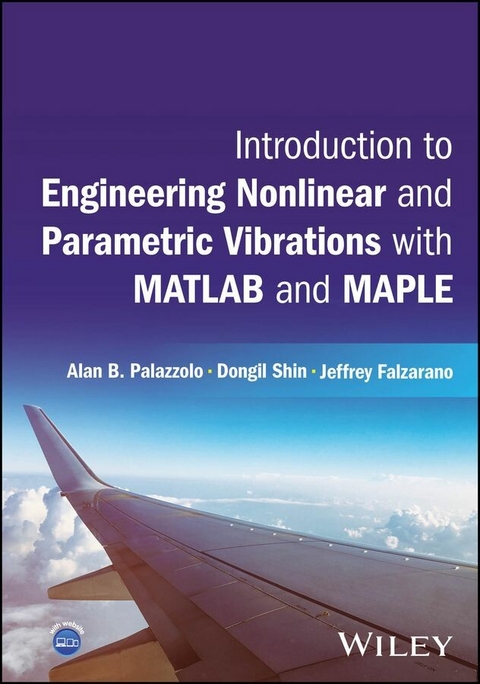
Introduction to Engineering Nonlinear and Parametric Vibrations with MATLAB and Maple (eBook)
1296 Seiten
Wiley (Verlag)
978-1-119-31956-6 (ISBN)
Textbook on nonlinear and parametric vibrations discussing relevant terminology and analytical and computational tools for analysis, design, and troubleshooting
Introduction to Engineering Nonlinear and Parametric Vibrations with MATLAB and MAPLE is a comprehensive textbook that provides theoretical breadth and depth and analytical and computational tools needed to analyze, design, and troubleshoot related engineering problems.
The text begins by introducing and providing the required math and computer skills for understanding and simulating nonlinear vibration problems. This section also includes a thorough treatment of parametric vibrations. Many illustrative examples, including software examples, are included throughout the text. A companion website includes the MATLAB and MAPLE codes for examples in the textbook, and a theoretical development for a homoclinic path to chaos.
Introduction to Engineering Nonlinear and Parametric Vibrations with MATLAB and MAPLE provides information on:
- Natural frequencies and limit cycles of nonlinear autonomous systems, covering the multiple time scale, Krylov-Bogellubov, harmonic balance, and Lindstedt-Poincare methods
- Co-existing fixed point equilibrium states of nonlinear systems, covering location, type, and stability, domains of attraction, and phase plane plotting
- Parametric and autoparametric vibration including Floquet, Mathieu and Hill theory
- Numerical methods including shooting, time domain collocation, arc length continuation, and Poincare plotting
- Chaotic motion of nonlinear systems, covering iterated maps, period doubling and homoclinic paths to chaos, and discrete and continuous time Lyapunov exponents
- Extensive MATLAB and MAPLE coding for the examples presented
Introduction to Engineering Nonlinear and Parametric Vibrations with MATLAB and MAPLE is an essential up-to-date textbook on the subject for upper level undergraduate and graduate engineering students as well as practicing vibration engineers. Knowledge of differential equations and basic programming skills are requisites for reading.
Alan B. Palazzolo, James J. Cain Professor of Mechanical Engineering, Texas A&M University, USA. Professor Palazzolo has extensive industrial, research, and teaching experience in vibrations. He has taught graduate level courses in Nonlinear and Parametric Vibrations (MEEN 649) and Rotordynamics (MEEN 639). In addition, he has also held industrial positions at Bently Nevada, Southwest Research Institute, and Allis Chalmers Corporation in these areas, and has performed approximately $21M in funded research.
Dongil Shin, Lead Research Engineer at GE Vernova Advanced Research in Niskayuna, New York. Dongil has extensive experience in nonlinear vibration analysis of turbomachinery systems and has published multiple journal papers in this field. At GE Vernova, he specializes in tackling practical nonlinear vibration challenges in turbomachinery components, including blades, dampers, and bearings, with a focus on gas and steam turbine systems.
Jeffrey Falzarano, Professor of Ocean Engineering, Texas A&M University, USA. Professor Falzarano has extensive research, teaching, and industry/government experience. He has taught undergraduate and graduate courses in vibrations and ship dynamics (seakeeping and ship maneuvering). He has held engineering and research positions in both government and industry. He has performed research funded by the Office of Naval Research, National Science Foundation, and other government and industry entities. He is also the 2022 recipient of the Society of Naval Architects and Marine Engineers Davidson Medal for excellence in ship research.
Textbook on nonlinear and parametric vibrations discussing relevant terminology and analytical and computational tools for analysis, design, and troubleshooting Introduction to Engineering Nonlinear and Parametric Vibrations with MATLAB and MAPLE is a comprehensive textbook that provides theoretical breadth and depth and analytical and computational tools needed to analyze, design, and troubleshoot related engineering problems. The text begins by introducing and providing the required math and computer skills for understanding and simulating nonlinear vibration problems. This section also includes a thorough treatment of parametric vibrations. Many illustrative examples, including software examples, are included throughout the text. A companion website includes the MATLAB and MAPLE codes for examples in the textbook, and a theoretical development for a homoclinic path to chaos. Introduction to Engineering Nonlinear and Parametric Vibrations with MATLAB and MAPLE provides information on: Natural frequencies and limit cycles of nonlinear autonomous systems, covering the multiple time scale, Krylov-Bogellubov, harmonic balance, and Lindstedt-Poincare methodsCo-existing fixed point equilibrium states of nonlinear systems, covering location, type, and stability, domains of attraction, and phase plane plottingParametric and autoparametric vibration including Floquet, Mathieu and Hill theoryNumerical methods including shooting, time domain collocation, arc length continuation, and Poincare plottingChaotic motion of nonlinear systems, covering iterated maps, period doubling and homoclinic paths to chaos, and discrete and continuous time Lyapunov exponents Extensive MATLAB and MAPLE coding for the examples presented Introduction to Engineering Nonlinear and Parametric Vibrations with MATLAB and MAPLE is an essential up-to-date textbook on the subject for upper level undergraduate and graduate engineering students as well as practicing vibration engineers. Knowledge of differential equations and basic programming skills are requisites for reading.
Preface
Figure 1 Dr. Palazzolo with parametric pendulum demo.
This book originated in Dr. Palazzolo's inheriting of the Nonlinear Vibration Graduate Course at Texas A&M University in 2003, after the passing of the prior instructor and his dear colleague Dr. Sherif Noah. Chapters 1–8 and 10 evolved from Dr. Palazzolo's course notes. Chapters 9 and 12 were obtained from Dr. Shin's PhD studies under the mentorship of Dr. Palazzolo while at TAMU, and Chapter 11 was contributed by Dr. Falzarano's research in ship stability.
Although much of the material in this text is presented in the context of vibrations, the methodology presented may be employed for any dynamical system, i.e. chemical, electrical, fluidic, pneumatic, and economic systems. Governing differential equations have forms similar to vibrations in many cases; however, the physical interpretations of the dependent variables and the coefficients have different meanings, relative to displacements, velocities, stiffness, mass, damping, etc. In a general sense, the course is really focused on obtaining approximate analytical and numerical solutions to the nonlinear differential equations that govern dynamic processes and to qualitatively and quantitatively categorize response types. The book is self-contained with introductory or review material in vibrations, dynamics, differential equations, programming, etc.
Conventional dynamic system modeling relies on linearized models to provide predictions of response. This approach typically identifies operating point (OP) values of external excitations and the corresponding OP model and system responses. It is assumed that the total external excitations are composed of the OP components plus small, time varying perturbations taken about the respective OP values. The perturbation components of the responses are determined by expressing the total excitations in linearized – two-term Taylor series form, substituting this form into the governing nonlinear differential equations, along with the OP conditions, to obtain a system of coupled linear differential equations for the response perturbations. The linearized system response is then obtained through linear system transient, steady-state harmonic (resonance, amplitude, phase angle, and frequency response), free vibration (natural frequencies and mode shapes), and stability (eigenvalue) methods. The linearized response approach enjoys widespread usage, but in some instances will provide totally misleading results, risking system failure. The present work instead retains the nonlinear terms and provides response predictions when the assumption of small excitations and responses about the OP is inadequate.
Another assumption utilized with linear models is that the coefficient terms in the model are constants, invariant with time. However, actual physical system may have periodically varying coefficients. These parametrically excited systems may have vastly different response characteristics compared with their linear time invariant representations. The present work provides the theoretical underpinning and related computational methods for predicting the response of parametrically excited systems.
Chapter 1 introduces the reader to nonlinear systems with math definitions, illustrative examples, and related foundation skill material. The discussion introduces the reader to some qualitative aspects of nonlinear systems and their unexpected and potentially deleterious effects. Likewise, a discussion of parametrically excited systems illustrates the potential for incurring high, “unstable” vibrations. Parametric excited vibrations refer to time-varying parameters (stiffness, mass, damping, etc.) causing vibration. Some mathematical preliminaries such as Taylor series, Jacobians, nondimensionalization of differential equations, and secular terms are presented, along with an introduction to Maple and MATLAB.
Chapter 2 dives deep into the Floquet theory that underpins the use of the Mathieu and Hill's approaches for predicting the parameter conditions for a parametrically excited instability. This elegant theory develops conditions to analyze the vibration stability of arbitrary size (dimension) and linear model dynamical systems subjected to periodic parametric excitation. Floquet theory provides a powerful tool to analyze parametrically excited linear system, but it is also useful for analyzing the individual stabilities of multiple coexisting solutions for harmonically excited nonlinear systems. Examples such as variable length pendulums and non-axisymmetric shafts are provided to connect the theory to practical applications. Motions internal to a vibrating system may setup conditions that cause parametric excitation and resulting instability, resulting in autoparametric response. A pendulum pivoted on a vertically vibrating mass provides an example of autoparametric vibration.
Chapter 3 extends the introductory discussion of nonlinear systems in Chapter 1. Several examples of actual mechanical systems with nonlinear forces are provided. This is followed by presentation of nine simple dynamic systems and their nonlinear equations of motion. Finally, the chapter shows the qualitative behavior of simple dynamic systems as obtained by direct numerical integration of their governing equations of motion.
Chapter 4 provides analytical methods to solve for the natural frequencies of some single degree of freedom systems with nonlinear restoring force characteristics. The resulting natural frequency formulas are expressed in terms of less familiar transcendental functions such as elliptic, Bessel, and gamma. Both the inertial and restoring force (stiffness) terms are proportional to the motion amplitude in linear systems. Consequently, the natural frequency, being the frequency at which the two terms cancel, is independent of the oscillation amplitude. The nonlinear system natural frequency formulas in Chapter 5 show an explicit dependence on the free vibration motion amplitude, via the initial release amplitude. This is illustrated by a pendulum natural frequency that decreases as amplitude of sway increases.
Chapter 5 covers approximate approaches to obtain nonlinear system natural frequencies and limit cycle frequencies, amplitudes, and stability. The methods considered here are not exhaustive and include the multiple time scales method, the Krylov–Bogeliubov method, the harmonic balance method, and the Linstedt–Poincare method. These methods typically involve approximating the solution of the original nonlinear differential equation that governs a dynamical system by solving a set of linear recursive differential equations. A recursive differential equation is solved in a finite set of stages, where the differential equation of the present stage includes solutions of all preceding differential equations in the recursion process. Generally, the linear differential equations to be solved increase in complexity at each stage and the recursion process is truncated, providing an approximate solution for the original nonlinear differential equation. Modern symbolic math codes such as MATLAB symbolic, Maple, and Mathematica can be programmed to obtain a recursion solution.
Chapter 6 discusses linear systems oscillating about a single state referred to as the equilibrium state or point toward which the system converges if it is positively damped and unforced. In contrast, autonomous nonlinear systems can possess multiple equilibrium points (EP). Autonomous systems are those that do not have time-varying external excitations. The EP toward which the system converges are called stable attractors and those from which the system is ejected are called unstable repellors. A pendulum at the 6 o'clock position is a stable attractor and at the 12 o'clock position is an unstable repellor. The equilibrium state that an autonomous nonlinear dynamical system converges to will depend on how it is originally released, i.e. its initial conditions. The region in initial condition space in which the system will converge to an EP is called the EP's domain of attraction (DOA). The boundaries of the domains of attraction are called separatrices since they separate DOA of neighboring stable EP. They are also referred to as invariant manifolds (IM) since a system cannot separate from an IM once on the IM. States on a stable IM or inset will converge toward a “saddle” EP after an infinite time. A physical example is a pendulum that can be released from a given angle at a certain angular velocity and ending at the unstable EP with vertical position and zero angular velocity. It can theoretically be done, but the pendulum would need an infinite amount of time to reach the EP at top dead center (vertical) with zero velocity. One could theoretically plot a measured stable IM (inset) by plotting the required initial velocity required to reach the vertical state with zero velocity versus starting angle....
| Erscheint lt. Verlag | 3.6.2025 |
|---|---|
| Sprache | englisch |
| Themenwelt | Technik ► Maschinenbau |
| Schlagworte | 2D axisymmetric planar • 3D Timeshenko beam elements • flexible shaft vibrations. Shaft modeling development • Fluid Film Bearings • liquid annular seals • nonlinear vibration • Parametric vibrations • Rotordynamic applications |
| ISBN-10 | 1-119-31956-0 / 1119319560 |
| ISBN-13 | 978-1-119-31956-6 / 9781119319566 |
| Informationen gemäß Produktsicherheitsverordnung (GPSR) | |
| Haben Sie eine Frage zum Produkt? |
 EPUB (Adobe DRM)
Kopierschutz: Adobe-DRM
Adobe-DRM ist ein Kopierschutz, der das eBook vor Mißbrauch schützen soll. Dabei wird das eBook bereits beim Download auf Ihre persönliche Adobe-ID autorisiert. Lesen können Sie das eBook dann nur auf den Geräten, welche ebenfalls auf Ihre Adobe-ID registriert sind.
Details zum Adobe-DRM
Dateiformat: EPUB (Electronic Publication)
EPUB ist ein offener Standard für eBooks und eignet sich besonders zur Darstellung von Belletristik und Sachbüchern. Der Fließtext wird dynamisch an die Display- und Schriftgröße angepasst. Auch für mobile Lesegeräte ist EPUB daher gut geeignet.
Systemvoraussetzungen:
PC/Mac: Mit einem PC oder Mac können Sie dieses eBook lesen. Sie benötigen eine
eReader: Dieses eBook kann mit (fast) allen eBook-Readern gelesen werden. Mit dem amazon-Kindle ist es aber nicht kompatibel.
Smartphone/Tablet: Egal ob Apple oder Android, dieses eBook können Sie lesen. Sie benötigen eine
Geräteliste und zusätzliche Hinweise
Buying eBooks from abroad
For tax law reasons we can sell eBooks just within Germany and Switzerland. Regrettably we cannot fulfill eBook-orders from other countries.
aus dem Bereich