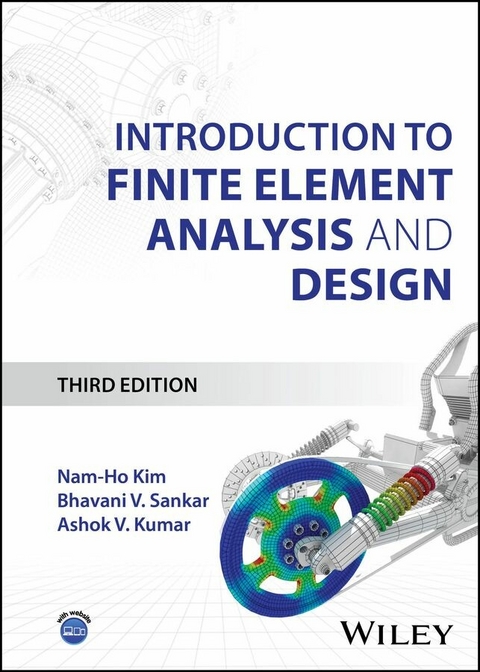
Introduction to Finite Element Analysis and Design (eBook)
1189 Seiten
Wiley (Verlag)
978-1-394-18746-1 (ISBN)
A clear and accessible overview of the Finite Element Method
The finite element method (FEM), which involves solutions to partial differential equations and integro-differential equations, is a powerful tool for solving structural mechanics and fluid mechanics problems. FEM results in versatile computer programs with flexible applications, usable with minimal training to solve practical problems in a variety of engineering and design contexts. Introduction to Finite Element Analysis and Design offers a comprehensive yet readable overview of both theoretical and practical elements of FEM. With a greater focus on design aspects than most comparable volumes, it's an invaluable introduction to a key suite of software and design tools. The third edition has been fully updated to reflect the latest research and applications.
Readers of the third edition of Introduction to Finite Element Analysis and Design will find:
- 50% more exercise problems than the previous edition, with an accompanying solutions manual for instructors
- A brand-new chapter on plate and shell finite elements
- Tutorials for commercial finite element software, including MATLAB, ANSYS, ABAQUS, and NASTRAN
Introduction to Finite Element Analysis and Design is ideal for advanced undergraduate students in finite element analysis- or design-related courses, as well as for researchers and design engineers looking for self-guided tools.
Nam-Ho Kim, PhD, is Professor in the Department of Mechanical and Aerospace Engineering at the University of Florida, where he has taught Finite Element Analysis and Design for 20 years. His research focuses on structural design optimization, sensitivity analysis, design under uncertainty, nonlinear structural mechanics, and related subjects. He has authored or co-authored several books and over 250 articles.
Bhavani V. Sankar, PhD, is Professor in the Department of Mechanical and Aerospace Engineering at the University of Florida. He has published over 300 articles in journals and conference proceedings and is a Fellow of ASME, Founding Member and Fellow of the American Society for Composites, and Associate Fellow of the AIAA. He is a three-time recipient of the Bisplinghoff Memorial Teaching Award and a two-time recipient of the Florida Teaching Incentive Program Award.
Ashok V. Kumar, PhD, is Associate Professor in the Department of Mechanical and Aerospace Engineering at the University of Florida, where he has taught both undergraduate and graduate-level finite element analysis courses. He has authored over 50 papers in journals and conference proceedings, and his research group has developed commercial finite element analysis software which enables mesh independent analysis.
A clear and accessible overview of the Finite Element Method The finite element method (FEM), which involves solutions to partial differential equations and integro-differential equations, is a powerful tool for solving structural mechanics and fluid mechanics problems. FEM results in versatile computer programs with flexible applications, usable with minimal training to solve practical problems in a variety of engineering and design contexts. Introduction to Finite Element Analysis and Design offers a comprehensive yet readable overview of both theoretical and practical elements of FEM. With a greater focus on design aspects than most comparable volumes, it s an invaluable introduction to a key suite of software and design tools. The third edition has been fully updated to reflect the latest research and applications. Readers of the third edition of Introduction to Finite Element Analysis and Design will find: 50% more exercise problems than the previous edition, with an accompanying solutions manual for instructorsA brand-new chapter on plate and shell finite elementsTutorials for commercial finite element software, including MATLAB, ANSYS, ABAQUS, and NASTRAN Introduction to Finite Element Analysis and Design is ideal for advanced undergraduate students in finite element analysis- or design-related courses, as well as for researchers and design engineers looking for self-guided tools.
Chapter 1
Direct Method—Springs, Bars, and Truss Elements
The ability to predict the behavior of machines in engineering systems, in general, is of great importance at every stage of engineering processes, including design, manufacture, and operation. Such predictive methodologies are possible because engineers and scientists have made tremendous progress in understanding the physical behavior of materials and structures and have developed mathematical models, albeit approximate, in order to describe their physical behavior. Most often the mathematical models result in algebraic, differential, or integral equations or combinations thereof. Seldom can these equations be solved in closed form, and hence numerical methods are used to obtain solutions. The finite difference method is a classical method that provides approximate solutions to differential equations with reasonable accuracy. There are other methods of solving mathematical equations that are covered in traditional numerical methods courses.1
The finite element method (FEM) is one of the numerical methods for solving differential equations. The FEM, originated in the area of structural mechanics, has been extended to other areas of solid mechanics and later to other fields such as heat transfer, fluid dynamics, and electromagnetism. In fact, FEM has been recognized as a powerful tool for solving partial differential equations and integro‐differential equations, and it has become the numerical method of choice in many engineering and applied science areas. One of the reasons for FEM’s popularity is that the method results in computer programs versatile in nature that can solve many practical problems with the least amount of training. Obviously, there is a danger in using computer programs without a proper understanding of the theory behind them, and that is one of the reasons to have a thorough understanding of the theory behind the FEM.
The basic principle of FEM is to divide or discretize the system into a number of smaller elements called finite elements (FEs), to identify the degrees of freedom (DOFs) that describe its behavior, and then to write down the equations that describe the behavior of each element and its interaction with neighboring elements. The element‐level equations are assembled to obtain global equations, often a linear system of equations, which are solved for the unknown DOFs. The phrase finite element refers to the fact that the elements are of a finite size as opposed to the infinitesimal or differential element considered in deriving the governing equations of the system. Another interpretation is that the FE equations deal with a finite number of DOFs as opposed to the infinite number of DOFs of a continuous system.
In general, solutions to practical engineering problems are quite complex, and they cannot be represented using simple mathematical expressions. An important concept of the FEM is that the solution is approximated using simple polynomials, often linear or quadratic, within each element. Since elements are connected throughout the system, the solution of the system is approximated using piecewise polynomials. Such approximation may contain errors when the size of an element is large. As the size of the element reduces, however, the approximated solution will converge to the exact solution.
There are three methods that can be used to derive the FE equations of a problem: (i) direct method, (ii) variational method, and (iii) weighted residual method. The direct method provides a clear physical insight into the FEM and is preferred in the beginning stages of learning the principles. However, it is limited in its application in that it can be used to solve 1D problems only. The variational method is akin to the methods of calculus of variations and is a powerful tool for deriving the FE equations. However, it requires the existence of a functional, whose minimization results in the solution of the differential equations. The Galerkin method is one of the popular weighted residual methods and is applicable to most problems. If a variational function exists for the problem, then the variational and Galerkin methods yield identical solutions.
In this chapter, we will illustrate the direct method of FE analysis using 1D elements such as linear spring, uniaxial bar, and truss elements. The emphasis is on the construction and solution of the FE equations and interpretation of the results, rather than the rigorous development of the general principles of the FEM.
1.1 ILLUSTRATION OF THE DIRECT METHOD
Consider a system of rigid bodies connected by springs as shown in figure 1.1. The bodies move only in the horizontal direction. Furthermore, we consider only the static problem and, hence, the mass effects (inertia) will be ignored. External forces, F2, F3, and F4, are applied on the rigid bodies as shown. The objectives are to determine the displacement of each body, forces in the springs, and support reactions.
We will introduce the principles involved in the FEM through this example. Notice that there is no need to discretize the system as it already consists of discrete elements, namely, the springs. The elements are connected at the nodes. In this case, the rigid bodies are the nodes. Of course, the two walls are also the nodes as they connect to the elements. Numbers inside the little circles mark the nodes. The system of connected elements is called the mesh and is best described using a connectivity table that defines which nodes an element is connected to as shown in table 1.1. It is noted that in this 1D problem, LN1 is the node on the left, and LN2 is the node on the right. Such a connectivity table is included in input files for FE analysis software to describe the mesh.
Figure 1.1 Rigid bodies connected by springs
Table 1.1 Connectivity table for figure 1.1
| Element | LN1 (i) | LN2 (j) |
|---|
| 1 | 1 | 2 |
| 2 | 2 | 4 |
| 3 | 2 | 3 |
| 4 | 1 | 3 |
| 5 | 3 | 4 |
| 6 | 4 | 5 |
Figure 1.2 Spring element (e) connected by node i and node j
In this 1D system, each node is allowed to move in the horizontal direction. Such a movement is referred to as DOF. Since nodes 2, 3, and 4 are free to move, they are referred to as free DOFs, while nodes 1 and 5 are fixed DOFs. The displacements of the fixed DOFs are given (zero in this case), and they are referred to as boundary conditions. Those nodes on the boundary conditions have unknown reaction forces, which need to be calculated by solving the system of equations. The displacements of the free DOFs are unknown, which also need to be calculated, but the applied forces at the free DOFs are all known. This includes those nodes that do not have applied forces (or it can be considered as applying a zero force). Applying forces on nodes is referred to as loading conditions.
Consider the free‐body diagram of a typical element (e) as shown in figure 1.2. It has two nodes, i and j. They will also be referred to as the first and the second node or local node 1 (LN1) and local node 2 (LN2), respectively, as shown in the connectivity table. Assume a coordinate system going from left to right. The convention for the first and second nodes is that xi < xj. The forces acting at the nodes are denoted by and In this notation, the subscripts denote the node numbers and the superscript the element number. This notation is adopted because multiple elements can be connected at a node, and each element may have different forces at the node. We will refer to them as internal forces. In figure 1.2, the forces are shown in the positive direction. The unknown displacements (i.e., DOFs) of nodes i and j are ui and uj, respectively. Note that there is no superscript for u, as the displacement is unique to the node denoted by the subscript. We would like to develop a relationship between the nodal displacements ui and uj and the internal forces and .
The elongation of the spring is denoted by Δ(e) = uj − ui. Then the force of the spring is given by
where k(e) is the spring rate or stiffness of element (e). In this text, the force in the spring, P(e), is referred to as element force. If uj > ui, then the spring is elongated, and the force in the spring is positive (tension). Otherwise, it is in compression. The spring element force is related to the internal force by
Note that the sign of and is determined based on the direction that the force is applied, while the sign of P(e) is determined based on whether the element is in tension or compression. For equilibrium, the sum of the forces acting on element (e) must be equal to zero, that is,
Therefore, the two forces are equal, and they are applied in opposite...
| Erscheint lt. Verlag | 2.6.2025 |
|---|---|
| Sprache | englisch |
| Themenwelt | Technik ► Maschinenbau |
| Schlagworte | 2D solids • ABAQUS • ANSYS • beams and frames • Dynamic problems • Finite Element Method • Heat Transfer Problems • materials mechanics • Materials Science • MATLAB • NASTRAN • plate and shell finite elements • spring elements • truss elements |
| ISBN-10 | 1-394-18746-7 / 1394187467 |
| ISBN-13 | 978-1-394-18746-1 / 9781394187461 |
| Informationen gemäß Produktsicherheitsverordnung (GPSR) | |
| Haben Sie eine Frage zum Produkt? |
 EPUB (Adobe DRM)
Kopierschutz: Adobe-DRM
Adobe-DRM ist ein Kopierschutz, der das eBook vor Mißbrauch schützen soll. Dabei wird das eBook bereits beim Download auf Ihre persönliche Adobe-ID autorisiert. Lesen können Sie das eBook dann nur auf den Geräten, welche ebenfalls auf Ihre Adobe-ID registriert sind.
Details zum Adobe-DRM
Dateiformat: EPUB (Electronic Publication)
EPUB ist ein offener Standard für eBooks und eignet sich besonders zur Darstellung von Belletristik und Sachbüchern. Der Fließtext wird dynamisch an die Display- und Schriftgröße angepasst. Auch für mobile Lesegeräte ist EPUB daher gut geeignet.
Systemvoraussetzungen:
PC/Mac: Mit einem PC oder Mac können Sie dieses eBook lesen. Sie benötigen eine
eReader: Dieses eBook kann mit (fast) allen eBook-Readern gelesen werden. Mit dem amazon-Kindle ist es aber nicht kompatibel.
Smartphone/Tablet: Egal ob Apple oder Android, dieses eBook können Sie lesen. Sie benötigen eine
Geräteliste und zusätzliche Hinweise
Buying eBooks from abroad
For tax law reasons we can sell eBooks just within Germany and Switzerland. Regrettably we cannot fulfill eBook-orders from other countries.
aus dem Bereich