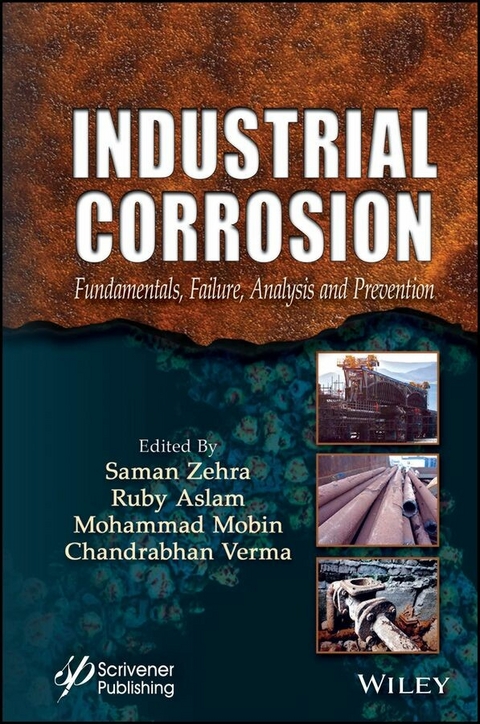
Industrial Corrosion (eBook)
493 Seiten
Wiley-Scrivener (Verlag)
978-1-394-30154-6 (ISBN)
The book equips professionals with essential insights into corrosion science, practical techniques for diagnosis and prevention, and access to the latest advancements in the field, making it an invaluable resource for enhancing industry practices and safeguarding assets.
Industrial Corrosion: Fundamentals, Failure, Analysis and Prevention offers an in-depth look at the science behind corrosion and its impact on industries worldwide. Covering both theoretical and practical aspects, this volume provides a clear understanding of corrosion mechanisms, materials degradation, and the reasons behind common industrial failures. It explores advanced techniques for diagnosing corrosion issues and presents effective solutions to mitigate and prevent them. The book not only delves into traditional corrosion control methods but also highlights the latest advancements in corrosion inhibitors and smart coatings, showcasing cutting-edge technologies that can revolutionize industry practices. With practical case studies, real-world examples, and expert insights, this comprehensive guide serves as a crucial resource for engineers, researchers, and professionals seeking to enhance their knowledge and apply corrosion prevention techniques in their work.
- Provides a detailed exploration of corrosion fundamentals, failure mechanisms, and prevention strategies, perfect for professionals and students alike
- Includes practical case studies and examples to help readers apply corrosion prevention methods in various industries
- Highlights the latest innovations in corrosion inhibitors and smart coatings for enhanced industrial protection
Audience
Engineers, materials scientists, chemists, academics, researchers, and professionals in corrosion prevention, oil and gas, manufacturing, transportation, and infrastructure, where corrosion control is critical.
Saman Zehra, PhD, works in the Women Scientist Program in the Department of Applied Chemistry at Aligarh Muslim University. She has published over 50 articles in international journals and five books in addition to presenting her research at several international conferences. Her research interests include the development of smart coating materials for corrosion sensing and protection and the evaluation of green corrosion inhibitors.
Ruby Aslam, PhD, is a Postdoctoral fellow in the School of Civil Engineering and Architecture at Chongqing University of Science and Technology, Chongqing, China. She received her PhD from Aligarh Muslim University, India. She has authored/co-authored several research articles in international peer-reviewed journals of wide readership, including critical reviews and book chapters. She has edited 13 books for international publishers. Her research interests include corrosion inhibitors, coatings, colloid and surface science, and ionic liquids.
Mohammad Mobin, PhD, is the Vice Chancellor at the Cluster University of Srinagar. He has authored about 185 research papers and contributed to five books and 38 book chapters. Additionally, he has completed 40 research projects and presented his work as a keynote speaker at several international conferences. His research interests include corrosion inhibitors, conducting polymers, and seawater desalination.
Chandrabhan Verma, PhD, works in the Department of Chemical Engineering at the Khalifa University of Science and Technology, Abu Dhabi, UAE. He has edited and authored over 40 books and numerous research articles in addition to serving as a reviewer and board member for several international journals. His research focuses on designing and developing industrially applicable corrosion inhibitors.
The book equips professionals with essential insights into corrosion science, practical techniques for diagnosis and prevention, and access to the latest advancements in the field, making it an invaluable resource for enhancing industry practices and safeguarding assets. Industrial Corrosion: Fundamentals, Failure, Analysis and Prevention offers an in-depth look at the science behind corrosion and its impact on industries worldwide. Covering both theoretical and practical aspects, this volume provides a clear understanding of corrosion mechanisms, materials degradation, and the reasons behind common industrial failures. It explores advanced techniques for diagnosing corrosion issues and presents effective solutions to mitigate and prevent them. The book not only delves into traditional corrosion control methods but also highlights the latest advancements in corrosion inhibitors and smart coatings, showcasing cutting-edge technologies that can revolutionize industry practices. With practical case studies, real-world examples, and expert insights, this comprehensive guide serves as a crucial resource for engineers, researchers, and professionals seeking to enhance their knowledge and apply corrosion prevention techniques in their work. Provides a detailed exploration of corrosion fundamentals, failure mechanisms, and prevention strategies, perfect for professionals and students alike Includes practical case studies and examples to help readers apply corrosion prevention methods in various industries Highlights the latest innovations in corrosion inhibitors and smart coatings for enhanced industrial protection Audience Engineers, materials scientists, chemists, academics, researchers, and professionals in corrosion prevention, oil and gas, manufacturing, transportation, and infrastructure, where corrosion control is critical.
1
Corrosion Fundamentals: Understanding the Science Behind the Damage
Saman Zehra*, Mohammad Mobin, Mosarrat Parveen and Rais Ahmad
Corrosion Research Laboratory, Department of Applied Chemistry, Faculty of Engineering and Technology, Aligarh Muslim University, Aligarh, India
Abstract
Corrosion, a pervasive and complex phenomenon, significantly impacts industries leading to material degradation, economic losses, and safety hazards. This chapter delves into the fundamental principles of corrosion offering a comprehensive understanding of its underlying science. It explores the chemical mechanisms that drive corrosion examining various types such as uniform corrosion, pitting, galvanic corrosion, stress corrosion cracking, and microbiologically influenced corrosion. Additionally, the chapter outlines the influence of different environmental factors—ranging from atmospheric conditions to industrial pollutants—that exacerbate corrosion processes. Through historical and contemporary perspectives, the chapter underscores the far-reaching economic, environmental, and safety implications of corrosion. It also discusses the evolution of corrosion monitoring techniques in industrial environments emphasizing their importance in predicting material failure, optimizing maintenance, and enhancing operational efficiency. By addressing the multifaceted nature of corrosion, this chapter serves as a foundational guide for understanding and managing this critical issue across industries.
Keywords: Corrosion science, corrosion, degradation, galvanic corrosion, pitting, stress corrosion cracking
1.1 Introduction
Corrosion has long been a topic of extensive scientific research due to its significant and often devastating consequences. It is generally defined as the deterioration of a material, typically a metal, or its properties as a result of chemical reactions with its environment [1–3]. While traditionally associated with metal oxidation, corrosion now encompasses a broader range of materials, including ceramics, polymers, composites, biomaterials, and nanomaterials. The International Standard Organization (ISO) defines corrosion as the “physicochemical reaction between a material and its environment, leading to modifications in the properties of the material, and often resulting in degradation of the material’s function or the function of the system it is part of” [3]. This more inclusive understanding of corrosion reflects the profound technological advancements and diversification of materials used in modern industries.
At its core, corrosion is an inevitable interaction between a material and its surrounding environment. The environment can take many forms— whether gas, liquid, or solid—and includes various physical and chemical factors such as temperature and the composition of substances in contact with the material [1]. Metals, in particular, are prone to corroding because they naturally tend to revert to more stable states, such as oxides, hydroxides, salts, or carbonates [4]. This transformation is governed by thermodynamics, specifically the Law of Entropy, which dictates that metals produced and shaped into their refined forms tend to revert back to their natural ore state (e.g., iron returning to rust). Because of this tendency, pure metals are rarely found in nature, as they readily combine with other elements to form ores.
The scope of corrosion has evolved over time from an obscure area of study to a well-established engineering discipline. Significant strides have been made in understanding and preventing corrosion, but many challenges remain for scientists and engineers. Learned societies, such as NACE International, the European Corrosion Federation, and the Japan Society of Corrosion Engineers, have played a pivotal role in advancing corrosion education and research fostering collaboration among experts and addressing industry-relevant problems [5].
This chapter will explore the brief outline of the fundamental principles of corrosion aiming to provide a comprehensive understanding of this complex phenomenon. By delving into the chemical mechanisms that drive corrosion, readers will gain insights into how and why materials degrade, and how this process can be mitigated or controlled. The chapter serves as an introduction to corrosion science laying the groundwork for understanding both the basic concepts and the advanced approaches used to prevent or manage corrosion in various industries.
1.2 Types of Corrosion
Corrosion manifests in various forms each influenced by specific environmental conditions, material properties, and the nature of exposure [6]. Understanding the different types of corrosion is essential for diagnosing problems and implementing effective prevention or mitigation strategies [3, 7]. An illustrative representation of these corrosion types is provided in Figure 1.1. Below are the most common types of corrosion:
1.2.1 Uniform Corrosion
Uniform corrosion, also known as general corrosion, is the most common form and occurs evenly across the entire surface of a material. This type of corrosion is predictable, as the material gradually deteriorates at a consistent rate when exposed to corrosive environments, such as air, water, or chemicals. Uniform corrosion typically leads to thinning of the material, which can be counteracted through coatings, inhibitors, or material selection. Despite its widespread occurrence, uniform corrosion is often easier to manage because its rate can be accurately estimated [9].
1.2.2 Pitting Corrosion
Pitting corrosion is a localized form of corrosion that results in the formation of small holes or pits on the material’s surface. These pits can be difficult to detect initially, but they can lead to significant damage over time, especially in stainless steel and other passive metals. Pitting often occurs in environments containing chloride ions, such as seawater, and can quickly penetrate a material leading to structural failure. Even though the overall loss of material may be minimal, the concentrated nature of pitting makes it particularly dangerous [10]. Figure 1.2 illustrates a pit in stainless steel.
Figure 1.1 Eight different types of corrosion, where A, R, and S represent the area mostly affected, the reason for particular corrosion, and the solution, which can prevent or reduce the rate of corrosion, respectively [8].
Figure 1.2 Pitting corrosion of stainless steel.
1.2.3 Crevice Corrosion
Crevice corrosion (Figure 1.3) occurs in areas where a stagnant solution is trapped within narrow spaces, such as joints, gaps, or under seals. These confined spaces can create micro-environments that promote corrosion due to a lack of oxygen or the accumulation of corrosive substances. Like pitting, crevice corrosion is often found in chloride-rich environments and can lead to rapid material failure if not properly addressed [11].
Figure 1.3 Crevice corrosion driven by (a) a differential aeration cell and (b) a differential metal ion concentration cell [2].
1.2.4 Galvanic Corrosion
Galvanic corrosion arises when two dissimilar metals are in electrical contact with each other in the presence of an electrolyte, such as water. The more reactive metal, known as the anode, corrodes faster, while the less reactive metal, the cathode, is protected. Galvanic corrosion is a common issue in marine environments or systems where multiple metals are used together. Figure 1.4 depicts a metal, such as iron, steel, or zinc, immersed in electrolyte such as sodium chloride solution. Preventive measures include the use of insulating materials, coatings, or selecting metals with similar electrochemical potentials.
1.2.5 Intergranular Corrosion
Intergranular corrosion affects the grain boundaries of a metal. This type of corrosion is especially problematic in stainless steels that have been improperly heat treated or welded. The grain boundaries become susceptible to attack, while the bulk of the material remains unaffected leading to a weakening of the structure and eventual failure. Proper material selection, heat treatments, and alloying can help mitigate intergranular corrosion [12].
Figure 1.4 Anodic and cathodic corrosion reaction [2].
1.2.6 Stress Corrosion Cracking (SCC)
Stress corrosion cracking occurs when a material is subjected to tensile stress in a corrosive environment. The combination of mechanical stress and corrosion leads to the formation of cracks, which propagate over time and may cause sudden and catastrophic failure. SCC is particularly dangerous because it can occur without obvious signs of corrosion. It is commonly found in pipelines, aircraft, and industrial equipment. Controlling stress levels, using corrosion inhibitors, and selecting resistant materials are key strategies to prevent SCC [13].
1.2.7 Erosion Corrosion
Erosion corrosion results from the combined action of mechanical wear and chemical attack. This type of corrosion is common in environments where fluids are moving rapidly, such as in pipes, pumps, and turbine blades. The constant flow of abrasive particles or fluids removes protective films or coatings from the surface exposing the material to accelerated...
| Erscheint lt. Verlag | 2.6.2025 |
|---|---|
| Sprache | englisch |
| Themenwelt | Naturwissenschaften ► Chemie |
| Technik ► Maschinenbau | |
| ISBN-10 | 1-394-30154-5 / 1394301545 |
| ISBN-13 | 978-1-394-30154-6 / 9781394301546 |
| Informationen gemäß Produktsicherheitsverordnung (GPSR) | |
| Haben Sie eine Frage zum Produkt? |
 EPUB (Adobe DRM)
Kopierschutz: Adobe-DRM
Adobe-DRM ist ein Kopierschutz, der das eBook vor Mißbrauch schützen soll. Dabei wird das eBook bereits beim Download auf Ihre persönliche Adobe-ID autorisiert. Lesen können Sie das eBook dann nur auf den Geräten, welche ebenfalls auf Ihre Adobe-ID registriert sind.
Details zum Adobe-DRM
Dateiformat: EPUB (Electronic Publication)
EPUB ist ein offener Standard für eBooks und eignet sich besonders zur Darstellung von Belletristik und Sachbüchern. Der Fließtext wird dynamisch an die Display- und Schriftgröße angepasst. Auch für mobile Lesegeräte ist EPUB daher gut geeignet.
Systemvoraussetzungen:
PC/Mac: Mit einem PC oder Mac können Sie dieses eBook lesen. Sie benötigen eine
eReader: Dieses eBook kann mit (fast) allen eBook-Readern gelesen werden. Mit dem amazon-Kindle ist es aber nicht kompatibel.
Smartphone/Tablet: Egal ob Apple oder Android, dieses eBook können Sie lesen. Sie benötigen eine
Geräteliste und zusätzliche Hinweise
Buying eBooks from abroad
For tax law reasons we can sell eBooks just within Germany and Switzerland. Regrettably we cannot fulfill eBook-orders from other countries.
aus dem Bereich