


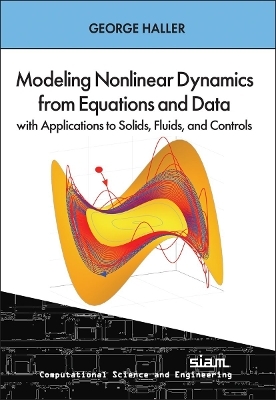
Modeling Nonlinear Dynamics from Equations and Data with Applications to Solids, Fluids, and Controls
Seiten
2025
Society for Industrial & Applied Mathematics,U.S. (Verlag)
978-1-61197-834-6 (ISBN)
Society for Industrial & Applied Mathematics,U.S. (Verlag)
978-1-61197-834-6 (ISBN)
An innovative method reduces complex nonlinear equations to spectral submanifolds (SSMs), low-dimensional invariant structures that capture the essence of system dynamics with precision. Applications in fluid and solid mechanics and control theory demonstrate the power of these mathematically sound, predictive models.
This concise text presents an introduction to the emerging area of reducing complex nonlinear differential equations or time-resolved data sets to spectral submanifolds (SSMs). SSMs are ubiquitous low-dimensional attracting invariant manifolds that can be constructed systematically, building on the spectral properties of the linear part of a nonlinear system. The internal dynamics within SSMs then serve as exact, low-dimensional models with which the full system evolution synchronizes exponentially fast.
SSM-based model reduction has a solid mathematical foundation and hence is guaranteed to deliver accurate and predictive reduced-order models under a precise set of assumptions. This book illustrates the power of SSM reduction on a large collection of equation- and data-driven applications in fluid mechanics, solid mechanics, and control.
Audience
This book is intended for graduate students, postdocs, faculty, and industrial researchers working in model reduction for nonlinear physical systems arising in solid mechanics, fluid dynamics, and control theory. It is appropriate for courses on differential equations, modeling, dynamical systems, and data-driven modeling.
This concise text presents an introduction to the emerging area of reducing complex nonlinear differential equations or time-resolved data sets to spectral submanifolds (SSMs). SSMs are ubiquitous low-dimensional attracting invariant manifolds that can be constructed systematically, building on the spectral properties of the linear part of a nonlinear system. The internal dynamics within SSMs then serve as exact, low-dimensional models with which the full system evolution synchronizes exponentially fast.
SSM-based model reduction has a solid mathematical foundation and hence is guaranteed to deliver accurate and predictive reduced-order models under a precise set of assumptions. This book illustrates the power of SSM reduction on a large collection of equation- and data-driven applications in fluid mechanics, solid mechanics, and control.
Audience
This book is intended for graduate students, postdocs, faculty, and industrial researchers working in model reduction for nonlinear physical systems arising in solid mechanics, fluid dynamics, and control theory. It is appropriate for courses on differential equations, modeling, dynamical systems, and data-driven modeling.
George Haller is a professor of mechanical engineering at ETH Zürich, where he holds the Chair in Nonlinear Dynamics and heads the Institute for Mechanical Systems. His prior appointments include tenured faculty positions at Brown, McGill, and MIT. He also served as the inaugural director of Morgan Stanley’s fixed-income modeling center. Professor Haller is the recipient of a Sloan Fellowship in mathematics, an ASME Thomas Hughes Young Investigator Award, a School of Engineering Distinguished Professorship (McGill), the Stanley Corrsin Award of the APS, and the Lyapunov Award of the ASME. He is an external member of the Hungarian Academy of Science and a fellow of SIAM, APS, and ASME.
| Erscheinungsdatum | 02.07.2025 |
|---|---|
| Reihe/Serie | Computational Science and Engineering |
| Verlagsort | New York |
| Sprache | englisch |
| Themenwelt | Informatik ► Theorie / Studium ► Algorithmen |
| Mathematik / Informatik ► Mathematik ► Angewandte Mathematik | |
| Technik | |
| ISBN-10 | 1-61197-834-3 / 1611978343 |
| ISBN-13 | 978-1-61197-834-6 / 9781611978346 |
| Zustand | Neuware |
| Informationen gemäß Produktsicherheitsverordnung (GPSR) | |
| Haben Sie eine Frage zum Produkt? |
Mehr entdecken
aus dem Bereich



aus dem Bereich
Buch | Softcover (2025)
Lehmanns Media (Verlag)
CHF 62,95
die Welt der generativen KI verstehen
Buch | Hardcover (2025)
Hanser (Verlag)
CHF 48,95
IT zum Anfassen für alle von 9 bis 99 – vom Navi bis Social Media
Buch | Softcover (2021)
Springer (Verlag)
CHF 46,15


