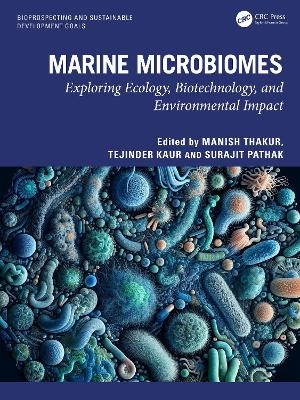
Marine Microbiomes
CRC Press (Verlag)
978-1-032-83481-8 (ISBN)
- Noch nicht erschienen (ca. Februar 2026)
- Versandkostenfrei
- Auch auf Rechnung
- Artikel merken
This book examines the diversity, ecological roles, and biotechnological potential of marine microorganisms. The introductory chapters provide the vast biodiversity of marine archaebacteria, actinobacteria, cyanobacteria, and algal and fungal ecosystems. The subsequent chapters examine the contribution of these microbiomes to biogeochemical cycles and the establishment of symbiotic relationships within marine ecosystems. The text also highlights the biotechnological insights gained from studying marine microbes, including the discovery, characterization, and utilization of novel marine enzymes and the burgeoning bioeconomy centered on marine microbial products. Further, this book explores the mechanisms behind microorganism-mediated metal solubilization, the degradation of marine micropollutants, and the breakdown of petroleum hydrocarbons. The chapters also cover the realms of microbial bioprospecting for functional foods, novel medicinal compounds, cosmeceuticals, and the development of microbial biosensors. Toward the end, Marine Microbiomes: Exploring Ecology, Biotechnology, and Enviornmental Impact reviews human activities such as ocean acidification, rising temperatures, heavy metal pollution, and the introduction of microplastics and pathogens affecting marine microbial communities. This book caters to researchers and students in marine biology, microbiology, environmental science, and biotechnology.
Key features
Provides an in-depth examination of the vast diversity of marine microorganisms, including archaebacteria, actinobacteria, cyanobacteria, algae, fungi, and viruses
Examines the ecological roles and biotechnological potential of these microorganisms, emphasizing the richness and complexity of life in marine extreme habitats
Explores the crucial role played by marine microbiomes in biogeochemical cycles
Covers microorganism-mediated metal solubilization, bioleaching, the degradation of micropollutants, and the breakdown of petroleum hydrocarbons
Discusses the potential of marine microorganisms as sources for novel applications in functional foods, medicines, cosmeceuticals, and biosensors
Manish Thakur, who has earned a Ph.D. in microbiology, is an expert in the field, focusing on microbiology and the identification of bioactive components. His vast teaching and research experience has led to significant contributions, documented through various publications in esteemed journals. He has published more than 25 articles in peer-reviewed international journals and books. His research excellence has been acknowledged with numerous awards and certificates. Additionally, he has engaged with the scientific community by presenting his research at both national and international conferences, sharing his insights with a broader audience. Tejinder Kaur, a distinguished academician and researcher, has been the Coordinator of the Department of Zoology at DAV University, Jalandhar, India, since 2013. She completed her PhD at Panjab University, Chandigarh, in 2011, demonstrating her dedication to academic achievement. Dr. Kaur's significant impact in her field is reflected in her substantial publication portfolio, which includes over 37 papers in both national and international journals. Her research interests are diverse, covering immunoprophylaxis, chemotherapy, immunochemotherapy, immunodiagnostics of Leishmania donovani, the developmental genetics of Drosophila and Tribolium, as well as antimicrobial resistance. Surajit Pathak, PhD, is currently working as a professor at the Chettinad Academy of Research and Education, Chennai, India (from 2015 until date). He has also worked at Linkoping University, Linkoping, Sweden, as a principal research scientist (2022–2022). He received his Ph.D. degree from India in 2007 and completed his post-doctoral training (2007–2015) at the University of Alabama, USA; the University of Padova, Italy; and the University of Linkoping, Sweden. His current research focuses on “biomarker discoveries for early detection of colorectal cancer." He has published more than 100 research articles in peer-reviewed international journals of repute. He received various research grants, including core international and national research grants from SERB-CRG (DST, Govt. of India), DST Indo-Italy Bilateral Research Projects, and other international funding agencies. He has various active international and national research collaborations. He is the editorial board member of various renowned international high-impact journals. He is a member of various professional research bodies in India, including the Indian Association of Cancer Research, the Indian Science Congress, and the Aesthetic Multispecialty Society (AMS).
The Enigmatic Depths: Exploring Marine Extreme Habitats. 2. Marine Archaeabacteria, Actinobacteria and Cyanobacteria. 3. Marine Algal and Fungal Ecosystems. 4. The Mysterious World of Oceanic Viruses. 5. Marine Microbiomes and Biogeochemical Cycles. 6. Symbiotic Relationships in Marine Microbial Communities. 7. Discovery, Characterization, and Utilization of Marine Enzymes. 8. Marine Microbiomes and their Endless Potential for the Bioeconomy. 9. Microorganism Mediated Metal Solubilization or Bioleaching. 10. Microbes as Biocatalysts of Marine Micropollutants. 11. Mighty Microbes: Nature’s Cleanup Crew for Petroleum Hydrocarbons in the Deep Blue Sea. 12. Unleashing the Power of Omics: Revolutionizing Bioremediation for a Greener Tomorrow. 13. Exploring the Potential of Microbial Bioprospecting for Functional Foods. 14. Marine Microbes: A Treasure Trove of Novel Medicines. 15. Cosmeceuticals: The Beauty Elixirs from the Deep. 16. Advancements in Marine Biosensing: Applications and Future Trends. 17. The Silent Shift: How Ocean Acidification and Rising Temperature Affect Marine Organisms. 18. The Heavy Metal Menace: Impact on Marine Microorganisms. 19. Delving Deep into the Microplastics Crisis in the Indian Aquatic Environment: An Overview. 20. Human Pathogen Spillover in Oceans.
| Erscheint lt. Verlag | 13.2.2026 |
|---|---|
| Reihe/Serie | Bioprospecting and Sustainable Development Goals |
| Zusatzinfo | 42 Line drawings, color; 5 Line drawings, black and white; 1 Halftones, color; 43 Illustrations, color; 5 Illustrations, black and white |
| Verlagsort | London |
| Sprache | englisch |
| Maße | 210 x 280 mm |
| Themenwelt | Naturwissenschaften ► Biologie ► Genetik / Molekularbiologie |
| Naturwissenschaften ► Biologie ► Limnologie / Meeresbiologie | |
| Naturwissenschaften ► Biologie ► Ökologie / Naturschutz | |
| Technik ► Umwelttechnik / Biotechnologie | |
| ISBN-10 | 1-032-83481-1 / 1032834811 |
| ISBN-13 | 978-1-032-83481-8 / 9781032834818 |
| Zustand | Neuware |
| Informationen gemäß Produktsicherheitsverordnung (GPSR) | |
| Haben Sie eine Frage zum Produkt? |
aus dem Bereich