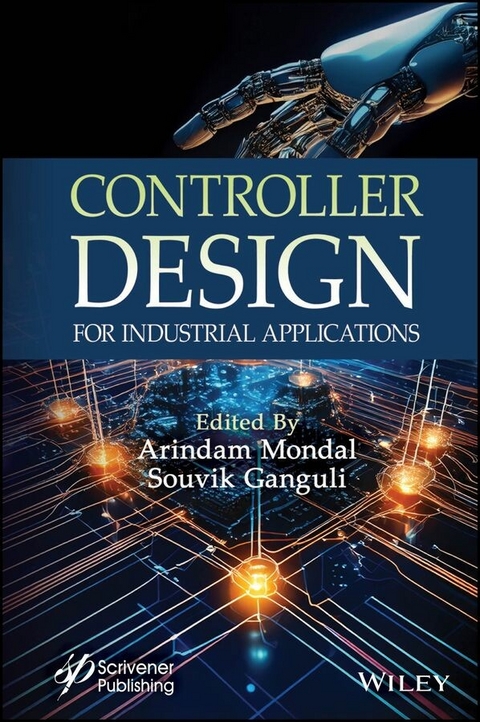
Controller Design for Industrial Applications (eBook)
561 Seiten
Wiley-Scrivener (Verlag)
978-1-394-28708-6 (ISBN)
Controller Design for Industrial Applications is essential for anyone looking to master the advanced techniques of intelligent controller design, enabling you to effectively tackle the complexities of modern industrial processes and optimize performance in an ever-evolving landscape.
Industrial processes are often complex and dynamic, making it challenging to design controllers that can maintain stable and optimal operation. Traditional controllers, such as PID controllers, have been widely used in industrial applications but have limitations in handling non-linear and uncertain systems. Intelligent controllers offer an alternative solution that can adapt to changing system dynamics and disturbances. The use of intelligent controllers in industrial applications has gained increasing attention in recent years, with numerous successful implementations in various fields, such as process control, robotics control, HVAC control, power systems control, and autonomous vehicle control. However, the design and implementation of intelligent controllers require careful consideration of hardware and software requirements, as well as simulation and testing procedures to ensure reliable and safe operation.
In the rapidly evolving industrial landscape, it is essential to develop advanced control techniques to enhance productivity, minimize costs, and ensure safety. Traditional control methods often struggle to handle complex systems and unpredictable environments. However, with the emergence of intelligent control techniques, there is a great opportunity to improve industrial automation and control systems. Controller Design for Industrial Applications aims to provide a comprehensive understanding of intelligent controller design for industrial applications, from theoretical concepts to practical implementation. It will cover the fundamental concepts of intelligent control theory and techniques, their application in various industrial fields, and practical implementation and design considerations.
Arindam Mondal, PhD, is a co-private investigator for a Technology Development Program project under the Indian Department of Science and Technology. He has published 33 research papers in reputed international journals, conferences, and book chapters and has 12 patents published in his credit. His research interests include digital controller design, system identification, fractional order control and signal processing, Internet of Things, bioinformatics, load frequency control, and quantum computing.
Souvik Ganguli, PhD, is an assistant professor at the Thapar Institute of Engineering and Technology, Patiala. He has published 17 papers in international journals, 36 SCOPUS-indexed papers, book chapters, and conference papers, and has been granted nine Indian patents, four German patents, and two South African patents. His research interests include model order reduction, identification and control, nature-inspired metaheuristic algorithms, electronic devices, and renewable energy applications.
Controller Design for Industrial Applications is essential for anyone looking to master the advanced techniques of intelligent controller design, enabling you to effectively tackle the complexities of modern industrial processes and optimize performance in an ever-evolving landscape. Industrial processes are often complex and dynamic, making it challenging to design controllers that can maintain stable and optimal operation. Traditional controllers, such as PID controllers, have been widely used in industrial applications but have limitations in handling non-linear and uncertain systems. Intelligent controllers offer an alternative solution that can adapt to changing system dynamics and disturbances. The use of intelligent controllers in industrial applications has gained increasing attention in recent years, with numerous successful implementations in various fields, such as process control, robotics control, HVAC control, power systems control, and autonomous vehicle control. However, the design and implementation of intelligent controllers require careful consideration of hardware and software requirements, as well as simulation and testing procedures to ensure reliable and safe operation. In the rapidly evolving industrial landscape, it is essential to develop advanced control techniques to enhance productivity, minimize costs, and ensure safety. Traditional control methods often struggle to handle complex systems and unpredictable environments. However, with the emergence of intelligent control techniques, there is a great opportunity to improve industrial automation and control systems. Controller Design for Industrial Applications aims to provide a comprehensive understanding of intelligent controller design for industrial applications, from theoretical concepts to practical implementation. It will cover the fundamental concepts of intelligent control theory and techniques, their application in various industrial fields, and practical implementation and design considerations.
Preface
Industrial processes are often complex and dynamic, making it challenging to design controllers that can maintain stable and optimal operation. Traditional controllers, such as PID controllers, have been widely used in industrial applications but have limitations in handling non-linear and uncertain systems. Intelligent controllers offer an alternative solution that can adapt to changing system dynamics and disturbances.
Intelligent controllers utilize advanced control theory and techniques, such as fuzzy logic control, neural network control, and model predictive control, to achieve optimal control performance. They are capable of learning from data and experience, making them suitable for handling non-linear and uncertain systems. Furthermore, they can improve the robustness and flexibility of the control system and enhance the overall performance.
The use of intelligent controllers in industrial applications has gained increasing attention in recent years, with numerous successful implementations in various fields, such as process control, robotics control, HVAC control, power systems control, and autonomous vehicles control. However, the design and implementation of intelligent controllers require careful consideration of hardware and software requirements, as well as simulation and testing procedures to ensure reliable and safe operation.
In recent years, there has been a growing interest in the development and implementation of intelligent controllers for industrial applications. Intelligent controllers are capable of adapting to changing system dynamics and disturbances, resulting in improved performance and robustness. In the rapidly evolving industrial landscape, it is essential to develop advanced control techniques to enhance productivity, minimize costs, and ensure safety. Traditional control methods often struggle to handle complex systems and unpredictable environments.
However, with the emergence of intelligent control techniques, there is a great opportunity to improve industrial automation and control systems. This book aims to provide a comprehensive understanding of intelligent controller design for industrial applications, from theoretical concepts to practical implementation. It will cover the fundamental concepts of intelligent control theory and techniques, their application in various industrial fields, and the practical implementation and design considerations. It is suitable for researchers, engineers, and students in the field of control engineering and industrial automation.
Chapter 1 deals with the practical applications of Fuzzy Logic Control (FLC) in various industries, highlighting its ability to manage imprecise and uncertain data effectively. It underscores the adaptability of FLC to dynamic and complex systems, illustrating its utilization in automotive, consumer electronics, robotics, and other sectors.
Chapter 2 discusses the application of Artificial Neural Networks (ANNs) in various industrial contexts, emphasizing their capacity to handle complex data and improve decision-making processes. It also explains the basic structure of ANNs, including different types like multilayer perceptron and recurrent networks, and how they are used in sectors such as manufacturing, energy management, and process control. Moreover, the chapter highlights the role of ANN in enhancing productivity and cost-efficiency through examples like predictive maintenance and quality control, demonstrating the technology’s broad applicability and effectiveness across different industries.
Chapter 3 deliberates an innovative approach that combines an Artificial Neural Network (ANN) based observer with a Sliding Mode Controller (SMC) to enhance control over non-linear systems. This integration aims to utilize the capability of ANN to accurately estimate unknown system states and disturbances, improving the robustness and performance of the SMC. The effectiveness of this combined strategy is demonstrated through simulations, particularly using a single-link robot dynamical model, showing significant improvement in handling system uncertainties and disturbances.
Chapter 4 presents a comprehensive examination of the Finite Control Set Model Predictive Control (FCSMPC) approach for Permanent Magnet Synchronous Motor (PMSM) drives, focusing on the application in electric vehicles (EVs) and its integration with renewable energy sources. It covers the evolution from traditional motor control strategies like Field-Oriented Control and Direct Torque Control to the advanced FCSMPC, detailing its advantages in handling complex, dynamic performance requirements. The chapter also elaborates on the mathematical models and the real-time implementation challenges of FCSMPC, underscoring its effectiveness in reducing computational complexity and improving system responsiveness and efficiency.
Chapter 5 explores the kinematic and dynamic modeling of walking robots, focusing on creating accurate simulations using MATLAB to better understand the complexities of robotic locomotion. It also emphasizes the importance of integrating mechanical, electrical, and control systems to develop robots capable of handling real-world tasks. The chapter further highlights the potential applications of walking robots in various fields such as healthcare, manufacturing, and service industries, underscoring the ongoing innovations and challenges in the field of robotics.
Chapter 6 discusses the design and implementation of a hybrid FUZZY-(1+PD)-FOPID controller for a two-area power system, integrating thermal, nuclear, and non-conventional energy sources. It highlights the use of the Tree-Seed Algorithm (TSA) for optimizing controller parameters to enhance system stability and response characteristics, such as settling time and overshoot. The effectiveness of this controller is demonstrated through MATLAB simulations, showing superior performance over traditional PID controllers in managing frequency and tie-bar power deviations within the power system.
Chapter 7 explores the implementation of the Tree Seed Algorithm (TSA) for tuning a Model Predictive Control (MPC) system aimed at enhancing the performance of a two-area interconnected hybrid power system. This hybrid system incorporates both conventional (thermal and nuclear) and non-conventional (ocean thermal and solar) energy sources. The TSA optimizes the MPC parameters to minimize power system oscillations, effectively improving stability and response times in the face of load changes and system uncertainties, as demonstrated through MATLAB simulations.
Chapter 8 outlines the development and implementation of Wide Area Monitoring, Protection, Automation, and Control (WAMPAC) systems in response to the integration of renewable energy sources and the risks of power outages. It further emphasizes the role of Phasor Measurement Units (PMUs) and Intelligent Electronic Devices (IEDs) in enhancing grid visibility and control by providing real-time data, which aids in maintaining system stability and efficiency. The chapter also discusses various phasor estimation techniques and the critical use of communication protocols like DNP3, IEC61850, and others to ensure seamless data flow and reliable grid operation.
Chapter 9 discusses the design and implementation of a smart prepaid interface for power distribution in industrial settings, focusing on the integration of microgrid technology with prepaid systems. This approach enhances consumer empowerment by allowing them to purchase electricity efficiently from the closest available power station, thereby optimizing the electricity flow and improving cost-effectiveness. The system also utilizes a dynamic fusion of centralized and decentralized features to streamline user experiences and tailor electricity distribution based on location and priority, ultimately promising a more resilient and consumer-centric future in energy distribution.
Chapter 10 presents a study on the implementation of the Grey Wolf Optimization (GWO) algorithm for maximum power point tracking (MPPT) in photovoltaic (PV) systems under partial shading conditions. It contrasts the GWO method with the traditional Perturb and Observe (P&O) method, highlighting the effectiveness of GWO in avoiding local maxima and efficiently tracking the global maximum power point, even with variable irradiance. The analysis includes simulation results validating the enhanced performance and reliability of the GWO algorithm, which optimizes the output of the PV system by adapting dynamically to changes in environmental conditions.
Chapter 11 introduces an efficient optimization approach for solving the Relay Coordination Problem (RCP) in power distribution systems, emphasizing the need for precise configuration of over-current relays (OCRs) to handle real-time fault mitigation. It discusses the optimization of relay settings to achieve minimal fault clearance times while maintaining system integrity, using Particle Swarm Optimization (PSO) among other techniques. The chapter further details various strategies and algorithms used historically and currently, providing a comprehensive look at advancements in relay coordination to enhance the reliability and efficiency of power systems.
Chapter 12 focuses on the advanced control strategies for energy-efficient HVAC systems, particularly the integration of intelligent control techniques using machine learning and artificial intelligence. It discusses the complexities of modeling HVAC systems due to dynamic, interconnected components and external influences like weather changes...
| Erscheint lt. Verlag | 28.5.2025 |
|---|---|
| Sprache | englisch |
| Themenwelt | Technik ► Elektrotechnik / Energietechnik |
| Schlagworte | Adaptive Control • Aerospace and Defense Control • Autonomous Vehicle Control • Batch Process Control • Communication Delay • Communication System Control • Controllability • Control Law • Control Theory • Conventional State Feedback Controller • digital controller • Discrete-time systems • flexibility • fuzzy logic control • Fuzzy Neural Networks |
| ISBN-10 | 1-394-28708-9 / 1394287089 |
| ISBN-13 | 978-1-394-28708-6 / 9781394287086 |
| Informationen gemäß Produktsicherheitsverordnung (GPSR) | |
| Haben Sie eine Frage zum Produkt? |
 EPUB (Adobe DRM)
Kopierschutz: Adobe-DRM
Adobe-DRM ist ein Kopierschutz, der das eBook vor Mißbrauch schützen soll. Dabei wird das eBook bereits beim Download auf Ihre persönliche Adobe-ID autorisiert. Lesen können Sie das eBook dann nur auf den Geräten, welche ebenfalls auf Ihre Adobe-ID registriert sind.
Details zum Adobe-DRM
Dateiformat: EPUB (Electronic Publication)
EPUB ist ein offener Standard für eBooks und eignet sich besonders zur Darstellung von Belletristik und Sachbüchern. Der Fließtext wird dynamisch an die Display- und Schriftgröße angepasst. Auch für mobile Lesegeräte ist EPUB daher gut geeignet.
Systemvoraussetzungen:
PC/Mac: Mit einem PC oder Mac können Sie dieses eBook lesen. Sie benötigen eine
eReader: Dieses eBook kann mit (fast) allen eBook-Readern gelesen werden. Mit dem amazon-Kindle ist es aber nicht kompatibel.
Smartphone/Tablet: Egal ob Apple oder Android, dieses eBook können Sie lesen. Sie benötigen eine
Geräteliste und zusätzliche Hinweise
Buying eBooks from abroad
For tax law reasons we can sell eBooks just within Germany and Switzerland. Regrettably we cannot fulfill eBook-orders from other countries.
aus dem Bereich