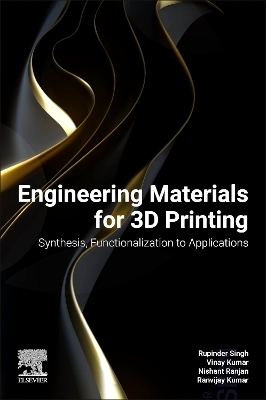
Engineering Materials for 3D Printing
Elsevier - Health Sciences Division (Verlag)
978-0-443-33625-6 (ISBN)
- Noch nicht erschienen (ca. Januar 2026)
- Versandkostenfrei
- Auch auf Rechnung
- Artikel merken
While existing literature extensively covers manufacturing processes, this work bridges the gap by exploring 3D printable materials for diverse engineering uses.
Dr. Rupinder Singh is currently Professor and Head of the Department of Mechanical Engineering, National Institute of Technical Teacher Training and Research, Chandigarh. He received a Ph.D. in Mechanical Engineering from the Thapar Institute of Engineering and Technology Patiala. His research interests are additive manufacturing, composite filament processing, rapid tooling, metal casting and plastic solid waste management Dr Vinay Kumar is an Assistant Professor at the University Centre for Research and Development, Chandigarh University. He has received Ph.D. in Mechanical Engineering from Punjabi University, Patiala. His area of research is additive manufacturing and the application of 3D printing for the development of new customizable solutions for structural and non-structural defects in heritage structures, and biomaterials for clinical applications. He has contributed extensively to additive manufacturing literature with publications appearing in Composite Part: B, Materials Letters, Journal of Manufacturing Processes, Journal of Thermoplastic composite Materials, Journal of Composite Materials, Journal of Materials Engineering and Performance, Sadhana, Materials Research Express, Advances in Materials Processing Technology, Proceedings of Institute of Mechanical Engineers Part-B, Part E, Part H, Part L, etc. He has authored 30 research papers and 25 book chapters Dr Nishant Ranjan is an Assistant Professor at the University Centre for Research and Development of Chandigarh University, India. His research interests include: materials development for biomedical-based 3D printing applications, materials processing of thermoplastic polymers, reinforcement and the development of new composite thermoplastic polymers, and scaffold printing Dr. Ranvijay Kumar is an Assistant Professor (Research) at Marwadi University Research Center. He holds a Ph.D. in Mechanical Engineering from Punjabi University, Patiala. His expertise includes additive manufacturing, smart materials, friction-based welding, polymer composites, and plastic waste management. He has co-authored 80+ SCI-indexed research papers, 50 book chapters, and presented at 20 conferences. A recipient of the prestigious CII MILCA Award (2020), his work is published in top journals. Recognized among Stanford University’s top 2% scientists (2022–2024), he has significantly contributed to additive manufacturing and advanced material research.
Section A: Polymer/ polymer composites-based 3D printable materials
1. In-house fabrication of extrusion-based polymer and composites for 3D printing
2. Sol-gel method for 3D printing of smart polymer materials
3. Pulverization as material processing for 3D printed thermoplastics
4. Meta-structure base 3D printing of polymers for structural applications
Section B: Metals-based 3D printable materials
5. Atomization and solid-state metal reduction for 3D printing
6. Electrolysis and chemical treated metal and alloys for structural engineering applications
7. Meta-structures-based metal 3D printing for non-structural applications
8. Hybridization of metal 3D printing for smart structures
Section C: Applications and case studies
9. Fabrication of smart orthopaedic implants for human and veterinary patients
10. Meta-structures based smart repair solutions for structural defects of heritage buildings
11. A case study on the fabrication of dental implants and tools for humans
12. Some comprehensive studies on compressive properties of metal 3D printed strategic canine tooth
13. Meta-structures inspired mesh based smart solutions for surgical practices of diaphragmatic hernia in bovines
| Erscheint lt. Verlag | 1.1.2026 |
|---|---|
| Verlagsort | Philadelphia |
| Sprache | englisch |
| Maße | 152 x 229 mm |
| Gewicht | 450 g |
| Themenwelt | Technik ► Maschinenbau |
| ISBN-10 | 0-443-33625-3 / 0443336253 |
| ISBN-13 | 978-0-443-33625-6 / 9780443336256 |
| Zustand | Neuware |
| Informationen gemäß Produktsicherheitsverordnung (GPSR) | |
| Haben Sie eine Frage zum Produkt? |
aus dem Bereich