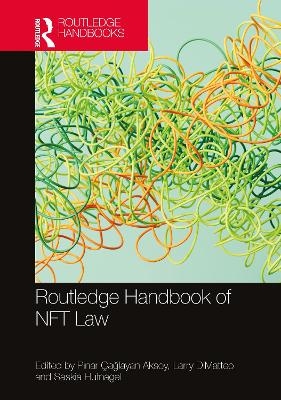
Routledge Handbook of NFT Law
Routledge (Verlag)
978-1-032-67599-2 (ISBN)
Non-fungible tokens (NFTs) are types of crypto-assets that function on the blockchain. Anything that one can digitize has the potential of becoming an NFT. While NFTs raise similar issues as other crypto-assets, there are many use cases and characteristics that are unique and call for special attention. At a time when individual countries have started responding to various legal issues, this volume examines these matters from a comparative law perspective.
The book approaches NFTs from a multidisciplinary perspective and provides in-depth information about the potential legal problems that arise from their use and transfer. The work looks at NFTs from different areas of law to determine the problems and how they can be resolved. Divided into seven parts, Part I introduces the key elements of NFTs and lays the foundation for the understanding of subsequent chapters. Part II focuses on NFTs from the perspective of contract law and discusses if/how they conflict with its traditional principles. Part III examines issues around intellectual property, trademark and patent law. Part IV reflects on how NFTs will transform business law. Part V deals with complex public law aspects. Part VI focuses on data and consumer protection problems that arise when NFTs become mainstream. Finally, Part VII focuses on how NFTs will change the dispute resolution process and the courts.
The book will be an essential resource for academics, researchers and policymakers working in the areas of technology and law.
Pınar Çağlayan Aksoy is Associate Professor of civil law at Bilkent University and visiting researcher at King’s College London. She is a member of BCTR Platform, Istanbul Blockchain Women, and UZH Blockchain Center. She led a TÜBİTAK-funded project on smart contracts and data protection and won the 2024 BAGEP Award. Her research covers contract law, tort law, and legal implications of emerging technologies. Larry DiMatteo is the Huber Hurst Professor of contract law and legal studies at the University of Florida. He holds a JD from Cornell, LLM from Harvard and PhD from Monash. Named UF’s Teacher-Scholar of the Year (2012), he has authored 170+ publications and 20 books, including AI and Consumer Law (CUP, 2024), Principles of Contract Law & Theory (Elgar, 2023), and Smart Contracts, Blockchain Technology & Digital Platforms (CUP, 2020). He is the former editor-in-chief of the American Business Law Journal. Saskia Hufnagel is Professor at the University of Sydney Law School and Co-Director of the Sydney Institute of Criminology. She is a senior associate research fellow at the Institute of Advanced Legal Studies, University of London. Her research focuses on transnational criminal justice, global law enforcement cooperation, and art crime. A qualified German legal professional and criminal law specialist, she has held academic posts in Europe and Australia.
Part I: NFTs from a Technological Perspective
1. A General Approach to Tokens and Non-Fungible Tokens
2. Exploring Types of NFTs in Unconventional Categories
3. NFT Use Cases
4. Regulating NFT Marketplaces: A Comparative Analysis of the EU And UK Legal Systems
Part II: NFTs and Contract Law
5. NFTs and Smart Contracts
6. Contract Law and NFT Marketplaces: The EU Digital Services Act
Part III: NFTs and Property
7. Ownership of NFTs: An Analogical Paradox
8. Unpacking Copyright Law in the NFT Era: Legal Questions and Emerging Trends
9. The Intersection between NFTs and Trademark and Patent Protection
Part IV: NFTs and Business Law
10. Non-Fungible Tokens (NFTs) and Decentralized Autonomous Organisations (DAOs): An Odd Couple?
11. NFTs and International Trade
Part V: Public Law Aspects of NFTs
12. Taxation of NFTs
13. Criminal Law and Technology: The Complex Case of Non-Fungible Tokens (NFTs)
14. NFTs and Financial Market Regulation
15. Blockchain Consensus Mechanism and Climate Change: A Comparative Analysis of The Current International, European, And Domestic Legislative Framework
Part VI :Data and Consumer Protection
16. NFTs and Data Protection
17. Cutting Through the Hype: Consumer Protection in NFT Transactions
Part VII: NFTs and Courts
18. Jurisdiction And Applicable Law In NFT-Related Contractual Disputes Under EU Private International Law
19. ADR in the Age of NFTs: Smart Disputes, Smarter Justice!
20. NFTs and Access to Justice
21. Lawyers in Cryptoland
| Erscheinungsdatum | 17.10.2025 |
|---|---|
| Reihe/Serie | Routledge Handbooks in Law |
| Zusatzinfo | 17 Tables, black and white; 5 Halftones, black and white; 5 Illustrations, black and white |
| Verlagsort | London |
| Sprache | englisch |
| Maße | 174 x 246 mm |
| Gewicht | 900 g |
| Themenwelt | Recht / Steuern ► EU / Internationales Recht |
| Recht / Steuern ► Privatrecht / Bürgerliches Recht ► IT-Recht | |
| Recht / Steuern ► Wirtschaftsrecht ► Gesellschaftsrecht | |
| Technik | |
| ISBN-10 | 1-032-67599-3 / 1032675993 |
| ISBN-13 | 978-1-032-67599-2 / 9781032675992 |
| Zustand | Neuware |
| Informationen gemäß Produktsicherheitsverordnung (GPSR) | |
| Haben Sie eine Frage zum Produkt? |
aus dem Bereich