


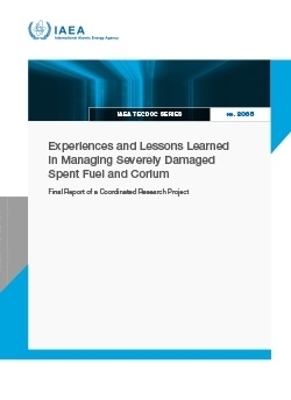
Experiences and Lessons Learned in Managing Severely Damaged Spent Fuel and Corium
Seiten
2025
IAEA (Verlag)
978-92-0-105925-3 (ISBN)
IAEA (Verlag)
978-92-0-105925-3 (ISBN)
Nuclear power plant accidents spanning 1979–2011—including events at Three Mile Island, Chornobyl, Fukushima Daiichi, and a Hungarian plant—led to melted reactor cores and cooling failures. The work reviews efforts to recover, characterize, and manage damaged fuel materials, guiding future decommissioning and remediation strategies.
Between 1979 and 2011, three severe nuclear power plant (NPP) accidents occurred at Three Mile Island (TMI, USA), Chornobyl (ChNPP, Ukraine), and Fukushima Daiichi (IF, Japan), resulting in melted reactor cores. Additionally, PAKs NPP Unit 2 (Hungary) experienced a loss of cooling accident in 2003 during the cleaning of irradiated fuel. The accidents at TMI and PAKs have been remediated to the extent that the material is either in monitored safe storage or is packaged pending processing. ChNPP Unit 4, which was destroyed during the accident, was finally stabilized in 2016 with the installation of new safe containment. The decommissioning of IF NPP remains a major challenge as three of the first-generation reactor cores suffered meltdown. In 2015, the Coordinated Research Project on the management of severely damaged spent fuel and corium was established. This publication examines the efforts of participating Member States in the characterization, recovery, and management of fuel containing materials (fuel assemblies, fuel debris, corium and melted corium-concrete interaction products) to support future decommissioning and environmental remediation activities. It also provides an overview of the loss of cooling accidents and insights into the evolution of corium and fuel debris in storage conditions, which will support ongoing decision-making on the management of these materials.
Between 1979 and 2011, three severe nuclear power plant (NPP) accidents occurred at Three Mile Island (TMI, USA), Chornobyl (ChNPP, Ukraine), and Fukushima Daiichi (IF, Japan), resulting in melted reactor cores. Additionally, PAKs NPP Unit 2 (Hungary) experienced a loss of cooling accident in 2003 during the cleaning of irradiated fuel. The accidents at TMI and PAKs have been remediated to the extent that the material is either in monitored safe storage or is packaged pending processing. ChNPP Unit 4, which was destroyed during the accident, was finally stabilized in 2016 with the installation of new safe containment. The decommissioning of IF NPP remains a major challenge as three of the first-generation reactor cores suffered meltdown. In 2015, the Coordinated Research Project on the management of severely damaged spent fuel and corium was established. This publication examines the efforts of participating Member States in the characterization, recovery, and management of fuel containing materials (fuel assemblies, fuel debris, corium and melted corium-concrete interaction products) to support future decommissioning and environmental remediation activities. It also provides an overview of the loss of cooling accidents and insights into the evolution of corium and fuel debris in storage conditions, which will support ongoing decision-making on the management of these materials.
| Erscheinungsdatum | 02.07.2025 |
|---|---|
| Reihe/Serie | IAEA TECDOC Series No. |
| Verlagsort | Vienna |
| Sprache | englisch |
| Maße | 210 x 297 mm |
| Gewicht | 840 g |
| Themenwelt | Naturwissenschaften ► Biologie ► Ökologie / Naturschutz |
| Technik ► Elektrotechnik / Energietechnik | |
| ISBN-10 | 92-0-105925-6 / 9201059256 |
| ISBN-13 | 978-92-0-105925-3 / 9789201059253 |
| Zustand | Neuware |
| Informationen gemäß Produktsicherheitsverordnung (GPSR) | |
| Haben Sie eine Frage zum Produkt? |
Mehr entdecken
aus dem Bereich


aus dem Bereich
Methoden – Lösungen – Anwendungen
Buch | Hardcover (2025)
Hanser (Verlag)
CHF 69,95


