


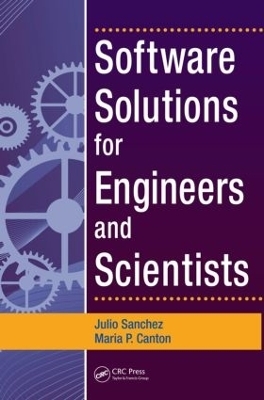
Software Solutions for Engineers and Scientists
Seiten
2007
Crc Press Inc (Verlag)
978-1-4200-4302-0 (ISBN)
Crc Press Inc (Verlag)
978-1-4200-4302-0 (ISBN)
- Titel z.Zt. nicht lieferbar
- Versandkostenfrei
- Auch auf Rechnung
- Artikel merken
Provides development tools and practical shortcuts for professionals who already have basic programming skills but may lack the knowledge needed to perform sophisticated tasks and difficult mathematic calculations. This book includes mathematical-computation intensive code along with programming techniques.
Software requirements for engineering and scientific applications are almost always computational and possess an advanced mathematical component. However, an application that calls for calculating a statistical function, or performs basic differentiation of integration, cannot be easily developed in C++ or most programming languages. In such a case, the engineer or scientist must assume the role of software developer. And even though scientists who take on the role as programmer can sometimes be the originators of major software products, they often waste valuable time developing algorithms that lead to untested and unreliable routines.
Software Solutions for Engineers and Scientists addresses the ever present demand for professionals to develop their own software by supplying them with a toolkit and problem-solving resource for developing computational applications. The authors' provide shortcuts to avoid complications, bearing in mind the technical and mathematical ability of their audience.
The first section introduces the basic concepts of number systems, storage of numerical data, and machine arithmetic. Chapters on the Intel math unit architecture, data conversions, and the details of math unit programming establish a framework for developing routines in engineering and scientific code. The second part, entitled Application Development, covers the implementation of a C++ program and flowcharting. A tutorial on Windows programming supplies skills that allow readers to create professional quality programs. The section on project engineering examines the software engineering field, describing its common qualities, principles, and paradigms. This is followed by a discussion on the description and specification of software projects, including object-oriented approaches to software development.
With the introduction of this volume, professionals can now design effective applications that meet their own field-specific requirements using modern tools and technology.
Software requirements for engineering and scientific applications are almost always computational and possess an advanced mathematical component. However, an application that calls for calculating a statistical function, or performs basic differentiation of integration, cannot be easily developed in C++ or most programming languages. In such a case, the engineer or scientist must assume the role of software developer. And even though scientists who take on the role as programmer can sometimes be the originators of major software products, they often waste valuable time developing algorithms that lead to untested and unreliable routines.
Software Solutions for Engineers and Scientists addresses the ever present demand for professionals to develop their own software by supplying them with a toolkit and problem-solving resource for developing computational applications. The authors' provide shortcuts to avoid complications, bearing in mind the technical and mathematical ability of their audience.
The first section introduces the basic concepts of number systems, storage of numerical data, and machine arithmetic. Chapters on the Intel math unit architecture, data conversions, and the details of math unit programming establish a framework for developing routines in engineering and scientific code. The second part, entitled Application Development, covers the implementation of a C++ program and flowcharting. A tutorial on Windows programming supplies skills that allow readers to create professional quality programs. The section on project engineering examines the software engineering field, describing its common qualities, principles, and paradigms. This is followed by a discussion on the description and specification of software projects, including object-oriented approaches to software development.
With the introduction of this volume, professionals can now design effective applications that meet their own field-specific requirements using modern tools and technology.
Minnesota State University, Mankato, USA South Central College, North Mankato, Minnesota, USA
Computer Number Systems. Storing Numeric Data. Machine Arithmetic. High-Precision Arithmetic. Numerical Hardware. Floating Point Operations. The Intel Math Unit. Transcendental Primitives. General Mathematical Functions. Financial Calculations. Statistics. Interpolation, Differentiation, and Integration. The Solution of Linear Systems. Solving Equations. Artificial Intelligence Methods.
| Erscheint lt. Verlag | 31.10.2007 |
|---|---|
| Zusatzinfo | 99 Tables, black and white; 208 Illustrations, black and white |
| Verlagsort | Bosa Roca |
| Sprache | englisch |
| Maße | 178 x 254 mm |
| Gewicht | 1780 g |
| Themenwelt | Mathematik / Informatik ► Informatik ► Software Entwicklung |
| Mathematik / Informatik ► Informatik ► Theorie / Studium | |
| Technik ► Umwelttechnik / Biotechnologie | |
| ISBN-10 | 1-4200-4302-1 / 1420043021 |
| ISBN-13 | 978-1-4200-4302-0 / 9781420043020 |
| Zustand | Neuware |
| Informationen gemäß Produktsicherheitsverordnung (GPSR) | |
| Haben Sie eine Frage zum Produkt? |
Mehr entdecken
aus dem Bereich

aus dem Bereich
Grundlagen, Prozesse, Methoden und Werkzeuge
Buch | Hardcover (2024)
Springer Vieweg (Verlag)
CHF 153,95
Praxishandbuch für Java- und Webservice-Entwickler
Buch | Softcover (2025)
dpunkt (Verlag)
CHF 62,85


