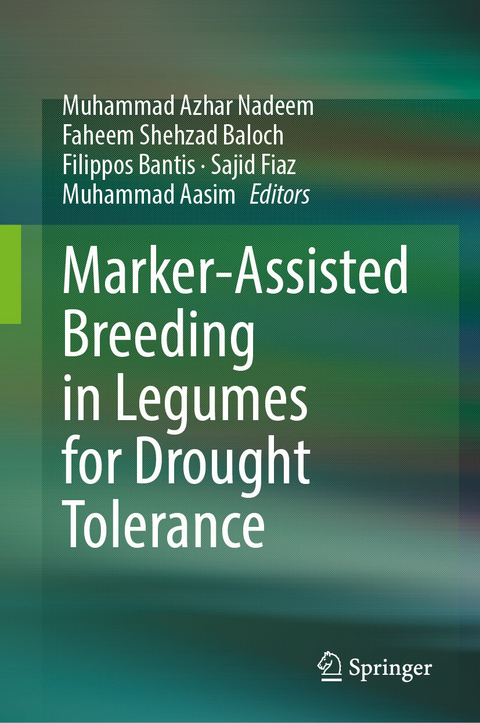
Marker-Assisted Breeding in Legumes for Drought Tolerance (eBook)
431 Seiten
Springer Nature Singapore (Verlag)
978-981-96-4112-3 (ISBN)
This contributed volume highlights cutting-edge breeding techniques in legumes, specifically targeting drought tolerance. It examines the challenges faced and explores future perspectives for achieving sustainable legume production.
The dual challenges of a rapidly growing global population and climate change impose immense pressure on agricultural systems to meet current and future food demands. Climate change significantly threatens agriculture, causing substantial yield losses due to biotic and abiotic stresses, with drought being one of the most severe environmental factors impacting plant productivity. Water, which constitutes approximately 80-95% of the fresh biomass of plants, is vital for various physiological processes, including plant growth, development, and metabolism.
Legumes, second only to cereals in global food production, account for 27% of world primary crop production and fulfill 33% of protein requirements. Cultivated across diverse climates and soil types, legumes contribute to over 35% of global vegetable oil production. However, drought remains a major yield-limiting factor in grain legumes, a challenge expected to intensify in the future. Drought adversely affects legumes at all growth stages, disrupting germination (through malfunctioning enzymes like proteases and amylases), nutrient uptake (due to reduced water use efficiency), growth (by inhibiting cell division and leaf expansion), and yield formation (by restricting photosynthesis).
Given these challenges, the scientific community is focusing on developing drought-resistant legume cultivars to ensure future food security. This volume consolidates research efforts on advancing drought-tolerant legumes using marker-assisted breeding techniques.
This book will serve as a valuable resource for students, researchers, and breeding professionals engaged in legume breeding for drought tolerance. By fostering advancements in sustainable agriculture, this volume aims to contribute to global food security and empower stakeholders in addressing climate change-induced agricultural challenges.
This contributed volume highlights cutting-edge breeding techniques in legumes, specifically targeting drought tolerance. It examines the challenges faced and explores future perspectives for achieving sustainable legume production.The dual challenges of a rapidly growing global population and climate change impose immense pressure on agricultural systems to meet current and future food demands. Climate change significantly threatens agriculture, causing substantial yield losses due to biotic and abiotic stresses, with drought being one of the most severe environmental factors impacting plant productivity. Water, which constitutes approximately 80-95% of the fresh biomass of plants, is vital for various physiological processes, including plant growth, development, and metabolism.Legumes, second only to cereals in global food production, account for 27% of world primary crop production and fulfill 33% of protein requirements. Cultivated across diverse climates and soil types, legumes contribute to over 35% of global vegetable oil production. However, drought remains a major yield-limiting factor in grain legumes, a challenge expected to intensify in the future. Drought adversely affects legumes at all growth stages, disrupting germination (through malfunctioning enzymes like proteases and amylases), nutrient uptake (due to reduced water use efficiency), growth (by inhibiting cell division and leaf expansion), and yield formation (by restricting photosynthesis).Given these challenges, the scientific community is focusing on developing drought-resistant legume cultivars to ensure future food security. This volume consolidates research efforts on advancing drought-tolerant legumes using marker-assisted breeding techniques.This book will serve as a valuable resource for students, researchers, and breeding professionals engaged in legume breeding for drought tolerance. By fostering advancements in sustainable agriculture, this volume aims to contribute to global food security and empower stakeholders in addressing climate change-induced agricultural challenges.
| Erscheint lt. Verlag | 16.5.2025 |
|---|---|
| Zusatzinfo | XVII, 431 p. 44 illus., 43 illus. in color. |
| Sprache | englisch |
| Themenwelt | Naturwissenschaften ► Biologie ► Botanik |
| Naturwissenschaften ► Biologie ► Genetik / Molekularbiologie | |
| Technik ► Umwelttechnik / Biotechnologie | |
| Weitere Fachgebiete ► Land- / Forstwirtschaft / Fischerei | |
| Schlagworte | Breeding Advancements • Drought Tolerance • marker-assisted breeding • Marker-assisted selection • Omics Approach for Legume Breeding • sustainable legume production |
| ISBN-10 | 981-96-4112-8 / 9819641128 |
| ISBN-13 | 978-981-96-4112-3 / 9789819641123 |
| Informationen gemäß Produktsicherheitsverordnung (GPSR) | |
| Haben Sie eine Frage zum Produkt? |
 PDF (Wasserzeichen)
DRM: Digitales Wasserzeichen
Dieses eBook enthält ein digitales Wasserzeichen und ist damit für Sie personalisiert. Bei einer missbräuchlichen Weitergabe des eBooks an Dritte ist eine Rückverfolgung an die Quelle möglich.
Dateiformat: PDF (Portable Document Format)
Mit einem festen Seitenlayout eignet sich die PDF besonders für Fachbücher mit Spalten, Tabellen und Abbildungen. Eine PDF kann auf fast allen Geräten angezeigt werden, ist aber für kleine Displays (Smartphone, eReader) nur eingeschränkt geeignet.
Systemvoraussetzungen:
PC/Mac: Mit einem PC oder Mac können Sie dieses eBook lesen. Sie benötigen dafür einen PDF-Viewer - z.B. den Adobe Reader oder Adobe Digital Editions.
eReader: Dieses eBook kann mit (fast) allen eBook-Readern gelesen werden. Mit dem amazon-Kindle ist es aber nicht kompatibel.
Smartphone/Tablet: Egal ob Apple oder Android, dieses eBook können Sie lesen. Sie benötigen dafür einen PDF-Viewer - z.B. die kostenlose Adobe Digital Editions-App.
Buying eBooks from abroad
For tax law reasons we can sell eBooks just within Germany and Switzerland. Regrettably we cannot fulfill eBook-orders from other countries.
aus dem Bereich