


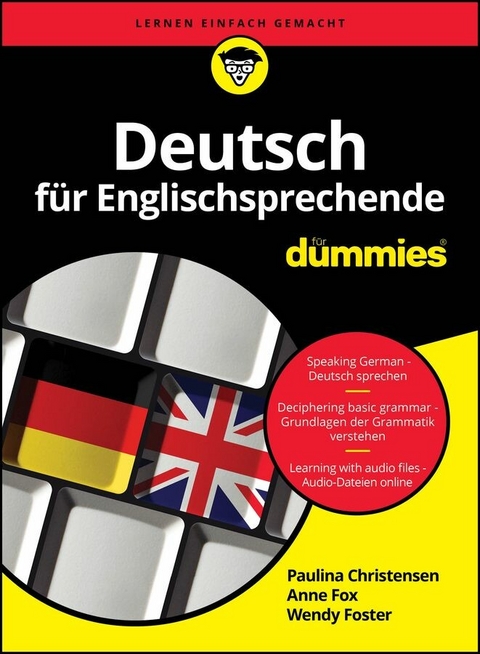
Deutsch für Englischsprechende für Dummies (eBook)
488 Seiten
Wiley-VCH (Verlag)
978-3-527-85182-9 (ISBN)
Wenn es mehr als »Guten Tag« sein soll
»Deutsch für Englischsprechende« bietet einen leichten Einstieg in die deutsche Sprache. Das Buch ist in Englisch geschrieben. Hier lernen Sie alles Wissenswerte zur deutschen Grammatik und zur Konjugation der Verben. Und die Downloaddateien mit Dialogbeispielen aus dem richtigen Leben helfen Ihnen, die Aussprache zu erlernen.
»German for Dummies« offers an easy introduction to the German language for English speakers. You will learn the essentials you need to know about grammar and verb conjugation. And the download files with real-life dialog examples will help you learn the pronunciation.
Sie erfahren
- Wie Sie im Deutschen richtig betonen - How to emphasize German words correctly
- Wie Sie sich auf Deutsch zurechtfinden - How to find your way around in German
- Wie Sie deutsche Redewendungen richtig benutzen - How to use German idioms correctly
Dr. Paulina Christensen und Anne Fox sind erfahrene Deutschlehrerinnen.
Auch Wendy Foster unterrichtet Deutsch. Sie ist Autorin von Intermediate German for Dummies.
Dr. Paulina Christensen and Anne Fox are experienced German teachers.
Wendy Foster also teaches German. She is the author of Intermediate German for Dummies.
Introduction
We are the players in a fascinating era, one that interconnects us with others all around the world. With globalization and technology as the driving forces, we find ourselves getting in closer and closer contact with more and more people. As a result, knowing how to say at least a few words in a language such as German is becoming an ever-more-vital tool.
Our natural curiosity to find out about other cultures motivates us to hop on a plane and find out firsthand what everyday life is like in the German-speaking regions: Germany, Austria, Switzerland, South Tyrol in northern Italy, Luxembourg, and Liechtenstein. Conducting international business in an increasingly competitive market necessitates personal contact; hence, more businesspeople are traveling overseas to countries like Germany, which has the largest economy in the European Union. On a more personal level, you may have friends, relatives, and neighbors who speak German, or you may want to get in touch with your heritage by learning a little bit of the language that your ancestors spoke.
Whatever your reasons for wanting to learn some German, Deutsch für Englischsprechende für Dummies is a terrific choice because it gives you the skills you need for basic communication in German. We're not promising super fluency here, but if you want to know how to greet someone, purchase a train ticket, or order food from a menu in German, you need look no further than this book.
About This Book
Deutsch für Englischsprechende für Dummies is set up so that you can use it any way you want to — as a reference to dip into for specific questions you have about German, as a means of gaining knowledge of German in a systematic way, or just for the fun of getting the feel for another language. Perhaps your goal is to learn some words and phrases to help you get around when you travel to a German-speaking country. Maybe you simply want to be able to say »Hello, how are you?« to your German-speaking neighbor. At any rate, you can go through this book at your own pace, reading as much or as little at a time as you like. You don't need to plod through the chapters in order, either; you're welcome to read the sections that interest you most.
Conventions Used in This Book
To make this book easy for you to navigate, we've set up a few conventions:
- German terms are set in boldface to make them stand out.
- Pronunciation is set in parentheses following the German terms, and the stressed syllables are italicized.
- English translations are italicized. You'll find them set in parentheses following the pronunciation of German terms or sentences.
- In some cases, German speakers use the same pronunciation as English speakers for words, many of which are borrowed from English or other languages. When such words are pronounced the same way in German as in English, you'll see the English word in the pronunciation followed by the notation »as in English« rather than the usual phonetic pronunciation. Of course, if the pronunciation differs between the English and German, we include the German pronunciation as usual.
- Verb conjugations (lists that show you the forms of a verb) are given in tables in this order:
- The »I« form
- The »you« (singular, informal [or sing. inf.]) form
- The »you« (singular, formal [or sing. form.]) form
- The »he, she, it« form
- The »we« form
- The »you« (plural, informal [or pl. inf.]) form
- The »you« (plural, formal [or pl. form.]) form
- The »they« form
- Pronunciations follow in the second column. The example shown uses the verb »to be.« The conjugation starts with the German equivalent of »I am, you are,« and so on.
| Conjugation | Pronunciation |
| ich bin | iH bin |
| du bist | dooh bist |
| Sie sind | zee zint |
| er, sie, es ist | êr, zee, ês ist |
| wir sind | veer zint |
| ihr seid | eer zayt |
| Sie sind | zee zint |
| sie sind | zee zint |
To help you make fast progress in German, this book includes a few elements to help you along:
- Talkin' the Talk dialogues: The best way to learn a language is to see and hear how it's used in conversation, so we include dialogues throughout the book. The dialogues come under the heading »Talkin' the Talk« and show you the German words, their pronunciations, and the English translations.
- Words to Know blackboards: Acquiring key words and phrases is also important in language learning, so we collect these important words in sections that resemble chalkboards, with the heading »Words to Know.« Note: In the pronunciations given in these sections, the stressed syllables are underlined rather than italicized.
- Fun & Games activities: If you want to flex your new language muscles, you can use the Fun & Games activities to reinforce what you learn. These activities are fun ways to check your progress.
Also note that, because each language has its own ways of expressing ideas, the English translations that we provide for the German terms may not be exactly literal. We want you to know the essence of what's being said, not just the meanings of single words. For example, the phrase Es geht (ês geyt) can be translated literally as It goes, but the phrase is actually the equivalent of So, so, or Okay, which is what you see as the translation.
Foolish Assumptions
To write this book, we made some assumptions about who you are and what you hope to gain from this book:
- You know no German — or if you took German somewhere in your deep, dark past, you don't remember much more than Ja, Nein, Kindergarten, Guten Tag, and auf Wiedersehen.
- You're primarily interested in communicating verbally in German, not in reading or writing German.
- You're definitely not looking for a ho-hum textbook that puts you to sleep, nor do you want to plod through monotonous language exercises that drill German into your brain. You just want to know some practical words, phrases, and sentence constructions so that you can communicate basic information in German — with confidence.
- You have no interest in memorizing long lists of bookish-sounding vocabulary words or a bunch of boring grammar rules.
- You're excited about German and are looking forward to having some fun as you pick up a bit of the language.
If any or all of these statements apply to you, you've found the right book!
How This Book Is Organized
This book is divided by topic: first into parts and then into chapters. The following sections tell you what types of information you can find in each part.
Part I: Getting Started
This part gets you acclimated by providing you with some German basics: how to pronounce words, how to form sentences, and so on. You find a wealth of basic survival-type expressions such as greetings and numbers. We even challenge you to boost your confidence by activating some German words that you probably already know. Finally, we outline the basics of German grammar that you may need to know when you work through later chapters in the book.
Part II: German in Action
In this part, you begin learning and using German. Instead of focusing on grammar points as many dull, dusty language textbooks do, this part focuses on communicating effectively in everyday situations, such as shopping, asking for directions, going to a museum, dining, phoning, and lots more.
Part III: German on the Go
This part gives you the tools you need to take your German on the road, whether you're looking to change money, find a place to stay, plan a trip, or take public or private transportation. There's even a chapter on handling emergencies.
Part IV: The Part of Tens
If you're looking for small, easily digestible pieces of information about German, this part is for you. Here, you can find ten ways to learn German quickly, ten useful German expressions to know, and more.
Part V: Appendixes
This part of the book includes important information that you can use for reference. Appendix A is a handy mini-dictionary in both German-to-English and English-to-German formats. If you encounter a German word that you don't understand or you need to know a specific word in German, you can look it up here. Appendix B features verb tables that show you how to conjugate both regular verbs and those verbs that stubbornly don't fit the pattern. Appendix C gives you the answer keys to all of the Fun & Games activities that appear in the book. Finally, Appendix D provides a listing of the tracks that appear on the accompanying audio files provided for download on...
| Erscheint lt. Verlag | 15.5.2025 |
|---|---|
| Sprache | deutsch |
| Themenwelt | Schulbuch / Wörterbuch ► Wörterbuch / Fremdsprachen |
| Technik | |
| ISBN-10 | 3-527-85182-8 / 3527851828 |
| ISBN-13 | 978-3-527-85182-9 / 9783527851829 |
| Informationen gemäß Produktsicherheitsverordnung (GPSR) | |
| Haben Sie eine Frage zum Produkt? |
 EPUB (Adobe DRM)
Kopierschutz: Adobe-DRM
Adobe-DRM ist ein Kopierschutz, der das eBook vor Mißbrauch schützen soll. Dabei wird das eBook bereits beim Download auf Ihre persönliche Adobe-ID autorisiert. Lesen können Sie das eBook dann nur auf den Geräten, welche ebenfalls auf Ihre Adobe-ID registriert sind.
Details zum Adobe-DRM
Dateiformat: EPUB (Electronic Publication)
EPUB ist ein offener Standard für eBooks und eignet sich besonders zur Darstellung von Belletristik und Sachbüchern. Der Fließtext wird dynamisch an die Display- und Schriftgröße angepasst. Auch für mobile Lesegeräte ist EPUB daher gut geeignet.
Systemvoraussetzungen:
PC/Mac: Mit einem PC oder Mac können Sie dieses eBook lesen. Sie benötigen eine
eReader: Dieses eBook kann mit (fast) allen eBook-Readern gelesen werden. Mit dem amazon-Kindle ist es aber nicht kompatibel.
Smartphone/Tablet: Egal ob Apple oder Android, dieses eBook können Sie lesen. Sie benötigen eine
Geräteliste und zusätzliche Hinweise
Buying eBooks from abroad
For tax law reasons we can sell eBooks just within Germany and Switzerland. Regrettably we cannot fulfill eBook-orders from other countries.
aus dem Bereich


