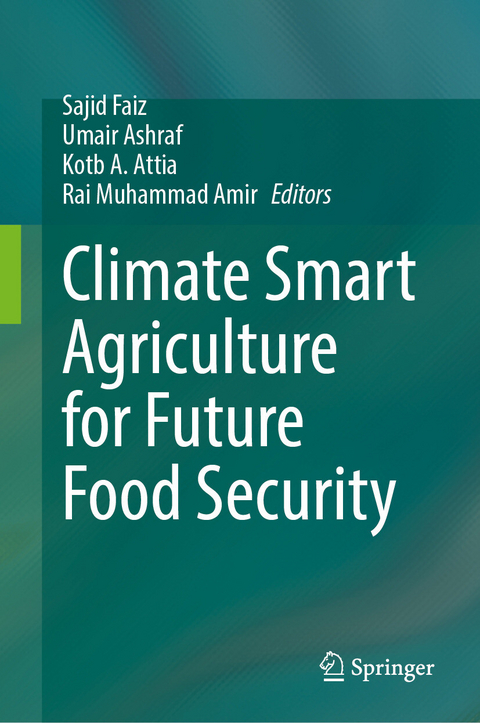
Climate Smart Agriculture for Future Food Security (eBook)
523 Seiten
Springer Nature Singapore (Verlag)
978-981-96-4499-5 (ISBN)
This contributed volume covers recent advancements in the development of climate-resilient agriculturally important crops by focusing on climate change, crop cultivation, crop breeding, and the application of novel biotechnological approaches in line with attaining second Sustainable Development Goal of zero hunger.
Climate-smart agriculture is a concept aimed at transforming and reorienting agricultural production systems to ensure food security in the ever-evolving situation of climate change. Widespread alterations in rainfall and temperature patterns have threatened agricultural production and elevated the vulnerability of human dependency on agriculture for food, feed, and fiber. Additionally, global food demand is estimated to increase to feed the estimated global population of 9.7 billion by the year 2050. Climate change, food, and nutritional insecurity pose the greatest challenges for the farming community, researchers, the private sector, civil society, and policymakers to develop more sustainable solutions ensuring food security, plant adaptability, and the mitigation of adverse effects on sustainable food production systems. This book will cover three pillars defined by the Food and Agriculture Organization of the United Nations for climate-smart agriculture: sustainable increase in agricultural production, adaptation, and plant resilience under climate change, and mitigation of environmental degradation through intensive agricultural practices. Furthermore, the book also highlights technological innovations taking place across different disciplines of agriculture to cater to both biotic and abiotic factors in agronomically important crops.
This book serves as a useful resource documenting all recent developments made to achieve sustainable crop production. It is an interesting read for master’s and doctoral-level students, academics, scientists, and researchers in the field of agronomy and agricultural biotechnology.
This contributed volume covers recent advancements in the development of climate-resilient agriculturally important crops by focusing on climate change, crop cultivation, crop breeding, and the application of novel biotechnological approaches in line with attaining second Sustainable Development Goal of zero hunger.Climate-smart agriculture is a concept aimed at transforming and reorienting agricultural production systems to ensure food security in the ever-evolving situation of climate change. Widespread alterations in rainfall and temperature patterns have threatened agricultural production and elevated the vulnerability of human dependency on agriculture for food, feed, and fiber. Additionally, global food demand is estimated to increase to feed the estimated global population of 9.7 billion by the year 2050. Climate change, food, and nutritional insecurity pose the greatest challenges for the farming community, researchers, the private sector, civil society, and policymakers to develop more sustainable solutions ensuring food security, plant adaptability, and the mitigation of adverse effects on sustainable food production systems. This book will cover three pillars defined by the Food and Agriculture Organization of the United Nations for climate-smart agriculture: sustainable increase in agricultural production, adaptation, and plant resilience under climate change, and mitigation of environmental degradation through intensive agricultural practices. Furthermore, the book also highlights technological innovations taking place across different disciplines of agriculture to cater to both biotic and abiotic factors in agronomically important crops.This book serves as a useful resource documenting all recent developments made to achieve sustainable crop production. It is an interesting read for master’s and doctoral-level students, academics, scientists, and researchers in the field of agronomy and agricultural biotechnology.
| Erscheint lt. Verlag | 16.5.2025 |
|---|---|
| Zusatzinfo | X, 523 p. 16 illus. in color. |
| Sprache | englisch |
| Themenwelt | Naturwissenschaften ► Biologie ► Genetik / Molekularbiologie |
| Technik ► Lebensmitteltechnologie | |
| Technik ► Umwelttechnik / Biotechnologie | |
| Weitere Fachgebiete ► Land- / Forstwirtschaft / Fischerei | |
| Schlagworte | Agricultural diversification for achieving zero hunger • biotic and abiotic stress • Climate-resilient crop production • Farm production for sustainable agriculture • Multi-stresses in neglected crops • Novel plant breeding techniques |
| ISBN-10 | 981-96-4499-2 / 9819644992 |
| ISBN-13 | 978-981-96-4499-5 / 9789819644995 |
| Informationen gemäß Produktsicherheitsverordnung (GPSR) | |
| Haben Sie eine Frage zum Produkt? |
 PDF (Wasserzeichen)
DRM: Digitales Wasserzeichen
Dieses eBook enthält ein digitales Wasserzeichen und ist damit für Sie personalisiert. Bei einer missbräuchlichen Weitergabe des eBooks an Dritte ist eine Rückverfolgung an die Quelle möglich.
Dateiformat: PDF (Portable Document Format)
Mit einem festen Seitenlayout eignet sich die PDF besonders für Fachbücher mit Spalten, Tabellen und Abbildungen. Eine PDF kann auf fast allen Geräten angezeigt werden, ist aber für kleine Displays (Smartphone, eReader) nur eingeschränkt geeignet.
Systemvoraussetzungen:
PC/Mac: Mit einem PC oder Mac können Sie dieses eBook lesen. Sie benötigen dafür einen PDF-Viewer - z.B. den Adobe Reader oder Adobe Digital Editions.
eReader: Dieses eBook kann mit (fast) allen eBook-Readern gelesen werden. Mit dem amazon-Kindle ist es aber nicht kompatibel.
Smartphone/Tablet: Egal ob Apple oder Android, dieses eBook können Sie lesen. Sie benötigen dafür einen PDF-Viewer - z.B. die kostenlose Adobe Digital Editions-App.
Buying eBooks from abroad
For tax law reasons we can sell eBooks just within Germany and Switzerland. Regrettably we cannot fulfill eBook-orders from other countries.
aus dem Bereich