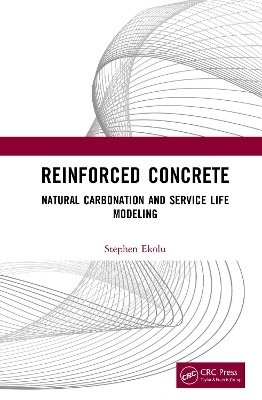
Reinforced Concrete
CRC Press (Verlag)
978-1-041-08350-4 (ISBN)
Carbonation-induced corrosion of reinforced concrete is among the most widespread durability problems affecting service life of structures, and it underscores the need to develop quantitative engineering methods. This book promulgates the Natural Carbonation Prediction (NCP) model derived through experiments, data mining and analyses, along with mathematical formulations and refinements. It initially delves into fundamental concepts on corrosion of reinforced concrete, before employing approaches to service life design based on the applicative and practical stochastic methods supported by independent data.
Features:
Focusses on corrosion due to carbonation of Portland cement-based concrete.
Covers natural carbonation mechanisms, and probabilistic service life design through reliability analysis and Monte Carlo simulation.
Presents a practical model for prediction of carbonation rate using a mathematical framework that incorporates key parameters for consideration in the engineering design process.
Using data from worldwide sources, various case studies from different countries globally, are employed comparing measurements with carbonation predictions.
Delves into carbonation modelling, originating from theoretical underpinnings based on Fick’s laws of diffusion.
This book is aimed at graduate students, researchers and professionals in civil engineering, concrete technology and the built environment.
Stephen Ekolu is Professor of Civil Engineering and is rated among the World’s Top 2% Scientists across all disciplines (Standford University/Elsevier; https://topresearcherslist.com/). He was formerly the Head of Civil Engineering Department at Nelson Mandela University (NMU). Before joining NMU, he was Associate Professor of Concrete Materials and Structures, and the Head of School of Civil Engineering and the Built Environment at University of Johannesburg. Previously he was a senior lecturer at School of Civil Engineering and the Built Environment, University of the Witwatersrand. He holds MSc (Eng) with distinction from University of Leeds, UK and PhD from University of Toronto, Canada. Prof. Ekolu is an NRF rated researcher and PrEng professionally registered engineer with extensive experience in the industry, academic teaching and research. In total, he has over 27 years of civil engineering experience with more than 20 years in academia following seven early career years of working in the industry. Prof. Ekolu has published a combined number of over 240 peer reviewed journal papers, conference articles, books, research and technical reports. His teaching and research expertise focus is concrete materials and structures, and his concerted 12-year research on natural carbonation and service life prediction, culminated into development of the NCP model. He is a reviewer (by invitation) for several leading international journals in the engineering field. He was Chair and Convenor of ICCMATS-1: International Conference on Construction Materials and Structures held on 24–6 November 2014 at Johannesburg, South Africa. He regularly provides consulting expertise and training in the industry.
Chapter 1. Introduction
Chapter 2. Steel corrosion and service life
Chapter 3. The natural carbonation prediction (NCP) model and methodology
Chapter 4. Experimental justification of NCP model
Chapter 5. Validation of NCP model’s application to real - life concrete structures
Chapter 6. Probabilistic service life design and analysis
| Erscheinungsdatum | 17.10.2025 |
|---|---|
| Zusatzinfo | 16 Tables, black and white; 38 Line drawings, black and white; 6 Halftones, black and white; 44 Illustrations, black and white |
| Verlagsort | London |
| Sprache | englisch |
| Maße | 156 x 234 mm |
| Gewicht | 400 g |
| Themenwelt | Technik ► Bauwesen |
| Technik ► Bergbau | |
| ISBN-10 | 1-041-08350-5 / 1041083505 |
| ISBN-13 | 978-1-041-08350-4 / 9781041083504 |
| Zustand | Neuware |
| Informationen gemäß Produktsicherheitsverordnung (GPSR) | |
| Haben Sie eine Frage zum Produkt? |
aus dem Bereich