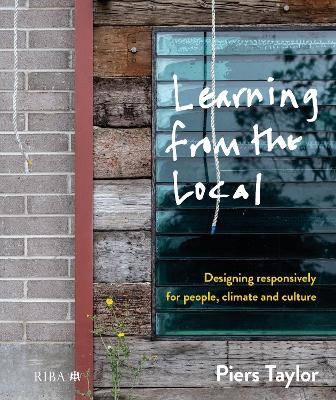
Learning from the Local
RIBA Publishing (Verlag)
978-1-915722-50-8 (ISBN)
Architecture struggles with the ‘local’.
As the move towards globalisation falters, the question of how a building might relate to its place in a meaningful manner has never been more pressing.
The sourcing and use of local materials has increasingly become an expectation in contemporary architecture. But what does local mean in this context? Should we use Cotswold stone in the Cotswolds forever – even if this necessitates using imitation stone? In rural areas, must we design traditional barns or farms with pitched roofs regardless of their sustainability?
Learning from the Local explodes the myth that vernacular style and national identity are the only design routes for place-specific architecture. The book is not a plea to return to pre-industrial times, but an attempt to understand the origins of the local in a global culture. Through a myriad of global case studies, it explores how geology, geography, material experimentation, waste, ecology, social issues, self-build and community engagement are heralding a new age. This sets the stage for a rich and evolving era of locally responsive architecture that is both low carbon and a true reflection of the circumstances of its production.
Features:
Over 30 case studies illustrated with full-colour photography, drawings and plans.
Architecture from across the world, spanning Spain, Greece, Australia, Costa Rica, China, Burkina Faso, Pakistan, Japan, USA, UK, Chile, Beirut, Netherlands, India and Italy.
Work from renowned architects, including Clancy Moore, Frank Gehry, Gianni Botsford, Glenn Murcutt, Jørn Utzon, Kéré Architecture, Lacol, Lina Ghotmeh, Mole Architects, Sarah Wigglesworth, Terunobu Fujimori and Yasmeen Lari.
Piers Taylor is an Architect and is Professor of Knowledge Exchange in Architecture at UWE, having formerly taught at the Architectural Association and the University for Cambridge. Piers studied in Sydney and in the UK and was awarded an anniversary scholarship for his PhD which examined the consequences of architectural making in a participatory context. Piers is also founder of Invisible Studio, which is a renowned multi-award-winning architecture practice, operating through collaboration, experimentation, research and education. He has pioneered a number of academic programmes that rethink the relationship between design and making, and is interested in making in terms of how material practice can address social and political questions. In addition, his current research also explores how we can design, plan and govern for social change and transition - how architecture supports and makes tangible the actions that encourage a civil society. Piers’ practice-based work includes numerous award-winning projects, including the National RIBA Award Winning Wolfson Tree Management Centre, Room 13, East Quay, Watchet and many others which have been widely and internationally published.
Acknowledgements
About the Author
Introduction
Chapter 1: Where Are We Now
Chapter 2: An Architecture of Local Adaptation
Chapter 3: Local Cultural Identity
Chapter 4: Architecture of Constraint
Chapter 5: Locality & Urbanism
Chapter 6: Learning from Community
Chapter 7: Ecological Locality
Chapter 8 Architecture of Accrual
Conclusion
Index
Endnotes
Image Credits
| Erscheinungsdatum | 25.09.2025 |
|---|---|
| Verlagsort | London |
| Sprache | englisch |
| Maße | 210 x 250 mm |
| Gewicht | 1100 g |
| Themenwelt | Technik ► Architektur |
| ISBN-10 | 1-915722-50-0 / 1915722500 |
| ISBN-13 | 978-1-915722-50-8 / 9781915722508 |
| Zustand | Neuware |
| Informationen gemäß Produktsicherheitsverordnung (GPSR) | |
| Haben Sie eine Frage zum Produkt? |
aus dem Bereich