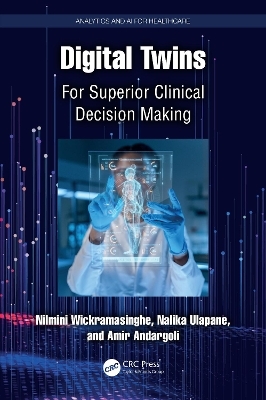
Digital Twins
CRC Press (Verlag)
9781032780344 (ISBN)
Together with cutting-edge technologies, the authors share the ability of data-driven models to offer more efficient clinical decision support. The authors take a three-prong approach in the study of digital twins, the positive contributions made in other industries, the different types of applications and the numerous benefits offered. Artificial intelligence (AI) techniques, such as machine learning (ML) and deep learning (DL) algorithms, are discussed in the context of digital twins in healthcare applications. By looking at digital twins it is possible to reduce workflow challenges and provide fast and precise diagnosis. This then demonstrates how digital twins therefore support superior clinical decision-making. Importantly, the authors identify critical success issues, including co-design and research, for the design, development, and deployment of suitable digital twins.
This book is written for the healthcare audience, professionals, physicians, medical administrators, managers, and IT practitioners. It also serves as a useful reference for senior-level undergraduate students and graduate students in health informatics and public health.
Nilmini Wickramasinghe is the Optus Chair and Professor of Digital Health at La Trobe University. She has been actively researching and teaching within the health informatics/digital health domain. In 2020, she was awarded an Alexander von Humboldt award for her outstanding contribution to digital health. Nalika Ulapane is a researcher contributing to the design, development, and assessment of digital health solutions. He brings mathematical modelling, engineering systems design, and design science research principles to solve problems in complex systems like the healthcare sector. Amir Andargoli focuses primarily on digitalization and digital transformation within the healthcare sector. He draws upon principles from information systems and management to conduct his research, which has resulted in publications in peer-reviewed journals and international symposiums.
Part I: The Why of Digital Twins/Why Now. 1. Decision-Making in Healthcare and the Rise of Technology and the Impact of the Digital Transformation. 2. Digital Twins in Other Industries. 3. The Case for Digital Twins for Healthcare. Part II: The What of Digital Twins. 4. From Algorithms to Outcomes: Leveraging Machine Learning Clustering Techniques for Enhanced Clinical Decision Support. 5. Clinical Decision Support through Federated Learning and Blockchain. 6. From Algorithms to Outcomes: Leveraging Machine Learning Classification Techniques for Enhanced Clinical Decision Support. 7. From Perceptron to Liquid Neural Networks: The Evolution of Neural Networks and Their Role in Black Box Modelling for Digital Twins in Healthcare. Part III: The How of Digital Twins. 8. Digital Twins and Clinical Decision-Making. 9. Application of Digital Twins in Healthcare Processes. 10. The Impact of Blockchain and Digital Twins in the Pharmaceutical Industry.
| Erscheinungsdatum | 31.07.2025 |
|---|---|
| Reihe/Serie | Analytics and AI for Healthcare |
| Zusatzinfo | 3 Tables, black and white; 7 Line drawings, black and white; 7 Illustrations, black and white |
| Verlagsort | London |
| Sprache | englisch |
| Maße | 156 x 234 mm |
| Gewicht | 270 g |
| Themenwelt | Informatik ► Theorie / Studium ► Künstliche Intelligenz / Robotik |
| Mathematik / Informatik ► Mathematik | |
| Technik ► Bauwesen | |
| ISBN-13 | 9781032780344 / 9781032780344 |
| Zustand | Neuware |
| Informationen gemäß Produktsicherheitsverordnung (GPSR) | |
| Haben Sie eine Frage zum Produkt? |
aus dem Bereich