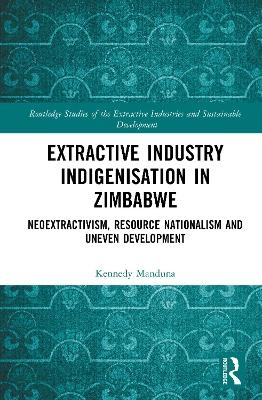
Extractive Industry Indigenisation in Zimbabwe
Routledge (Verlag)
978-1-032-50088-1 (ISBN)
This book explains how and why Zimbabwe’s extractive industry Indigenisation over-promised its benefits yet under-delivered upon implementation.
This book traces the history of uneven development in Zimbabwe from the initial days of colonialism to the present, using the extractive industry as the unit of analysis to carve out a granular and empirical analysis of the preponderance of transnational corporate control and ownership in the country. Indigenisation of Zimbabwe’s extractive industries was intended to address mining inequalities by transferring wealth from rich non-Indigenous mining capital to disadvantaged Indigenous citizens and communities. This policy, however, was a response to political, economic, and social crises posed by the international isolation of Zimbabwe’s government following the controversial Fast Track Land Reform Programme in 2000–2003. An intervention, therefore, which promised to address inequalities has thus been hampered by corruption, co-optation, and collusion which has led to it not only failing to address uneven development, but in actual fact worsening the situation. By examining the hidden structures and infrastructures of power, capital, and minerals and placing extractive industry Indigenisation in capitalism, this book makes a crucial scholarly contribution to the renewed and burgeoning debates around the resurgence of resource nationalism in general and the struggle for economic sovereignty in particular. This book steers readers more broadly to look for new and diversified ways of empowering Indigenous populations and their communities through mining Indigenisation in ways that do not threaten economic and political stability.
This book will be of great interest to students and scholars of the extractive industries, natural resource management, African politics, and African development.
Kennedy Manduna is a Research Associate at the African Centre for the Study United States (ACSUS) at the University of the Witwatersrand, Johannesburg. Between January 2023 and December 2024 he was one of only 12 fellows globally awarded a prestigious postdoctoral fellowship at the International Research Group on Authoritarianism and Counter-Strategies (IRGAC) of the Rosa‑Luxemburg‑Stiftung in Germany. As IRGAC’s sole African-based postdoctoral fellow, he was hosted by the Wits School of Governance at the University of the Witwatersrand in South Africa. He holds several academic affiliations, including associate fellow at the IRGAC, visiting scholar and fellow at the University of Potsdam, and academic trustee at the Rosa Luxemburg Foundation, Germany.
1. Introduction 2. Neo-Extractivism, Resource Nationalism and Green Imperialism 3. The Colonial Mining Regime: Extractivism, Accumulation and Dispossession 4. But then what is Indigenisation? 5. Contested Framings of Indigeneity and Impact of Indigenisation in Zimbabwe 6. Community and Share Ownership Trusts: The Controversies around them 7. The Indigenisation Programme and the Natural Capital Accounting in Zimbabwe 8. Political Settlements and Zimbabwe's Extractive Industry Indigenisation 9. Business Fronting, Beneficial Ownership and Political Settlements 10. Regime Survivalism and Private Accumulation of Public Resources Objectives 11. Green Colonialism, the Second Republic and The Reversal of the Indigenisation Programme 12. Conclusion: Policy Recommendations and the Proposed Way Forward
| Erscheinungsdatum | 12.09.2025 |
|---|---|
| Reihe/Serie | Routledge Studies of the Extractive Industries and Sustainable Development |
| Zusatzinfo | 13 Tables, black and white; 6 Line drawings, black and white; 6 Illustrations, black and white |
| Verlagsort | London |
| Sprache | englisch |
| Maße | 156 x 234 mm |
| Gewicht | 620 g |
| Themenwelt | Naturwissenschaften ► Biologie ► Ökologie / Naturschutz |
| Sozialwissenschaften ► Politik / Verwaltung ► Vergleichende Politikwissenschaften | |
| Sozialwissenschaften ► Soziologie ► Spezielle Soziologien | |
| Technik ► Bergbau | |
| ISBN-10 | 1-032-50088-3 / 1032500883 |
| ISBN-13 | 978-1-032-50088-1 / 9781032500881 |
| Zustand | Neuware |
| Informationen gemäß Produktsicherheitsverordnung (GPSR) | |
| Haben Sie eine Frage zum Produkt? |
aus dem Bereich