Physical Principles of Wireless Communications
Auerbach (Verlag)
978-0-8493-3259-3 (ISBN)
- Titel erscheint in neuer Auflage
- Artikel merken
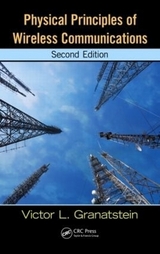
Wireless communications are based on the launching, propagation, and detection of electromagnetic waves emitted primarily at radio or microwave frequencies. Their history can be traced back to the mid-19th century when James Clerk Maxwell formulated the basic laws of electromagnetism and Heinrich Hertz demonstrated the propagation of radio waves across his laboratory. Recent engineering breakthroughs have led to wireless communication systems that have not only revolutionized modern lifestyles, but have also launched new industries.
Based on the author's course in the physics of wireless communications, Physical Principles of Wireless Communications provides students with a solid foundation in modern wireless communication systems. It offers rigorous analyses of the devices and physical mechanisms that constitute the physical layers of these systems. Starting with a review of Maxwell's equations, the textbook details the operation of antennas and antenna arrays, teaching students how to perform the necessary design calculations. It also explores the propagation of electromagnetic waves, leading to important descriptions of mean path loss.
The text also reviews the principles of probability theory, enabling students to calculate the margins that must be allowed to account for statistical variation in path loss. In addition, it covers the physics of Geostationary Earth Orbiting (GEO) satellites and Low Earth Orbiting (LEO) satellites so students may evaluate and make first-order designs of satellite communications (SATCOM) systems.
University of Maryland, College Park, Maryland, USA
AN INTRODUCTION TO MODERN WIRELESS COMMUNICATIONS
A Brief History of Wireless Communications
Faraday, Maxwell, and Hertz: The Discovery of Electromagnetic
Waves
Guglielmo Marconi, Inventor of Wireless Communications
Developments in the Vacuum Electronics Era (1906 to 1947)
The Modern Era in Wireless Communications (1947 to the
Present)
Basic Concepts
Information Capacity of a Communication Channel
Antenna Fundamentals
The Basic Layout of a Wireless Communications System
Decibels and Link Budgets
Characteristics of Some Modern Communication Systems
Mobile Communication Systems and Cell Phones
Wireless Local Area Networks (WLANs) of Computers
SATCOM Systems
The Plan of This Book
NOISE IN WIRELESS COMMUNICATIONS
Fundamental Noise Concepts
Radiation Resistance and Antenna Efficiency
Nyquist Noise Theorem, Antenna Temperature, and Receiver
Noise
Equivalent Circuit of Antenna and Receiver for Calculating Noise
Contributions to Antenna Temperature
Cosmic Noise
Atmospheric Noise
Big Bang Noise (Cosmic Microwave Background Radiation)
Noise Attenuation
Noise in Specific Systems
Noise in Pagers
Noise in Cell Phones
Noise in Millimeter Wave SATCOM
ANTENNAS
A Brief Review of Electromagnetism
Maxwell's Equations and Boundary Conditions
The Vector Potential, A, and the Inhomogeneous Helmholtz
Equation
Radiation from a Hertzian Dipole
Solution of the Inhomogeneous Helmholtz Equation in the Vector
Potential A
Near Fields and Far Fields of a Hertzian Dipole
Basic Antenna Parameters
Directive Gain, Directivity, and Gain
Radiation Resistance of a Hertzian Dipole Antenna
Electrically Short Dipole Antenna (Length
| Erscheint lt. Verlag | 29.10.2007 |
|---|---|
| Zusatzinfo | 406 equations; 15 Tables, black and white; 111 Illustrations, black and white |
| Verlagsort | London |
| Sprache | englisch |
| Maße | 156 x 235 mm |
| Gewicht | 544 g |
| Themenwelt | Technik ► Nachrichtentechnik |
| ISBN-10 | 0-8493-3259-1 / 0849332591 |
| ISBN-13 | 978-0-8493-3259-3 / 9780849332593 |
| Zustand | Neuware |
| Informationen gemäß Produktsicherheitsverordnung (GPSR) | |
| Haben Sie eine Frage zum Produkt? |
aus dem Bereich