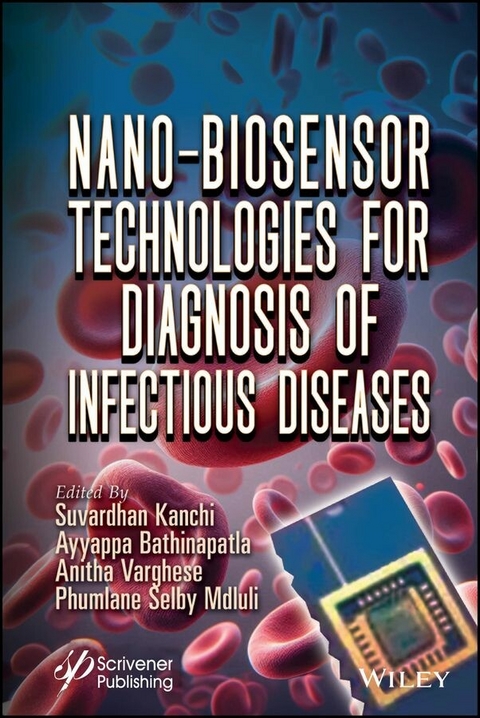
Nano-Biosensor Technologies for Diagnosis of Infectious Diseases (eBook)
735 Seiten
Wiley-Scrivener (Verlag)
978-1-394-28767-3 (ISBN)
The book offers a thorough exploration of revolutionary nano-biosensor technologies that enables rapid, accurate detection of infectious diseases, critical for effective disease management in today's world.
Nano-Biosensor Technologies for Diagnosis of Infectious Diseases delves into the cutting-edge developments in nano-biosensor technology, a transformative innovation for the field of medical diagnostics. Nano-biosensors integrate nanomaterials like nanoparticles, nanowires, and nanotubes with biological recognition elements such as antibodies, nucleic acids, or enzymes to create highly sensitive and specific detection systems. These sensors exploit unique properties of nanomaterials to detect minute quantities of pathogens or biomarkers with remarkable accuracy, enabling early diagnosis and monitoring of infectious diseases. The integration of electrochemical, optical, and piezoelectric detection mechanisms further enhances the versatility and efficiency of these nano-biosensors, allowing for rapid, real-time analysis that is crucial for effective disease management.
In the context of infectious diseases, nano-biosensors become particularly significant, as they can facilitate point-of-care testing (POCT), offering rapid and portable diagnostic solutions. This capability is invaluable in resource-limited settings and during outbreaks where traditional laboratory infrastructure may be lacking. The COVID-19 pandemic underscores the importance of swift and accurate diagnostic tools, spurring accelerated innovation and commercialization efforts in this domain. Nano-biosensors are now being developed and deployed to detect a wide range of pathogens with high sensitivity, providing a powerful tool in the global fight against infectious diseases. Nano-Biosensor Technologies for Diagnosis of Infectious Diseases provides a comprehensive overview of these technological advancements, exploring their applications, challenges, and future directions in the diagnosis and management of infectious diseases.
Audience
Biomedical engineers, material chemists, researchers, students, policymakers, and healthcare professionals interested in integrating nanomaterials in infectious disease care
Suvardhan Kanchi, PhD, is an associate professor in the Department of Chemistry at Christ University, India, with over ten years of experience in teaching and research and development. He has published eight patents and over 150 papers in national and international journals and has participated in several international conferences. His research interests include smart materials, nanodiagnostics, nanoelectrochemistry, and green nanotechnology.
Ayyappa Bathinapatla, PhD, is an assistant professor in the Department of Chemistry at CMR Institute of Technology, Bangalore, India. He has published over 20 articles in national and international journals, two book chapters, and six patents in addition to attending and presenting at international conferences. His research interests include engineering chemistry, electrochemical biosensors, and nanomaterials for energy and environmental applications.
Anitha Varghese, PhD, is a professor and the Head of the Department of Chemistry, Christ University, Bangalore, India. She has published over 150 articles in national and international journals and seven patents, co-edited one book, and presented at over 40 international conferences. Her main research focus is on the development of electrochemical sensors, electrorganic synthesis, electrocatalytic oxidation reactions, electrochemical synthesis, and characterization of novel mono/bimetallic nanocluster electrocatalysts.
Phumlane Selby Mdluli, PhD, is a Head of the Health Platform at Mintek and a National Research Foundation C2-rated researcher with over 15 years of industry and teaching experience. He was trained at Diagnostic Consultation and Biodot in California to develop and commercialize in vitro diagnostic devices. He has published 70 publications in peer-reviewed journals and book chapters. At Mintek, his role involves the development of rapid diagnostic assays and supervising postgraduate students in nanoscience and nanotechnology.
The book offers a thorough exploration of revolutionary nano-biosensor technologies that enables rapid, accurate detection of infectious diseases, critical for effective disease management in today s world. Nano-Biosensor Technologies for Diagnosis of Infectious Diseases delves into the cutting-edge developments in nano-biosensor technology, a transformative innovation for the field of medical diagnostics. Nano-biosensors integrate nanomaterials like nanoparticles, nanowires, and nanotubes with biological recognition elements such as antibodies, nucleic acids, or enzymes to create highly sensitive and specific detection systems. These sensors exploit unique properties of nanomaterials to detect minute quantities of pathogens or biomarkers with remarkable accuracy, enabling early diagnosis and monitoring of infectious diseases. The integration of electrochemical, optical, and piezoelectric detection mechanisms further enhances the versatility and efficiency of these nano-biosensors, allowing for rapid, real-time analysis that is crucial for effective disease management. In the context of infectious diseases, nano-biosensors become particularly significant, as they can facilitate point-of-care testing (POCT), offering rapid and portable diagnostic solutions. This capability is invaluable in resource-limited settings and during outbreaks where traditional laboratory infrastructure may be lacking. The COVID-19 pandemic underscores the importance of swift and accurate diagnostic tools, spurring accelerated innovation and commercialization efforts in this domain. Nano-biosensors are now being developed and deployed to detect a wide range of pathogens with high sensitivity, providing a powerful tool in the global fight against infectious diseases. Nano-Biosensor Technologies for Diagnosis of Infectious Diseases provides a comprehensive overview of these technological advancements, exploring their applications, challenges, and future directions in the diagnosis and management of infectious diseases. Audience Biomedical engineers, material chemists, researchers, students, policymakers, and healthcare professionals interested in integrating nanomaterials in infectious disease care
| Erscheint lt. Verlag | 7.5.2025 |
|---|---|
| Sprache | englisch |
| Themenwelt | Medizin / Pharmazie ► Medizinische Fachgebiete |
| Technik | |
| Schlagworte | Bacterial Infections • Bionanomaterials • copper nanoparticles • Electrochemical Sensors • Electrosurface Modification • enzymes • Fungal Infections • Infectious Diseases • Metal Nanoparticles • Metal Oxide Nanoparticles • Microbial infections • nanotechnology • SARS-Covid-19 • X-ray diffraction • zika virus |
| ISBN-10 | 1-394-28767-4 / 1394287674 |
| ISBN-13 | 978-1-394-28767-3 / 9781394287673 |
| Informationen gemäß Produktsicherheitsverordnung (GPSR) | |
| Haben Sie eine Frage zum Produkt? |
 EPUB (Adobe DRM)
Kopierschutz: Adobe-DRM
Adobe-DRM ist ein Kopierschutz, der das eBook vor Mißbrauch schützen soll. Dabei wird das eBook bereits beim Download auf Ihre persönliche Adobe-ID autorisiert. Lesen können Sie das eBook dann nur auf den Geräten, welche ebenfalls auf Ihre Adobe-ID registriert sind.
Details zum Adobe-DRM
Dateiformat: EPUB (Electronic Publication)
EPUB ist ein offener Standard für eBooks und eignet sich besonders zur Darstellung von Belletristik und Sachbüchern. Der Fließtext wird dynamisch an die Display- und Schriftgröße angepasst. Auch für mobile Lesegeräte ist EPUB daher gut geeignet.
Systemvoraussetzungen:
PC/Mac: Mit einem PC oder Mac können Sie dieses eBook lesen. Sie benötigen eine
eReader: Dieses eBook kann mit (fast) allen eBook-Readern gelesen werden. Mit dem amazon-Kindle ist es aber nicht kompatibel.
Smartphone/Tablet: Egal ob Apple oder Android, dieses eBook können Sie lesen. Sie benötigen eine
Geräteliste und zusätzliche Hinweise
Buying eBooks from abroad
For tax law reasons we can sell eBooks just within Germany and Switzerland. Regrettably we cannot fulfill eBook-orders from other countries.
aus dem Bereich