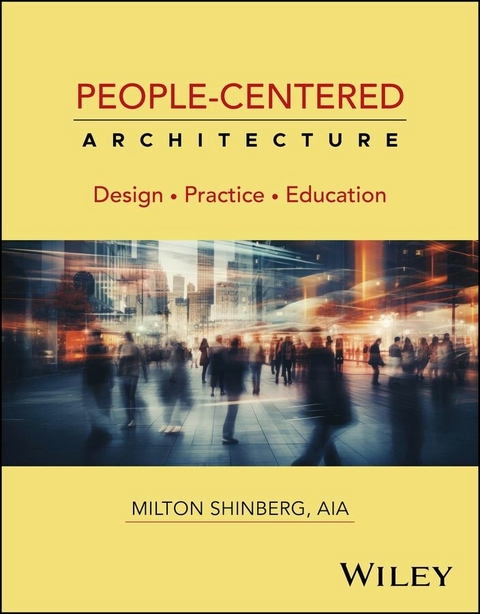
People-Centered Architecture (eBook)
307 Seiten
Wiley (Verlag)
978-1-394-26594-7 (ISBN)
Shinberg has done something truly impressive: He has created a practical framework for architectural thinking and design, grounded in the latest research on human perception and cognition. His ideas and insights offer a fresh perspective that have helped me clarify many aspects of my own approach to design.
-Stefan Behling, Architect, Senior Executive Partner, Head of Studio, Foster+Partners, London
This book is a must-read for architects and designers at any stage of their career. His inspiring and practical narrative makes even the most complex concepts accessible. Along the way, he offers aspiring and experienced professionals a fresh perspective to reignite their passion for architecture.
-Andrea de Paiva, Architect, Urban Planner, and Author, Director of NeuroAU at the University of Brasilia
Milton Shinberg is at the vanguard of architects convinced that the design of buildings for people to flourish should incorporate a deep understanding of human psychology and neuroscience. A very clearly written book, rich with reflections from the science of human emotions, embodiment, and aesthetics, People-Centered Architecture will greatly enhance architectural thinking, education, and practice.
-Anjan Chatterjee, MD, FAAN, Professor of Neurology, Psychology, and Architecture, University of Pennsylvania
A veteran architect's pragmatic guide to re-energizing design thinking, architectural practice and architectural education, with pivotal insights from the human sciences and wisdom harvested from non-architects.
People-Centered Architecture: Design Practice Education is a unique and probing exploration designed to help architects better serve everyone who uses what architects design. In this one-of-a-kind book, architect and educator Milton Shinberg presents game-changing approaches to enhance, reorient, and re-energize design thinking.
Shinberg draws from decades of dialogue with architects, designers, clients, artists, scientists, teachers, and his own students. His prompts and provocations, written in a clear and accessible narrative style, are organized to help architects, who are humanists, come to know much more about humans. Wise design becomes easier.
In one concise volume, People-Centered Architecture: Design Practice Education delivers a vibrant framework for architectural practice, for students and teachers of architecture, and for clients and stakeholders. Through this book, each will see their project partners more clearly, more empathetically, and in ways that foster richer, better brainstorming and more productive collaboration. The 'coalition of the curious,' people intrigued by architecture and architects, will get a peak behind the curtain.
Milton Shinberg, AIA, is principal emeritus of Shinberg Levinas Architects, an internationally recognized practice honored by many design awards and published firm profiles. He is also a long-time adjunct professor in architecture at Catholic University of America, teaching design, drawing, and theory courses, among them his Beauty & Brains seminar, one of the prompts for this book. He lectures and teaches extensively on its topics at regional and national AIA conferences and for programs in Italy, Germany, and Brazil. Shinberg is on the advisory boards of the Academy of Neuroscience for Architecture and the International Arts+Mnd Lab of Johns Hopkins University.
Shinberg has done something truly impressive: He has created a practical framework for architectural thinking and design, grounded in the latest research on human perception and cognition. His ideas and insights offer a fresh perspective that have helped me clarify many aspects of my own approach to design. Stefan Behling, Architect, Senior Executive Partner, Head of Studio, Foster+Partners, London This book is a must-read for architects and designers at any stage of their career. His inspiring and practical narrative makes even the most complex concepts accessible. Along the way, he offers aspiring and experienced professionals a fresh perspective to reignite their passion for architecture. Andrea de Paiva, Architect, Urban Planner, and Author, Director of NeuroAU at the University of Brasilia Milton Shinberg is at the vanguard of architects convinced that the design of buildings for people to flourish should incorporate a deep understanding of human psychology and neuroscience. A very clearly written book, rich with reflections from the science of human emotions, embodiment, and aesthetics, People-Centered Architecture will greatly enhance architectural thinking, education, and practice. Anjan Chatterjee, MD, FAAN, Professor of Neurology, Psychology, and Architecture, University of Pennsylvania A veteran architect s pragmatic guide to re-energizing design thinking, architectural practice and architectural education, with pivotal insights from the human sciences and wisdom harvested from non-architects. People-Centered Architecture: Design Practice Education is a unique and probing exploration designed to help architects better serve everyone who uses what architects design. In this one-of-a-kind book, architect and educator Milton Shinberg presents game-changing approaches to enhance, reorient, and re-energize design thinking. Shinberg draws from decades of dialogue with architects, designers, clients, artists, scientists, teachers, and his own students. His prompts and provocations, written in a clear and accessible narrative style, are organized to help architects, who are humanists, come to know much more about humans. Wise design becomes easier. In one concise volume, People-Centered Architecture: Design Practice Education delivers a vibrant framework for architectural practice, for students and teachers of architecture, and for clients and stakeholders. Through this book, each will see their project partners more clearly, more empathetically, and in ways that foster richer, better brainstorming and more productive collaboration. The coalition of the curious, people intrigued by architecture and architects, will get a peak behind the curtain.
| Erscheint lt. Verlag | 7.5.2025 |
|---|---|
| Sprache | englisch |
| Themenwelt | Technik ► Architektur |
| Schlagworte | architecture cognitive sciences • Architecture education • architecture human wellbeing • humanism architecture • human science architecture • neuroaesthetics architecture • neuroscience architecture • people-centered architecture • psychology architecture |
| ISBN-10 | 1-394-26594-8 / 1394265948 |
| ISBN-13 | 978-1-394-26594-7 / 9781394265947 |
| Informationen gemäß Produktsicherheitsverordnung (GPSR) | |
| Haben Sie eine Frage zum Produkt? |
 PDF (Adobe DRM)
Kopierschutz: Adobe-DRM
Adobe-DRM ist ein Kopierschutz, der das eBook vor Mißbrauch schützen soll. Dabei wird das eBook bereits beim Download auf Ihre persönliche Adobe-ID autorisiert. Lesen können Sie das eBook dann nur auf den Geräten, welche ebenfalls auf Ihre Adobe-ID registriert sind.
Details zum Adobe-DRM
Dateiformat: PDF (Portable Document Format)
Mit einem festen Seitenlayout eignet sich die PDF besonders für Fachbücher mit Spalten, Tabellen und Abbildungen. Eine PDF kann auf fast allen Geräten angezeigt werden, ist aber für kleine Displays (Smartphone, eReader) nur eingeschränkt geeignet.
Systemvoraussetzungen:
PC/Mac: Mit einem PC oder Mac können Sie dieses eBook lesen. Sie benötigen eine
eReader: Dieses eBook kann mit (fast) allen eBook-Readern gelesen werden. Mit dem amazon-Kindle ist es aber nicht kompatibel.
Smartphone/Tablet: Egal ob Apple oder Android, dieses eBook können Sie lesen. Sie benötigen eine
Geräteliste und zusätzliche Hinweise
Buying eBooks from abroad
For tax law reasons we can sell eBooks just within Germany and Switzerland. Regrettably we cannot fulfill eBook-orders from other countries.
aus dem Bereich