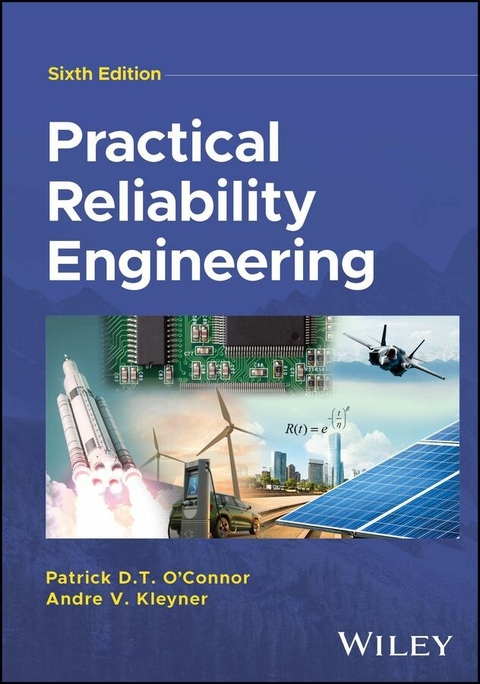
Practical Reliability Engineering (eBook)
Wiley (Verlag)
978-1-394-19998-3 (ISBN)
A key reference for reliability professionals worldwide and widely adopted as a textbook by universities across many countries. This material also aligns with the Certified Reliability Engineer (CRE) curriculum set by the American Society for Quality (ASQ), making it a valuable resource for those preparing for the CRE certification.
With a strong focus on practical engineering applications, the Sixth Edition of Practical Reliability Engineering continues to offer a balanced blend of reliability theory and real-world applications. This edition has been comprehensively updated to reflect the latest advancements in industry practices and state-of-the-art reliability engineering. Each chapter includes practical examples, and course instructors have access to a Solutions Manual and PowerPoint slides for training support available from the author at kleyner.consulting@sbcglobal.net.
The sixth edition introduces several significant updates. Every chapter has been refreshed with new material, and two new chapters - Repairable Systems and Human Reliability - have been added. This edition also covers emerging topics in reliability engineering, such as prognostics and health management (PHM), Agile hardware development, the reliability challenges posed by the ongoing miniaturization of integrated circuits, and many more, ensuring that the content remains relevant to modern technological developments.
Written by two highly qualified reliability professionals, each with decades of experience, this book covers nearly every aspect of reliability science and practice, making it a comprehensive reference guide. Practical Reliability Engineering has, over the years, helped to train multiple generations of reliability engineers and continues to be an essential resource for both emerging professionals and seasoned experts alike.
Patrick D.T. O'Connor received his engineering training at the Royal Air Force (RAF) Technical College and served for 16 years in the RAF Engineer Branch. Following a broad career that included posts as a visiting lecturer at the Universities of Lancaster, Leeds, and Cranfield (UK), he is now retired.
Andre V. Kleyner, PhD has over 30 years of engineering, research, consulting, and managerial experience specializing in the reliability of engineering systems designed to operate in severe environments. He spent his career in the automotive, defense, and medical devices industries and was a part-time lecturer at Purdue University. Andre Kleyner is also the editor of the Wiley Series in Quality and Reliability Engineering.
1
Introduction to Reliability Engineering
1.1 What is Reliability Engineering?
No one disputes the need for engineered products to be reliable. The average consumer is acutely aware of the problem of less‐than‐perfect reliability in domestic products such as TV sets, computers, and automobiles. Most products and industries are affected by the costs of unreliability. Manufacturers often suffer high costs of failure under warranty. Arguments and misunderstandings begin when we try to quantify reliability values or try to assign financial or other cost or benefit values to levels of reliability.
The customer, having accepted the product, accepts that it might fail at some future time. This simple approach is often coupled with a warranty, or the customer may have some protection in law, so that he may claim redress for failures occurring within a stated or reasonable time. However, this approach provides no measure of quality or reliability over a period of time, particularly outside a warranty period. Even within a warranty period, the customer usually has no grounds for further action if the product fails once, twice, or several times, provided that the manufacturer repairs or replaces the product as promised each time. If it fails often, the manufacturer will suffer high warranty costs, and the customers will suffer inconvenience. Outside the warranty period, only the customer suffers. In any case, the manufacturer will also probably incur a loss of reputation, possibly affecting future business.
Whether failures occur or not, and their times to occurrence, can seldom be forecast accurately. Reliability is therefore an aspect of engineering uncertainty. Whether an item will work for a particular period is a question that can be answered as a probability.
The most commonly used definition of reliability is: Reliability is the probability that an item will perform its intended function without failure in specified operating conditions (or environments) for a specified period of time or usage. The terms in this definition, such as probability, intended function, failure, specified operating conditions, and specified period of time, are all very important and carry a special meaning, which will be addressed and discussed in this book.
This definition also contains several key elements of making a reliable product. It is important to understand that reliability science is a fusion of multiple engineering subjects, including key disciplines, such as reliability statistics and physics of failure (PoF), sometimes referred to as reliability mathematics and reliability physics.
Reliability physics (this term will be used interchangeably with the term “physics of failure”) addresses the definitions of failure and of the stated conditions. It studies failure modes and failure mechanisms, which a product might experience under certain conditions, i.e., stress environments. For example, the failures caused by vibration are often attributed to fatigue, the failures experienced in high humidity environments are often caused by corrosion, mechanical shock often causes fracture, and so on. Understanding the physics of failure is critical to identifying, understanding, and correcting product failures to improve the reliability and the overall product design.
Since reliability is expressed as a probability, mathematical and statistical methods are also important for modeling reliability (for prediction, measurement, assessment, etc.) and for analyzing reliability data. Statistical methods are used to define reliability as a function of time, R = f(t) or a function of the appropriate usage equivalent of time, such as distance driven, number of ignition cycles, temperature cycles, mechanical shocks, ON/OFF cycles, and other product usage measures. Obtaining the reliability function, even with a degree of uncertainty, would allow an engineering professional to make an assessment of the expected reliability at the end of the product's mission life or at any time in between. This would allow us to make an assessment if the product is meeting (or not) its engineering requirements. Mathematical and statistical methods are covered in Chapters 2–6 of this book. A reliability professional needs to be knowledgeable in both key areas of reliability engineering—physics and mathematics.
Durability is a particular aspect of reliability, related to the ability of an item to withstand the effects of time or usage on failure mechanisms such as fatigue, wear, creep, and corrosion. Durability is usually expressed as a minimum time before the occurrence of wear‐out failures. In repairable systems, it often characterizes the ability of the product to function while maintained.
The objectives of reliability engineering, in the order of priority, are:
- To apply engineering knowledge and specialist techniques to prevent or reduce the likelihood or frequency of failures.
- To identify and correct the causes of failures that do occur, despite the efforts to prevent them.
- To determine ways of coping with failures that do occur, if their causes have not been corrected.
- To apply methods for estimating the likely reliability of new designs and for analyzing reliability data.
The reason for the priority emphasis is that it is by far the most effective way of working, in terms of minimizing costs and generating reliable products. The primary skills that are required, therefore, are the ability to understand and anticipate the possible causes of failures, and knowledge of how to prevent them. It is also necessary to have knowledge of the methods that can be used for analyzing designs and data. The primary skills are nothing more than good engineering knowledge and experience, so reliability engineering is first and foremost the application of good engineering, in the widest sense, during design, development, manufacture, and service.
Overriding all of these aspects, though, is the management of the reliability engineering effort. Since reliability (and very often safety) is such a critical parameter of most modern engineering products, and since failures are directly or indirectly generated by the people involved (designers, test engineers, manufacturing, suppliers, maintainers, users), it can be maximized only by an integrated effort that encompasses training, teamwork, discipline, and application of the most appropriate methods. Reliability engineering specialists cannot make this happen alone. They can provide support, training, and tools, but only managers can organize, motivate, lead, and provide the resources. Reliability engineering is a team effort and, ultimately, effective management of engineering.
1.2 Why Teach Reliability Engineering?
Engineering education is traditionally concerned with teaching how engineering products work. However, the ways in which products fail, the effects of failure, and aspects of design, manufacture, maintenance, and use that affect the likelihood of failure are not usually paid as much attention in engineering schools. The engineer's tasks are to design, make, and maintain the product so that the failed state is deferred. In these tasks, an engineer faces the problems of variability of engineering materials, processes, and applications. Variability and chance play an important role in determining the reliability of most products. Basic parameters like mass, dimensions, friction coefficients, strengths, and stresses are never absolute but are in practice subject to variability due to process and material variations, human factors, and applications. Some parameters may also vary with time. Understanding the laws of chance and the causes and effects of variability is, therefore, necessary for the creation of reliable products and for the solution of problems of unreliability.
Competition, the pressure of schedules and deadlines, the cost of failures, the rapid evolution of new materials, methods and complex systems, the need to reduce product costs, and safety considerations all increase the risks of product development. Figure 1.1 shows the pressures that lead to the overall perception of risk. However, in today's world reliability is almost taken for granted, i.e., a consumer expects the product to be reliable, whether an automobile, mobile phone, appliance, or any other device, although it takes effort and a lot of work behind the scenes to achieve the expected level of product reliability.
Figure 1.1 Perception of risk.
Later chapters will show how reliability engineering methods can be applied to design, development, manufacturing, and maintenance to control the level of risk. The extent to which the methods are applicable must be decided for each project and each design area. They should be used to supplement good engineering practice. However, there are times when new risks are being taken, and the normal rules and guidelines are inadequate or do not apply. Sometimes we take risks unwittingly when we assume that we can extrapolate safely from our present knowledge. Designers and managers are often over‐optimistic or are reluctant to point out risks about which they are unsure.
It is for these reasons that an understanding of reliability engineering principles and methods is now an essential ingredient of modern engineering. Despite its obvious importance, quality and reliability education, for some reason, is insufficient in today's engineering curricula. Few engineering schools offer degree programs or even an adequate number of courses in...
| Erscheint lt. Verlag | 6.5.2025 |
|---|---|
| Sprache | englisch |
| Themenwelt | Technik ► Elektrotechnik / Energietechnik |
| Wirtschaft ► Betriebswirtschaft / Management | |
| Schlagworte | accelerated testing • Acceleration Models • Asset Management • Availability • bathtub curve • Certified Reliability Engineer (CRE) • control charts • design of experiment • Engineering statistics • FMEA • Halt • Human reliability • life data analysis • load-strength interference • Maintenance • Monte Carlo simulation • reliability block diagrams • reliability demonstration • reliability growth • Reliability prediction • Repairable Systems • Sample Size • Statistical Process Control • system reliability |
| ISBN-10 | 1-394-19998-8 / 1394199988 |
| ISBN-13 | 978-1-394-19998-3 / 9781394199983 |
| Informationen gemäß Produktsicherheitsverordnung (GPSR) | |
| Haben Sie eine Frage zum Produkt? |
 EPUB (Adobe DRM)
Kopierschutz: Adobe-DRM
Adobe-DRM ist ein Kopierschutz, der das eBook vor Mißbrauch schützen soll. Dabei wird das eBook bereits beim Download auf Ihre persönliche Adobe-ID autorisiert. Lesen können Sie das eBook dann nur auf den Geräten, welche ebenfalls auf Ihre Adobe-ID registriert sind.
Details zum Adobe-DRM
Dateiformat: EPUB (Electronic Publication)
EPUB ist ein offener Standard für eBooks und eignet sich besonders zur Darstellung von Belletristik und Sachbüchern. Der Fließtext wird dynamisch an die Display- und Schriftgröße angepasst. Auch für mobile Lesegeräte ist EPUB daher gut geeignet.
Systemvoraussetzungen:
PC/Mac: Mit einem PC oder Mac können Sie dieses eBook lesen. Sie benötigen eine
eReader: Dieses eBook kann mit (fast) allen eBook-Readern gelesen werden. Mit dem amazon-Kindle ist es aber nicht kompatibel.
Smartphone/Tablet: Egal ob Apple oder Android, dieses eBook können Sie lesen. Sie benötigen eine
Geräteliste und zusätzliche Hinweise
Buying eBooks from abroad
For tax law reasons we can sell eBooks just within Germany and Switzerland. Regrettably we cannot fulfill eBook-orders from other countries.
aus dem Bereich