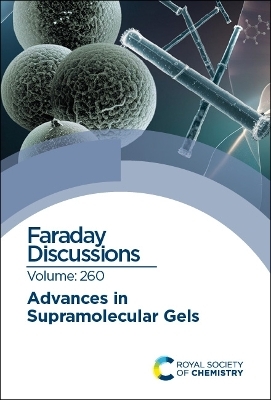
Advances in Supramolecular Gels
Royal Society of Chemistry (Verlag)
978-1-83707-066-4 (ISBN)
- Titel nicht im Sortiment
- Artikel merken
Our ability to make soft materials based on the fundamental principles of self-assembly has led to a rich and varied global interdisciplinary community, particularly in the area of functional supramolecular gels. These gels are formed by the self-assembly of small molecules into one dimensional structures that entangle to form a network. Their applications are broad; gels have been shown to be of value in the life sciences in 3D cell culture, with a number of recent spin-out companies focused in this area but also have promise as new optoelectronic materials. The inherent interdisciplinarity of the field provides opportunities for chemists, physicists, biologists and engineers to work together, but also raises a number of challenges. Exciting new developments are opening up in transient and dynamic gels, and in the techniques used to study these systems – in particular contrast-matched small-angle scattering, cryo-TEM, and super-resolution microscopy. The four themes of this meeting bring together different research communities and particular emphasis is placed upon the transfer of learning between the different themes.
Faraday Discussions documents a long-established series of Faraday Discussion meetings which provide a unique international forum for the exchange of views and newly acquired results in developing areas of physical chemistry, biophysical chemistry and chemical physics. The papers presented are published in the Faraday Discussion volume together with a record of the discussion contributions made at the meeting. Faraday Discussions therefore provide an important record of current international knowledge and views in the field concerned. The latest (2022) impact factor of Faraday Discussions is 3.4.
Design of gelling systems
Design of gelling systems is currently mainly a result of trial-and-error iteration around known structures or fortuitous discovery. We will bring together computational and experimentalists to discuss approaches to solving this. This session will explore and contrast effective approaches to gelator design (both experimental and computational), discuss how these approaches can be used to design the material properties of the resulting gels and what data are needed to inform these approaches.
Characterising supramolecular gels
Characterising supramolecular gels requires understanding across multiple length scales with all techniques used having advantages and disadvantages. To move forward, we need to be able to effectively combine multiple techniques. Recent innovations such as the use of superresolution microscopy have real potential but are not yet routinely applied to gels and there are real opportunities using more detailed cryo-TEM experiments. This session will bring together those inside and outside the community to spark ideas and drive new concepts.
Multicomponent systems
Multicomponent systems are a major potential step forward – here, we refer to combining gelling systems or mixing a gelling system with an additive. Both cases add significant complexity in terms of understanding but many opportunities that are not available with single component gels. The key discussion points in this session will be designing multicomponent systems, understanding and characterising all of the possibilities, and developing a language to describe these systems.
Using supramolecular gels
Designing gels for applications is difficult as it requires control of properties over many length scales as well as understanding of processing kinetically trapped materials. This session will also include aspects such as gels that change with time and how these can be used as well as 3D printing of gels. The key discussion points will be understanding how to control properties so that the gels can used for specific applications, with a focus on how to link measured properties to specific applications. Here, we aim to bring together users of gels for applications such as drug delivery, tissue culturing, optoelectronics etc. with those who are more focussed on preparing and characterising materials.
| Erscheinungsdatum | 07.10.2025 |
|---|---|
| Reihe/Serie | Faraday Discussions ; Volume 260 |
| Mitarbeit |
Sonstige Mitarbeit: Royal Society of Chemistry |
| Verlagsort | Cambridge |
| Sprache | englisch |
| Maße | 156 x 234 mm |
| Gewicht | 860 g |
| Themenwelt | Naturwissenschaften ► Chemie ► Organische Chemie |
| Naturwissenschaften ► Physik / Astronomie ► Festkörperphysik | |
| Technik ► Maschinenbau | |
| ISBN-10 | 1-83707-066-0 / 1837070660 |
| ISBN-13 | 978-1-83707-066-4 / 9781837070664 |
| Zustand | Neuware |
| Informationen gemäß Produktsicherheitsverordnung (GPSR) | |
| Haben Sie eine Frage zum Produkt? |
aus dem Bereich