


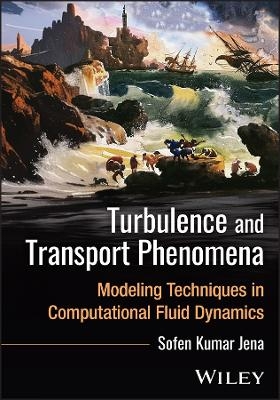
Turbulence and Transport Phenomena
Modeling Techniques in Computational Fluid Dynamics
Seiten
2026
John Wiley & Sons Inc (Verlag)
9781394361236 (ISBN)
John Wiley & Sons Inc (Verlag)
9781394361236 (ISBN)
- Noch nicht erschienen (ca. März 2026)
- Versandkostenfrei
- Auch auf Rechnung
- Artikel merken
Accessible guide to turbulence modelling theory and practical application with coverage of the most common turbulence models currently in use
Turbulence and Transport Phenomena provides an introductory understanding of turbulence theory, then connects it to the appropriate applications in turbulence modelling approaches. This book consolidates all necessary mathematical prerequisites, offers detailed derivations of governing equations using Einstein tensor notation, and explains both differential and integral forms in a cohesive and pedagogical manner. Concepts are broken down progressively, in an approachable style.
The book addresses current and emerging research trends in Reynolds-averaged Navier-Stokes modelling, large Eddy Simulation (LES), and compressible turbulence modelling, and includes practical, step-by-step guidance for implementing turbulence models in commercial CFD solvers. Each chapter concludes with a "Closure" section that summarizes key takeaways to foster clarity for readers. Sample code and data files are available for download on a companion site so readers can practice the modelling techniques discussed.
Turbulence and Transport Phenomena includes information on:
Essential principles of fluid kinematics, the meticulous derivation of the Navier-Stokes equations, and energy and species transport formulations
Boundary and initial conditions in fluid flow problems, boundary layer flows, and heat transfer
Vorticity dynamics, challenges of modelling compressible turbulent flows, and the origin and dynamics of turbulent transport
Coherent structures in turbulence including low- and high-speed streaks, wake structures, and wall-bounded coherent structures
Curvature and corner flow correction in turbulent transport modelling
Turbulence and Transport Phenomena is designed to be accessible to beginners while retaining the depth and rigor needed for advanced learners and practitioners who need a complete understanding of turbulence modelling for their work on aerospace, automotive, or energy system projects.
Turbulence and Transport Phenomena provides an introductory understanding of turbulence theory, then connects it to the appropriate applications in turbulence modelling approaches. This book consolidates all necessary mathematical prerequisites, offers detailed derivations of governing equations using Einstein tensor notation, and explains both differential and integral forms in a cohesive and pedagogical manner. Concepts are broken down progressively, in an approachable style.
The book addresses current and emerging research trends in Reynolds-averaged Navier-Stokes modelling, large Eddy Simulation (LES), and compressible turbulence modelling, and includes practical, step-by-step guidance for implementing turbulence models in commercial CFD solvers. Each chapter concludes with a "Closure" section that summarizes key takeaways to foster clarity for readers. Sample code and data files are available for download on a companion site so readers can practice the modelling techniques discussed.
Turbulence and Transport Phenomena includes information on:
Essential principles of fluid kinematics, the meticulous derivation of the Navier-Stokes equations, and energy and species transport formulations
Boundary and initial conditions in fluid flow problems, boundary layer flows, and heat transfer
Vorticity dynamics, challenges of modelling compressible turbulent flows, and the origin and dynamics of turbulent transport
Coherent structures in turbulence including low- and high-speed streaks, wake structures, and wall-bounded coherent structures
Curvature and corner flow correction in turbulent transport modelling
Turbulence and Transport Phenomena is designed to be accessible to beginners while retaining the depth and rigor needed for advanced learners and practitioners who need a complete understanding of turbulence modelling for their work on aerospace, automotive, or energy system projects.
Sofen Kumar Jena, Ph.D., is a Hydrogen Specialist at Bosch Transmission Technology BV in the Netherlands, where he works at the forefront of cutting-edge research into the future of sustainable energy and advanced fluid mechanics. Prior to industry, he worked in academia as a researcher and Assistant Professor, most recently within the Turbulence Research Lab in the Department of Mathematics at the University of Pau, France.
| Erscheint lt. Verlag | 3.3.2026 |
|---|---|
| Verlagsort | New York |
| Sprache | englisch |
| Themenwelt | Naturwissenschaften ► Physik / Astronomie ► Strömungsmechanik |
| Technik ► Maschinenbau | |
| ISBN-13 | 9781394361236 / 9781394361236 |
| Zustand | Neuware |
| Informationen gemäß Produktsicherheitsverordnung (GPSR) | |
| Haben Sie eine Frage zum Produkt? |
Mehr entdecken
aus dem Bereich



aus dem Bereich
Buch | Hardcover (2022)
Springer Vieweg (Verlag)
CHF 759,95


