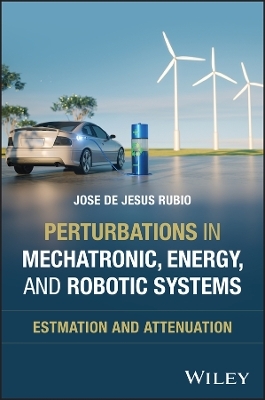
Perturbations in Mechatronic, Energy, and Robotic Systems
John Wiley & Sons Inc (Verlag)
978-1-394-38063-3 (ISBN)
- Noch nicht erschienen (ca. Mai 2026)
- Versandkostenfrei
- Auch auf Rechnung
- Artikel merken
Contents
1 Geometric approach and structure at infinity controls for the perturbation attenuation
1.1 Introduction
1.2 Notation
1.3 Perturbation attenuation problem
1.4 Perturbation attenuation via geometric approach control
1.5 Perturbation attenuation via structure at infinity control
1.6 Mechanical system
1.6.1 The states space system
1.6.2 Perturbation attenuation via the structure at infinity control
1.6.3 Perturbation attenuation via the geometric approach control
1.6.4 Simulation
1.7 Thermal system
1.7.1 Perturbation attenuation via the structure at in…nity control
1.7.2 Perturbation attenuation via the geometric approach control
1.7.3 Simulation
1.8 Concluding remarks
2 Structure control for the perturbation attenuation in two electromechanical processes
2.1 Introduction
2.2 Structure at infinity method for the perturbation attenuation
2.3 Structure control for the perturbation attenuation
2.3.1 Controller design
2.3.2 Stability analysis
2.3.3 Convergence analysis
2.4 Perturbation attenuation in a three phase electric circuit
2.4.1 Structure at in…nity control design
2.4.2 Structure control design
2.4.3 Results
2.5 Perturbation attenuation in a plotter
2.5.1 Structure at in…nity control design
2.5.2 Structure control design
2.5.3 Results
2.6 Concluding remarks
3 Hybrid controller with observer for the estimation and attenuation of per-turbations
3.1 Introduction
3.2 The perturbed system
3.3 Hybrid observer
3.3.1 Observer design
3.3.2 Stability analysis
3.3.3 Estimation of the perturbations
3.4 Hybrid controller with observer
3.4.1 Controller design
3.4.2 Stability analysis
3.5 Plotter system
3.6 Suspension system
3.7 Concluding remarks
4 Sliding mode regulator for the perturbations attenuation in two tank plants
4.1 Introduction
4.2 The perturbed plant
4.3 The sliding mode regulator
4.3.1 The regulator development
4.3.2 The stability analysis
4.4 The thermal plan
4.5 The hydraulic plant
4.6 Concluding remarks
5 Uniform stable observer for the perturbation estimation in two renewable energy systems
5.1 Introduction
5.2 Observer for the systems without perturbations
5.2.1 Observer design
5.2.2 Stability analysis of the observer
5.3 Observer for the systems with perturbations
5.3.1 Observer design
5.3.2 Stability analysis of the observer
5.3.3 Convergence analysis of the observer
5.3.4 Estimation of the perturbations
5.4 Wind turbine
5.4.1 Results
5.5 Electric vehicle
5.5.1 Results
5.6 Concluding remarks
6 The perturbation estimation in two gas plants
6.1 Introduction
6.2 The estimator for the variable and perturbation estimation
6.2.1 The variable estimator
6.2.2 The convergence analysis of the variable estimator
6.2.3 The perturbations estimator
6.3 The gas turbine plant
6.3.1 Results
6.4 The gasi…cation plant
6.4.1 Results
6.5 Concluding remarks
7 Stabilization of two electricity generators with dead-zone
7.1 Introduction
7.2 Mathematical model and regulators for the electricity generators with dead-zone
7.3 Sliding mode regulator with sine mapping
7.4 Simulations
7.4.1 Electricity generators with dead-zone with two static magnets and two dynamic magnets
7.4.2 Electricity generators with dead-zone with four static magnets and four dynamic magnets
7.5 Concluding remarks
8 A control to attenuate the perturbations and to stabilize the rotatory in-verted pendulum
8.1 Introduction
8.2 Rotary inverted pendulum
8.3 The problem of stabilization for the pole placement method
8.4 The problem of perturbation attenuation
8.5 Stable control which attenuate the perturbations for the rotatory inverted pendulum
8.5.1 Stability analysis of the system
8.5.2 Controllability of the system
8.5.3 Control design
8.6 Simulation
8.7 Concluding remarks
9 Proportional derivative control with inverse dead-zone for pendulum systems
9.1 Introduction
9.2 Dynamic model of the robotic arms with dead-zone input
9.3 Dynamic model of the pendulum systems with dead-zone inputs
9.4 Proportional derivative control with inverse dead-zone
9.5 Simulations
9.5.1 Example 1
9.5.2 Example 2
9.6 Concluding remarks
10 Sliding mode control of robotic arms with dead-zone
10.1 Introduction
10.2 Dynamic model of robotic arms with dead-zone and gravity
10.3 Sliding mode control for the regulation of robotic arms with dead-zone and gravity
10.4 Results
10.4.1 Transelevator
10.4.2 Articulated robotic arm
10.5 Concluding remarks
| Erscheint lt. Verlag | 21.5.2026 |
|---|---|
| Verlagsort | New York |
| Sprache | englisch |
| Themenwelt | Technik ► Elektrotechnik / Energietechnik |
| ISBN-10 | 1-394-38063-1 / 1394380631 |
| ISBN-13 | 978-1-394-38063-3 / 9781394380633 |
| Zustand | Neuware |
| Informationen gemäß Produktsicherheitsverordnung (GPSR) | |
| Haben Sie eine Frage zum Produkt? |
aus dem Bereich