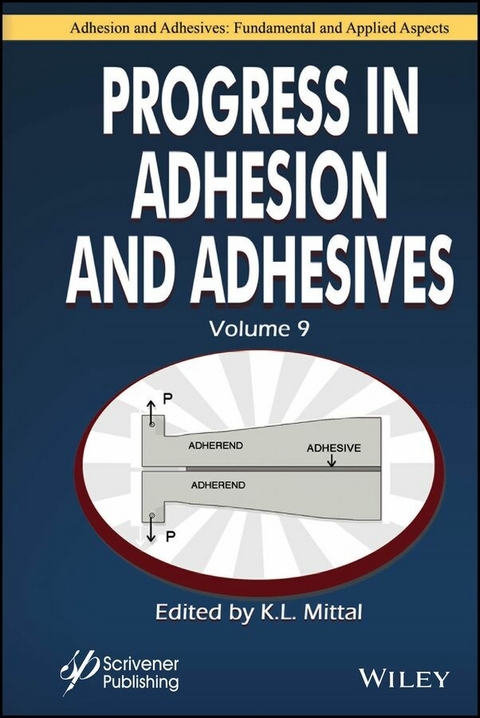
Progress in Adhesion and Adhesives, Volume 9 (eBook)
957 Seiten
Wiley-Scrivener (Verlag)
978-1-394-31506-2 (ISBN)
The current book contains 14 chapters that include the use of hydrophobic and icephobic coatings for aircraft icing mitigations; fundamental concepts and the application of hydrophobic coatings; plasma treatment of polymers to enhance their adhesion; atmospheric pressure plasma treatment of artificial leather; sustainable plasma technology as a surface treatment in footwear materials; failure cases in adhesive joints and coatings; initiating systems for curing anaerobic adhesives; use of fungal mycelia as an adhesive in composites; mechanically responsive hydrogels as adhesives for clinical applications; and adhesion of electrode coatings in lithium-ion batteries and supercapacitors.
Keep up-to-date with the latest on adhesion and adhesives from an expert group worldwide The present book constitutes Volume 9 in the book series Progress in Adhesion and Adhesives which was conceived as an annual publication and the premier volume made its debut in 2015. These volumes provide state-of-the-knowledge and curated reviews on many and varied topics about adhesion and adhesives. The current book contains 14 chapters that include the Usage of Hydrophobic and Icephobic Coatings for Aircraft Icing Mitigation; Hydrophobic Coatings: An Insight into Fundamental Concepts and Modern Applications; Enhancement of Adhesion of Polymers by Plasma Treatment; Hydrophobicity Modification of Artificial Leather by Atmospheric Pressure Plasma Treatment; Sustainable Plasma Technology as Surface Treatment on Footwear Materials: Bromination - The Only Selective Plasma Process; Structural Bonding to Low Surface Energy (LSE) Materials; Review on the Effects of a Defect and/or Joint Geometry on Stress Distribution in Tubular Joints Under Tensile Loads; Failure Cases in Adhesive Joints and Coatings; Initiating Systems for Curing Anaerobic Adhesives; Progress in Using Fungal Mycelia as Adhesive in Composites; Mechanically Responsive Hydrogels as Adhesives for Clinical Applications; Polyurea Adhesives and Coatings; Adhesion Strength of Electrode Coatings in Lithium-Ion Batteries and Supercapacitors. Audience This book will be valuable to adhesionists, adhesive technologists, polymer scientists, and materials scientists in adhesive bonding, plasma polymerization, adhesion in polymer composites, ice adhesion and mitigation, and adhesive joint testing.
1
On the Usage of Hydrophobic and Icephobic Coatings for Aircraft Icing Mitigation
Haiyang Hu1,2, Linchuan Tian1,3, Chukwudum Eluchie1, Harsha Sista1 and Hui Hu1*
1Department of Aerospace Engineering, Iowa State University, Ames, Iowa, USA
2Dept. of Mechanical & Aerospace Engineering, University of Alabama in Huntsville, AL, USA
3School of Aeronautics & Astronautics of Shanghai Jiao Tong University, Shanghai, China
Abstract
We report a comparative study to evaluate the effects of surface coatings with different hydrophobicities and icephobicities on the performance of a hybrid anti-/de-icing system that integrates surface heating with hydro-/ice-phobic coating for aircraft icing mitigation. While a flexible electric film heater wrapped around the leading edge of an airfoil/wing model was used to heat the airfoil frontal surface to prevent ice accretion near the airfoil leading edge, three different kinds of coatings were applied to coat the airfoil model at three distinct spanwise locations, which included an icephobic coating with an outstanding icephobicity but a weak hydrophobicity; a superhydrophobic surface (SHS) coating with outstanding water repellency but a moderate icephobicity; and a commonly used hydrophilic coating with poor hydrophobicity and poor icephobicity. Surface wettability was found to play a more important role than icephobicity in affecting the performance of the hybrid anti-/de-icing systems. In comparison to the approach of forceful heating the hydrophilic airfoil surface, the hybrid approach with the SHS coating was found to be able to achieve about 90% energy saving in keeping the entire airfoil surface ice free, the corresponding energy saving for the hybrid system with the icephobic coating was only about 10%.
Keywords: Aircraft inflight icing phenomenon, aircraft icing protection, active anti-/de-icing methods, passive methods for aircraft icing mitigation, icephobic coatings, hydrophobic coatings
1.1 Introduction
Aircraft icing is one of the most dangerous weather hazards faced by the aviation industry [1–8]. Aircraft in-flight icing occurs when airborne, supercooled water droplets, which make up clouds, mist, and fog, freeze into ice upon impacting airframe surfaces. Even a thin layer of ice accreted on the key components of aircraft, such as wings, rudders, tailplanes, propellers, and aero-engine fan blades, can lead to serious aerodynamic performance degradation to the aircraft due to the changes to the deliberately-designed profiles of the key components, which can pose a significant risk to the flight safety. The importance of proper icing control was highlighted by numerous deadly aircraft crashes like that occurred at Clarence Center, New York on February 12, 2009 with fifty fatalities in the accident of Continental Flight 3407 [9]. While considerable progress has been made to provide a better understanding of aircraft icing phenomenon, preventing the loss of control due to inflight icing still remains an important unsolved problem at the top of the National Transportation Safety Board (NTSB) most wanted list of aviation safety improvements.
Extensive efforts have been undertaken in recent years to develop effective anti-/de-icing strategies for aircraft inflight icing prevention [10–12]. All the current anti-/de-icing systems can be classified into two categories: active and passive strategies. While active anti-/de-icing methods rely on energy inputs from external systems to actively prevent ice formation or to remove ice once it has formed on an airframe surface; passive methods take advantage of the physical properties of the airframe surfaces (e.g., applying specially designed hydro-/ice-phobic coatings/materials) either to prevent or delay the ice formation or to promote accreted ice shedding by minimizing the ice adhesion stresses to the aircraft surfaces. Commonly used active anti-/de-icing methods include spraying de-icing fluids [13], mechanical/ultrasonic-based surface deformation [14, 15], and surface heating [10], Surface heating methods, including electric-thermal heating and hot air bleeding, are the most straightforward and effective ways to prevent ice formation and remove ice accretion from airframe surfaces. While electricalthermal heating systems employ electric resistive elements embedded in or bonded to the critical airframe surfaces [16], hot air bleeding systems utilize the hot air from aero-engines to the airframe surfaces for icing protection [17]. More recently, a new class of plasma-based anti-/de-icing technology has also been developed for aircraft inflight icing mitigation [18–20]. While the surface heating methods have been demonstrated to be effective for aircraft icing protection, substantial energy inputs are usually required for the anti-/de-icing operation, which would increase fuel consumption and cause economic penalties. With low installation cost and zero energy consumption, passive approaches of using hydro/-ice-phobic surface coatings have attracted increasing interest recently as viable strategies for aircraft inflight icing mitigation.
Inspired by the outstanding self-cleaning capability of lotus leaf, extensive studies have been conducted in recent years to develop coatings to make Super-Hydrophobic Surfaces (SHS) [21, 22], on which water droplets bead up with a very large contact angle (i.e., > 150°) and drip off rapidly when the surface is slightly inclined. One attractive application of SHS, in addition to the extraordinary water-repellency, is its potential to reduce snow/ice accumulation. Under frost-free environments (i.e., low humidity conditions), SHS was found to be very promising in delaying ice formation [23], even at temperatures as low as -25 to -30 °C [24]. It is well known that all SHS possess textured or rough surfaces [25, 26]. When a macroscopic water droplet encounters a textured super-hydrophobic surface, it adopts the so-called Cassie-Baxter state [27] with air trapped inside the surface textures beneath the droplet. Since the macroscopic water droplet is supported on thousands of air pockets, it beads up and displays very high contact angles (typically > 150° for SHS). However, microscopic water droplets can condense from the surrounding humid air within the surface textures to form a so-called Wenzel state [28], with water completely wetting the pores or asperities of the textures. For aircraft inflight icing scenario, airborne supercooled water droplets would impact the airframe surface at high speed (i.e., typically higher than 100 m/s). The impacting water droplets would readily penetrate the surface textures to promote the transition from the Cassie-Baxter state to the fully wetted Wenzel state. Once water freezes within the textures in the Wenzel state, it would be extremely difficult to remove the ice because of the interlocking between ice and the textures [29, 30]. Consequently, some SHS were found to display even higher ice adhesion strengths than non-treated surfaces, substantially increasing the energy required to remove the accumulated ice [26, 31]. In summary, SHS coatings with textured surfaces, which are effectively icephobic at nominal static icing conditions, may not perform well for the aircraft inflight icing scenario involving impingement of supercooled water droplets onto airframe surfaces at very high impacting speeds.
An icephobic material/surface usually refers to the material/surface that can hinder ice from forming and/or having a very small ice adhesion strength to the surface (i.e., τice <100 kPa) [32–36]. Icephobic surfaces are usually found to show the following ice repellency, i.e., more readily shedding of water droplets via roll-off or/and rebound on the cold surface before freezing; decreasing the temperature for ice nucleation; prolonging the frosting or freezing time; and lowering the ice adhesion strength when ice accretion is inevitable [32, 37, 38]. Some of the commonly used icephobic materials/surfaces include Pitcher plant-inspired slippery liquid infused porous surfaces (SLIPS) [39–43]; elastic icephobic surfaces [44, 45], hydrated surfaces [46, 47], and stress-localized icephobic surfaces [36, 46]. It should be noted that while some of the SHS coatings are found to be icephobic (i.e., τice <100 kPa), not all icephobic surfaces are superhydrophobic [32, 48, 49]. Some of the icephobic surfaces can even be hydrophilic [50].
While both hydrophobic and icephobic surface coatings have been demonstrated to have great potential for aircraft inflight icing protection [51–54], one of the major drawbacks of the passive methods using hydrophobic or icephobic coatings is their ineffectiveness in suppressing ice accretion in the regions near airframe leading edges [51, 55]. Since hydrophobic or icephobic coatings are assumed to produce low adhesion forces between the airframe surfaces and impinging water droplets or accreted ice, the passive methods rely on aerodynamic stress forces acting tangentially to the airframe surfaces to remove the impinged water droplets and accreted ice structures. Such passive strategies would become invalid at the stagnation lines because the required aerodynamic shear forces near the stagnation lines...
| Erscheint lt. Verlag | 29.4.2025 |
|---|---|
| Sprache | englisch |
| Themenwelt | Naturwissenschaften ► Chemie |
| Technik ► Maschinenbau | |
| Schlagworte | Adhesion • Adhesion Promotors • Adhesion Science • Adhesive joints • Adhesives • Chemical Aging • Epoxy Adhesives Technology • Hot-Melt Adhesives • Hydrophobic materials • Ice Adhesion • Interfacial Adhesion • Multicomponent Theories • Plasma-Deposited Polymer Layers • Polymer Composites • Thermoset Adhesives |
| ISBN-10 | 1-394-31506-6 / 1394315066 |
| ISBN-13 | 978-1-394-31506-2 / 9781394315062 |
| Informationen gemäß Produktsicherheitsverordnung (GPSR) | |
| Haben Sie eine Frage zum Produkt? |
 EPUB (Adobe DRM)
Kopierschutz: Adobe-DRM
Adobe-DRM ist ein Kopierschutz, der das eBook vor Mißbrauch schützen soll. Dabei wird das eBook bereits beim Download auf Ihre persönliche Adobe-ID autorisiert. Lesen können Sie das eBook dann nur auf den Geräten, welche ebenfalls auf Ihre Adobe-ID registriert sind.
Details zum Adobe-DRM
Dateiformat: EPUB (Electronic Publication)
EPUB ist ein offener Standard für eBooks und eignet sich besonders zur Darstellung von Belletristik und Sachbüchern. Der Fließtext wird dynamisch an die Display- und Schriftgröße angepasst. Auch für mobile Lesegeräte ist EPUB daher gut geeignet.
Systemvoraussetzungen:
PC/Mac: Mit einem PC oder Mac können Sie dieses eBook lesen. Sie benötigen eine
eReader: Dieses eBook kann mit (fast) allen eBook-Readern gelesen werden. Mit dem amazon-Kindle ist es aber nicht kompatibel.
Smartphone/Tablet: Egal ob Apple oder Android, dieses eBook können Sie lesen. Sie benötigen eine
Geräteliste und zusätzliche Hinweise
Buying eBooks from abroad
For tax law reasons we can sell eBooks just within Germany and Switzerland. Regrettably we cannot fulfill eBook-orders from other countries.
aus dem Bereich