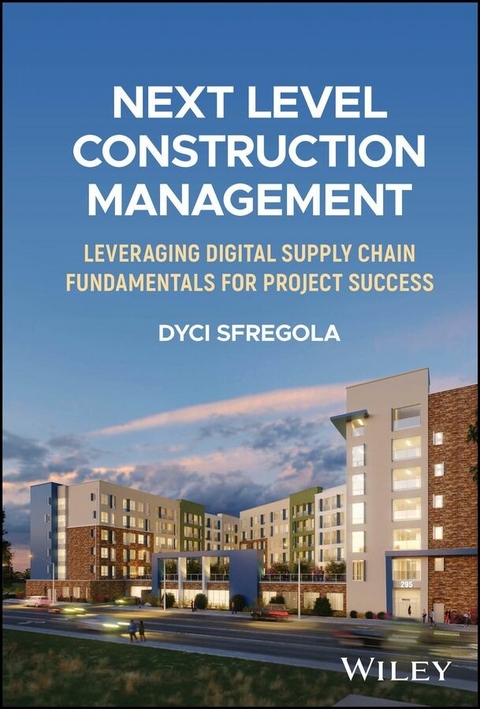
Next Level Construction Management (eBook)
327 Seiten
Wiley (Verlag)
978-1-394-27385-0 (ISBN)
A concise tour of need-to-know concepts in supply chain management for busy construction executives and project managers, complete with bulleted chapter-specific summaries
In Next Level Construction Management: Leveraging Digital Supply Chain Fundamentals for Project Success, renowned business process improvement and digital supply chain expert Dyci Sfregola delivers a timely and insightful discussion of how supply chain fundamentals from a variety of industries, including automotive manufacturing, medical devices, and pharmaceuticals, can be applied to the construction industry to achieve positive project outcomes. The author provides a thorough introduction to the fundamentals of supply chain design and governance, network design, strategic procurement and sourcing, integrated business planning, and the enabling technologies that support these processes.
The book also offers substantial coverage of supply chain leadership principles, technological innovation in the construction industry, digital tools and trends in construction supply chain, and resilience and agility best practices for project and program professionals attempting to execute on their projects.
Readers will also find:
- A thorough introduction to supply chain management and planning for construction
- Comprehensive explorations of the fundamentals of supply chain management and strategies for assessing the state and maturity level of their own organization's supply chains
- Practical discussions of key supply chain terminology and techniques for improving supply chain planning and management
- Insightful industry case studies from construction firms outlining the real-world application of the concepts discussed in the book
Perfect for executives, managers, and senior business leaders, Next Level Construction Management: Leveraging Digital Supply Chain Fundamentals for Project Success will also benefit students in construction-related programs, project management, supply chain and logistics disciplines, and undergraduate- and graduate-level business administration programs.
Dyci Sfregola is the CEO and Founder of New Gen Architects. She leads project teams across a variety of geographical regions, drives user adoption of digital business tools, and uncovers new ways of working to improve organizational productivity and efficiency, and reduce waste. She is an expert in business process improvement methods related to manufacturing and industrialized construction operations with a focus on designing sustainable supply chains.
A concise tour of need-to-know concepts in supply chain management for busy construction executives and project managers, complete with bulleted chapter-specific summaries In Next Level Construction Management: Leveraging Digital Supply Chain Fundamentals for Project Success, renowned business process improvement and digital supply chain expert Dyci Sfregola delivers a timely and insightful discussion of how supply chain fundamentals from a variety of industries, including automotive manufacturing, medical devices, and pharmaceuticals, can be applied to the construction industry to achieve positive project outcomes. The author provides a thorough introduction to the fundamentals of supply chain design and governance, network design, strategic procurement and sourcing, integrated business planning, and the enabling technologies that support these processes. The book also offers substantial coverage of supply chain leadership principles, technological innovation in the construction industry, digital tools and trends in construction supply chain, and resilience and agility best practices for project and program professionals attempting to execute on their projects. Readers will also find: A thorough introduction to supply chain management and planning for constructionComprehensive explorations of the fundamentals of supply chain management and strategies for assessing the state and maturity level of their own organization s supply chainsPractical discussions of key supply chain terminology and techniques for improving supply chain planning and managementInsightful industry case studies from construction firms outlining the real-world application of the concepts discussed in the book Perfect for executives, managers, and senior business leaders, Next Level Construction Management: Leveraging Digital Supply Chain Fundamentals for Project Success will also benefit students in construction-related programs, project management, supply chain and logistics disciplines, and undergraduate- and graduate-level business administration programs.
CHAPTER 1
Introduction
What became evident to the rest of the world (but was already very evident to those of us working daily in the supply chain) during the COVID‐19 pandemic of 2020 – and all of the subsequent supply chain disruptions – is that many companies have been successful despite themselves, not because of the good supply chain practices that they have in place. From 2020 to 2022, we learned how fragile and intertwined our global supply chain systems are. What soon followed were even more headlines related to delayed construction or canceled construction projects, or construction projects that were significantly over budget citing “supply chain issues.” Even in 2024, we continued to read about project cancelations and company closures, increased cost of materials, labor shortages, and other issues that present challenges to achieving strategic goals for many companies. While many industries face the same challenges and are conducting day‐to‐day operations in the same macroeconomic conditions, one thing has emerged as clear and evident: the companies with the best operations and supply chain talent and digital systems are navigating the waters of the “new normal” for business better than those that lack the digital architecture and supply chain know‐how to execute. Where industries like manufacturing, retail, pharmaceuticals and medical devices, grocery and food and beverage had been working for years to improve supply chain efficiency and implement foundational standard operating procedures, the construction industry, in recent years, emerged as a laggard in the adoption of these principles and the technologies associated with them. Construction managers, and construction leaders, by and large, were not and are not equipped with the knowledge of supply chain fundamentals and basic frameworks that are highly prevalent and, arguably, quite advanced in other industries. Where other industries were able to more effectively navigate disruptions and are striving toward resilience and agility, not just efficiency, the construction industry continues to struggle.
The adoption of supply chain fundamentals has become even more critical as offsite, and industrialized construction methods become more popular as a means to meet construction demand across all different types of buildings and construction. Offsite construction methods became the belle of the ball recently after many years of consisting of only a small percentage of construction projects. From 1960 to 2015, offsite projects consisted of about 10% of global construction projects. From 2020 to 2023, that percentage increased at a 5% rate year over year with an expected continued growth over the next 20 years of 20%. As many companies began to incorporate prefab and modular construction methods into their construction business models, many realized how unprepared they were from a supply chain management perspective to be able to properly execute the manufacturing and material flow activities required to realize the promises of offsite construction. Anecdotal evidence from countless personal conversations I've had with modular and prefab leaders, as well as executives from general contractor firms and owners in traditional construction, suggests that it is understood that effective supply chain management, componentization, and standardization are the keys to become capable of meeting current construction demands and truly re‐engineering the way we build buildings, reduce waste, and improve productivity. It is critical for construction leaders and project managers to understand and adopt supply chain management fundamentals and the technologies that enable supply chain execution if we are to achieve carbon reduction and net‐zero goals and meet construction needs for affordable housing. It is even more critical that they adopt not only modern digital fundamentals, but also the tried‐and‐true supply chain frameworks from the 20th century like Total Quality, Six Sigma, and Just in Time (JIT). These concepts, in some form or fashion, will always have their place in the supply chain, but we must also remember that these philosophies were developed and tested when the world was in a very different place. The effects of geopolitics and global trade, technology advancements like artificial intelligence (AI), blockchain, virtual reality and augmented reality, and generational human behavior changes and expectations of both customers and the labor force require us to fully redefine the way we approach supply chain management within the construction space.
When you talk to people from different industries, the concept of supply chain management is oftentimes commonplace. Companies might not be managing their supply chains well, but they are fully aware of the different business functions and activities that make up the supply chain and are impacted by their supply chain. I have personally worked with business and supply chain leaders in aviation, aerospace and defense, medical devices, pharmaceuticals, consumer products, wine and spirits, food and beverage, and all types of manufacturing – from global household names and multinational enterprises to startups that you may have never heard of. My career as a digital supply chain consultant exposed me to different functions of the supply chain across all types of industries and company sizes, and I have seen the inner workings as a practitioner as well. It was not until I began to work in the construction industry that I realized that the fundamental concepts of supply chain management, and the digital systems that enable supply chain planning and execution were not taught nor thoroughly understood by most project managers and construction managers, which is very interesting because construction project managers are arguably supply chain managers. Construction managers on any given project are responsible for the flow of material, labor, and services in order to ensure on‐time and on‐budget completion of a project. The level of risk associated with missed material deadlines is incredibly high in the construction industry, and yet even executive leaders at large construction firms have been slow to adopt workflows and standard operating procedures that are proven to improve operational excellence in other industries. I wrote this book with them in mind – construction leaders and project managers who were not taught supply chain fundamentals and will, undeniably, have a lot more success with their construction projects if they understand and leverage some of these basic principles.
After delivering several workshops to construction leaders, I noticed a pattern: many construction leaders are not aware of made‐to‐order supply chain management. On more than one occasion, following or during a supply chain workshop, I have had construction leaders tell me that supply chain management fundamentals were not important for their businesses because they worked on projects. Executing in a project‐based environment does not mean supply chain fundamentals should not be followed. It simply means that certain concepts will be more relevant than others. In this book, we will talk about made‐to‐order and assemble‐to‐order environments and how these concepts can also be leveraged for the engineer‐to‐order environment where many construction projects are executed. I will also address frequently asked questions like:
- When do I need to hire someone that knows about supply chain?
- What is an enterprise resource planning (ERP) system, and do I really need one?
- What digital systems are important to my business and when should I implement them?
- Is there a standard naming convention for stock keeping units (SKUs) and product numbers?
- How do I use these concepts and are they important to me if I work in a project‐based environment?
These are all questions that I have received from clients, prospects, and students that attend my training sessions.
Construction and the built environment is one of the oldest industries in the world. Humans have always needed shelter, and we must continue to innovate and improve the quality of the buildings where we live. When you look at the evolution of construction in a silo, one would think that the industry has come far, and it has – again in comparison to itself. But when you look at construction in comparison to other industries, innovation and productivity gains have lagged drastically. A 2017, McKinsey report highlighted that the construction industry has averaged only 1% growth over the past 20 years. Meanwhile, the total world economy has grown by 2.8%, and manufacturing (one of the industries most closely compared to construction, especially industrialized construction) has grown by 3.6%. Construction is one of the most important industries that truly affect the human experience – from healthcare to manufacturing and logistics, to leisure. On Maslow's Hierarchy of Needs, shelter is a foundational aspect of human well‐being.
Where we live, work, and play is crucial to human survival. So why have we not pushed the needle further? While there are many reasons that could be cited, one fundamental variable missing in construction operations is solid supply chain management foundations and frameworks. As previously mentioned, other related or similar industries like automotive, telecommunications, heavy machinery manufacturing, and pharmaceuticals have mastered, or at least understood the critical importance of concepts like supply chain...
| Erscheint lt. Verlag | 28.4.2025 |
|---|---|
| Sprache | englisch |
| Themenwelt | Technik ► Bauwesen |
| Schlagworte | Construction Supply Chain • Construction technology • Digital supply chain • industrialized construction supply chain • modular construction supply chain • supply chain constraints • supply chain for construction • Supply chain technology |
| ISBN-10 | 1-394-27385-1 / 1394273851 |
| ISBN-13 | 978-1-394-27385-0 / 9781394273850 |
| Informationen gemäß Produktsicherheitsverordnung (GPSR) | |
| Haben Sie eine Frage zum Produkt? |
 EPUB (Adobe DRM)
Kopierschutz: Adobe-DRM
Adobe-DRM ist ein Kopierschutz, der das eBook vor Mißbrauch schützen soll. Dabei wird das eBook bereits beim Download auf Ihre persönliche Adobe-ID autorisiert. Lesen können Sie das eBook dann nur auf den Geräten, welche ebenfalls auf Ihre Adobe-ID registriert sind.
Details zum Adobe-DRM
Dateiformat: EPUB (Electronic Publication)
EPUB ist ein offener Standard für eBooks und eignet sich besonders zur Darstellung von Belletristik und Sachbüchern. Der Fließtext wird dynamisch an die Display- und Schriftgröße angepasst. Auch für mobile Lesegeräte ist EPUB daher gut geeignet.
Systemvoraussetzungen:
PC/Mac: Mit einem PC oder Mac können Sie dieses eBook lesen. Sie benötigen eine
eReader: Dieses eBook kann mit (fast) allen eBook-Readern gelesen werden. Mit dem amazon-Kindle ist es aber nicht kompatibel.
Smartphone/Tablet: Egal ob Apple oder Android, dieses eBook können Sie lesen. Sie benötigen eine
Geräteliste und zusätzliche Hinweise
Buying eBooks from abroad
For tax law reasons we can sell eBooks just within Germany and Switzerland. Regrettably we cannot fulfill eBook-orders from other countries.
aus dem Bereich