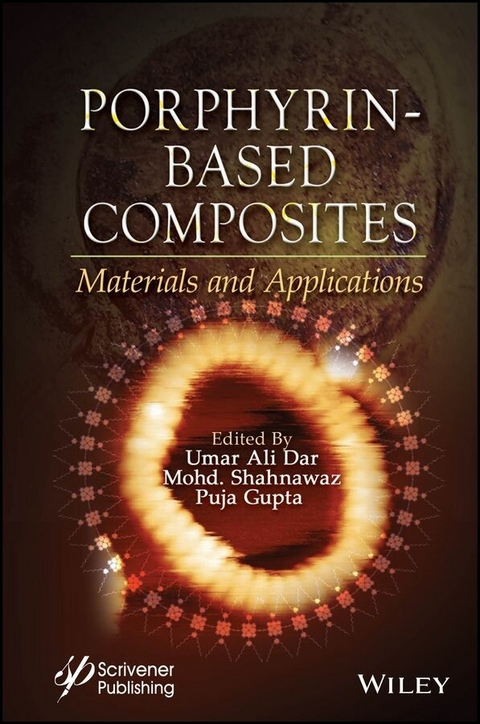
Porphyrin-Based Composites (eBook)
948 Seiten
Wiley-Scrivener (Verlag)
978-1-394-21441-9 (ISBN)
Discover the transformative potential of porphyrin-based composites in Porphyrin-Based Composites where readers will learn how these innovative materials enhance industrial sectors by combining multiple porphyrin components to create durable, sensitive, and efficient technologies that outperform traditional materials.
This book highlights the benefits of adopting porphyrin composites and discusses how they are used in different industrial sectors. Combining multiple porphyrin components is used to create materials with properties that are not possible with individual components, remove restrictions of water-insolubility, and ultimately lead to the development of durable and more sensitive technological materials. Composite materials have been essential to human life for thousands of years, beginning with the construction of houses by the first civilizations and advancing to modern technologies. Originating in the mid-twentieth century, composite materials show promise as a class of engineering materials that offer new opportunities for contemporary technology and have been beneficially incorporated into practically every sector due to their ability to choose elements, tune them to achieve the desired qualities, and efficiently use those features through design. Additionally, composite materials offer greater strength- and modulus-to-weight ratios than standard engineering materials. Materials based on porphyrin composites are used in a wide range of applications, including sensors, molecular probes, electrical gadgets, electronic devices, construction materials, catalysis, medicine, and environmental and energy applications.
Readers will find the book:
- Provides an overview of several porphyrin composites as model materials for commercial settings;
- Discusses fundamental, experimental, and theoretical research on structural and physicochemical properties of porphyrin composites;
- Demonstrates how complementary and alternative material designs that use porphyrin composites have evolved;
- Emphasizes important uses for cutting-edge, multipurpose materials that might contribute to a more sustainable society;
- Opens new possibilities by examining the role of developing unique hybrid, composite, and higher-order hierarchical materials that may be utilized to make valuable chemicals.
Audience
Researchers, academicians, chemists, industry experts, and students working in the fields of materials and environmental sciences, engineering, textiles, biology, and medicine.
Umar Ali Dar, PhD, is a postdoctoral fellow at the Key Laboratory of Biobased Polymer Materials, College of Polymer Science and Engineering, Qingdao University of Science and Technology, China. He has published numerous peer-reviewed articles, books, book chapters, and collaborative projects and serves as an editorial member and reviewer for several internationally published journals. His research expertise includes polymers following organic and inorganic synthesis, particularly in the chemical modification of porphyrins, quinones, anils, and azo compounds, with significant contributions to crystal engineering, materials science, energy applications, sensors, water treatment, and drug discovery.
Mohd. Shahnawaz, PhD,is an assistant professor in the Department of Botany at Government Degree College Drass, University of Ladakh, India. He has published 25 research articles, 24 book chapters, and 16 books and serves as a reviewer and editor for several international journals. His research interests include tissue culture of medicinal plants, genetic diversity assessment of medicinal plants using high-resolution molecular marks, enhancement of plant secondary metabolite contents, and biodegradation of plastic.
Puja Gupta, PhD, is an associate professor of biotechnology at RIMT University, Mandi Gobindgarh, Punjab, with three years of teaching experience. She has published 15 research articles in international journals, 20 book chapters, and four books and participated in various conferences and workshops. Her research interests include metagenomics, microbiology, microbial genetics, and plant-microbe interactions.
Discover the transformative potential of porphyrin-based composites in Porphyrin-Based Composites where readers will learn how these innovative materials enhance industrial sectors by combining multiple porphyrin components to create durable, sensitive, and efficient technologies that outperform traditional materials. This book highlights the benefits of adopting porphyrin composites and discusses how they are used in different industrial sectors. Combining multiple porphyrin components is used to create materials with properties that are not possible with individual components, remove restrictions of water-insolubility, and ultimately lead to the development of durable and more sensitive technological materials. Composite materials have been essential to human life for thousands of years, beginning with the construction of houses by the first civilizations and advancing to modern technologies. Originating in the mid-twentieth century, composite materials show promise as a class of engineering materials that offer new opportunities for contemporary technology and have been beneficially incorporated into practically every sector due to their ability to choose elements, tune them to achieve the desired qualities, and efficiently use those features through design. Additionally, composite materials offer greater strength- and modulus-to-weight ratios than standard engineering materials. Materials based on porphyrin composites are used in a wide range of applications, including sensors, molecular probes, electrical gadgets, electronic devices, construction materials, catalysis, medicine, and environmental and energy applications. Readers will find the book: Provides an overview of several porphyrin composites as model materials for commercial settings; Discusses fundamental, experimental, and theoretical research on structural and physicochemical properties of porphyrin composites; Demonstrates how complementary and alternative material designs that use porphyrin composites have evolved; Emphasizes important uses for cutting-edge, multipurpose materials that might contribute to a more sustainable society; Opens new possibilities by examining the role of developing unique hybrid, composite, and higher-order hierarchical materials that may be utilized to make valuable chemicals. Audience Researchers, academicians, chemists, industry experts, and students working in the fields of materials and environmental sciences, engineering, textiles, biology, and medicine.
1
Composite Materials Utilizing Porphyrin Template: An Overview
Umar Ali Dar1*, Shazia Nabi2 and Mohd Shahnawaz3
1Key Laboratory of Biobased Polymer Materials, College of Polymer Science and Engineering, Qingdao University of Science and Technology, Qingdao, China
2Department of Chemistry, University of Kashmir, Srinagar, Jammu and Kashmir, India
3Department of Botany, Govt. Degree College Drass, A Constituent College of University of Ladakh, Drass, Ladakh UT, India
Abstract
Porphyrins are complex ring-like compounds that are crucial for certain functions in the body, such as transporting oxygen and producing food through a process called photosynthesis. The ability to dissolve or decompose easily makes them not practical at all; however, changes in their structure have been found to provide additional properties to them thus making them more useful. Consequentially, these composites help to enhance many kinds of material characteristics such as conductivity, reactivity, and optical behavior, which would not otherwise be achieved if they were used alone. In the present chapter, an attempt was made to highlight the development of porphyrin-based composites into novel materials by offering an in-depth overview and a greater understanding of their flexibility and developments. All aspects of their preparation, manufacture, alterations, and possible uses are covered in the discussion. The chapter also explores the wide range of potential applications for porphyrin-based materials, from biomedical to sensing and catalysis.
Keywords: Porphyrins, composites, hybrid materials, applications
1.1 Introduction
A family of chemical compounds known as porphyrin has been derived from the Greek word (porphyra), meaning purple. This is a heterocyclic, tetrapyrrole macrocyclic organic compound, and its primary structure is called porphine [1]. Porphines are composed of four pyrrole subunits interconnected at α carbon atom via methylidene (CH) bridge, possessing 26 π electrons, with 18π electrons forming the planer continuous cycle satisfying the huckel (4n+2) rule of aromaticity. However, its substituted derivatives are named as porphyrin [2]. Surprisingly, meso-substituted porphyrins are not found in nature. They may be synthesized using a variety of techniques depending on the intended result for practical reasons [3]. Porphyrins are extensively distributed in nature and are crucial to activities like oxygen transport and photosynthesis [4]. Over the past 50 years, porphyrins have been thoroughly investigated for their interactions with natural proteins and their role in enzyme catalysis. These fascinating structures are an important part of material chemistry due to their vast size, broad systems, and adaptability of metal ion coordination [5–8]. This makes them a perfect topic for functionalization and post-synthesis alterations aimed at producing porphyrin hybrid materials [9–12].
Its practical applicability is limited by the porphyrin molecule’s inadequate water solubility, low optical stability, and strong π-π interaction with stiff macrocyclic molecules that cause aggregation [13–18]. There are primarily two strategies to address these issues. One involves molecularly altering the structural properties of porphyrins. For instance, by controlling the surrounding and center metal ions [11, 19, 20]. Second is the development of composites based on porphyrins [21–24]. This method not only corrects the fundamental problems with porphyrin molecules but also achieves the emergence of novel shapes and functions, one of the present hotspots in scientific inquiry. Porphyrin molecules can produce novel materials with clearly defined shapes and characteristics by being added to various supporting surfaces. One of the major benefits of using porphyrin templates in the synthesis of composite materials is their ability to control the size and shape of the final product. Several chemistries have been added to the porphyrin skeleton to increase porphyrin-based compounds’ variety, stability, and selectivity. Porphyrin-based composites can significantly enhance the functionalities of porphyrins extending their applications. Porphyrin composite materials are an emerging class of frameworks with multiple applications across various disciplines. Diverse porphyrin composite materials with various properties are of growing importance where porphyrins are embedded with metals, metal-organic frameworks (MOFs), polymers, carbon, nanomaterials, etc. (Figure 1.1) [10, 25–29]. The composites with porphyrin templates enable engineering the materials in terms of size, shape, and chemistry with multifunctionality. The new developments in functional materials, composites, and hybrid structures containing porphyrins with rich chemistry were attributed to intricate binding modes in porphyrin molecules.
Figure 1.1 (a) Porphyrin (b) metal induced porphyrin (c) porphyrin composite.
1.2 Development and Construction of Porphyrin Composites
Materials composed of porphyrin molecules combined with other materials or incorporated into a host matrix are known as porphyrin composites. Porphyrins have been incorporated into a range of composite materials by adding porphyrin or metalloporphyrin species into composites by covalent, non-covalent bonding, doping, impregnation, and intercalation. A porphyrin composite includes (1) carbon-based materials, (2) porous materials, (3) metal nanoparticles, and (4) core-shell materials (Figure 1.2) [25].
When carbon-based nanomaterials like graphene, graphene carbon nanotubes (CNT), graphene quantum dots (GQDs), graphene oxide, graphite carbon nitride, and fullerenes (C60) are combined with porphyrins or metalized porphyrin, hybrid materials have been attained [30, 31]. Four primary categories of porphyrin-based porous materials are known as porphyrin-based MOFs, porphyrin-based covalent organic frameworks (COFs), porphyrin-based amorphous porous organic polymers (POPs), and porphyrin-based hydrogen-bonded organic frameworks (HOFs). Porphyrins and metals combine to generate metal-porphyrin frameworks (MPFs), a subclass of MOFs. Porphyrin complexes are also able to be coupled with other nanomaterials, like SiO2 and TiO2, and metal clusters, like C60 and zirconium oxo clusters, among others [10, 31–33]. The core-shell structure includes Porphyrin-based polymer and porphyrin–core-shell structure nanomaterials and has been discussed in detail in other chapters.
Figure 1.2 Porphyrin composite.
1.2.1 Porphyrin Synthesis and Functionalization
Many techniques, including template-assisted, contemporary, and classical techniques, are used to synthesize porphyrin. The traditional Adler-Longo technique is used to synthesize metalloporphyrins. The Rothemund-Kokka method is another traditional technique for synthesizing porphyrins and metalloporphyrins. This method has been used to synthesize a large number of additional metalloporphyrins, including those containing iron, zinc, and copper [34]. Microwave-assisted synthesis is one modern technique (Palmisano et al., 2015).
Porphyrins have been functionalized to enhance their functional characteristics, this has added new chemical and functional sites. Functionalizing of porphyrins includes halogenations, metalation, substitution, click chemistry, etc. [35–38]. The porphyrin rings have different substituents grafted onto their outer ring, which has been demonstrated by carefully choosing from a variety of donor-acceptor porphyrin precursors as linkers that mediate as covalent and non-covalent contact and allow one to build porphyrin composites [35]. The primary driving force for complexation and molecular flattening is the electrostatic and π-π stacking synergistic interaction between the porphyrin and other combing materials as discussed in detail in the coming chapters. Researchers have started to invent and employ a variety of functional materials to produce high performance, thanks to the advancement of materials science.
1.2.2 Synthesis of Porphyrin Composites
A composite material is created by combining two materials that are not the same in order to create a material with more performance characteristics than the individual components. Composite materials typically consist of one continuous phase with one or more discontinuous phases dispersed throughout. Components classified as hybrids have many discontinuous stages of varying types. In general, discontinuous phases have better mechanical qualities and are tougher than continuous phases. We refer to the continuous phase as the “matrix.” The term “reinforcement”, or “reinforcing material,” refers to the discontinuous phase [39]. The synthesis of porphyrin has the following key steps (Figure 1.3). Choose the substance you wish to use to composite the porphyrin. This might be a substance of choice, a polymer, or a nanoparticle. Make the composite material’s surface more porphyrin-attachment-friendly. Functionalization with appropriate groups that may interact with the porphyrin may be necessary for this. Adhere the porphyrin via covalent or non-covalent interactions to the surface modification. By changing the synthesis conditions or adding...
| Erscheint lt. Verlag | 28.4.2025 |
|---|---|
| Sprache | englisch |
| Themenwelt | Naturwissenschaften ► Chemie |
| Technik ► Maschinenbau | |
| ISBN-10 | 1-394-21441-3 / 1394214413 |
| ISBN-13 | 978-1-394-21441-9 / 9781394214419 |
| Informationen gemäß Produktsicherheitsverordnung (GPSR) | |
| Haben Sie eine Frage zum Produkt? |
 EPUB (Adobe DRM)
Kopierschutz: Adobe-DRM
Adobe-DRM ist ein Kopierschutz, der das eBook vor Mißbrauch schützen soll. Dabei wird das eBook bereits beim Download auf Ihre persönliche Adobe-ID autorisiert. Lesen können Sie das eBook dann nur auf den Geräten, welche ebenfalls auf Ihre Adobe-ID registriert sind.
Details zum Adobe-DRM
Dateiformat: EPUB (Electronic Publication)
EPUB ist ein offener Standard für eBooks und eignet sich besonders zur Darstellung von Belletristik und Sachbüchern. Der Fließtext wird dynamisch an die Display- und Schriftgröße angepasst. Auch für mobile Lesegeräte ist EPUB daher gut geeignet.
Systemvoraussetzungen:
PC/Mac: Mit einem PC oder Mac können Sie dieses eBook lesen. Sie benötigen eine
eReader: Dieses eBook kann mit (fast) allen eBook-Readern gelesen werden. Mit dem amazon-Kindle ist es aber nicht kompatibel.
Smartphone/Tablet: Egal ob Apple oder Android, dieses eBook können Sie lesen. Sie benötigen eine
Geräteliste und zusätzliche Hinweise
Buying eBooks from abroad
For tax law reasons we can sell eBooks just within Germany and Switzerland. Regrettably we cannot fulfill eBook-orders from other countries.
aus dem Bereich