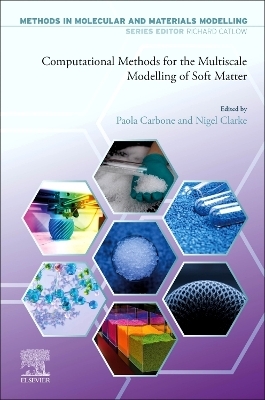
Computational Methods for the Multiscale Modeling of Soft Matter
Elsevier - Health Sciences Division (Verlag)
978-0-443-27314-8 (ISBN)
Bringing together all these modeling approaches and applications into one coherent volume, Computational Methods for the Multiscale Modeling of Soft Matter provides a one-stop resource that is written primarily for postgraduate students and researchers in materials science, computational physics, and chemists and chemical engineers interested in learning about simulation methods for soft materials such as polymers, surfactants, and colloids.
This is the first volume to publish in Elsevier's Methods in Molecular and Materials Modelling book series, curated by Sir Richard Catlow.
Paola Carbone is Professor of Physical Chemistry at the Department of Chemical Engineering, University of Manchester, UK. Her expertise is in the multiscale modelling of soft matter with a focus on developing workflows to couple different molecular modelling techniques. She obtained her PhD in Material Science from University of Milano-Bicocca in Milan, Italy in 2004. After a 2-years postdoc at the University of Bologna, Italy, in 2006 she was awarded a fellowship from the Humboldt Foundation and joined the group of Professor Mueller-Plathe at the Technical University of Darmstadt in Germany. In 2008 she was awarded a RCUK fellowship and joined the Department of Chemical Engineering at the University of Manchester, UK where she was promoted to Professor in 2020. Nigel Clarke is a Professor of Condensed Matter Theory at the School of Mathematical and Physical Sciences, University of Sheffield, UK. He has an active research program in both theory and simulations of polymer structure and dynamics. His research on developing models for structure evolution in polymers uses phase field models. Recently, his work on phase field models for phase separation helped elucidate the role of phase separation in creating structural colour in beetle scales. He developed the first theoretical framework for simultaneous de-wetting and phase separation. He pioneered the use of phase field models to predict structure/property relations in amorphous polymeric organic photovoltaics. He also has experience with molecular dynamics and dissipative particle dynamics, which he used to model structure and dynamics in polymer nanocomposites in a joint project with colleagues at the University of Pennsylvania, USA. He received his PhD from the University of Sheffield, UK in 1994, and following postdoctoral research positions at The University of Southampton and The University of Leeds, also in the UK he moved to the Manchester Institute of Science and Technology (UMIST) Materials Science for his first academic position. He then spent 13 years in the Department of Chemistry at Durham University, UK before returning to Sheffield University in 2011.
Foreword by Sir Richard Catlow
Preface by Paola Carbone and Nigel Clarke
Part I: Soft Matter Modelling Methods
1. Using Dissipative Particles Dynamics to Model Polymeric Systems
2. Self Consistent Field Theory and Field Theoretic Simulations for Predicting Microphase Separation in Block Copolymers
3. Simulations of Colloidal Systems
4. Methods to Model Ionic Systems
5. Capturing Atomistic Dynamics of Macromolecules via Coarse-Grained Modeling
6. Mixing Atoms and Coarse-Grained Beads in Modeling Polymers
Part II: Applications
7. Monte Carlo Simulations of Packings of Colloidal Systems
8. Insights into Morphology and Ion Transport from Simulations of Ionic Polymers
9. Modelling charge transfer in polymers
10. The Fascinating Behavior of Polymers at Interfaces
11. Polymer Field Theory Calculations of Grafted Nanoparticles
12. Nanocomposites. Applying MD to Determine Polymer Structure and Dynamics in the Presence of Nanoparticles
13. Free Volume Elements in Polymer Membranes: Theory, Characterization, Functional Significance, and Design Strategy
14. Polymer Composites Modeling in the Tyre Industry
| Erscheinungsdatum | 03.12.2025 |
|---|---|
| Verlagsort | Philadelphia |
| Sprache | englisch |
| Maße | 152 x 229 mm |
| Gewicht | 450 g |
| Themenwelt | Naturwissenschaften ► Chemie ► Physikalische Chemie |
| Naturwissenschaften ► Physik / Astronomie ► Festkörperphysik | |
| Technik ► Maschinenbau | |
| ISBN-10 | 0-443-27314-6 / 0443273146 |
| ISBN-13 | 978-0-443-27314-8 / 9780443273148 |
| Zustand | Neuware |
| Informationen gemäß Produktsicherheitsverordnung (GPSR) | |
| Haben Sie eine Frage zum Produkt? |
aus dem Bereich