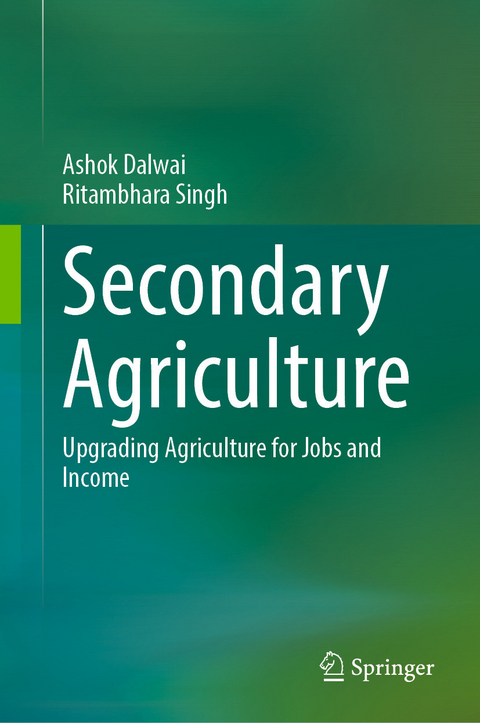
Secondary Agriculture (eBook)
310 Seiten
Springer Nature Singapore (Verlag)
978-981-96-4249-6 (ISBN)
A first of its kind, this authored book marshals data and logic that necessitate the agriculture sector to transcend beyond its conventional role of securing food, fodder, and feed. It examines India's growing working population and juxtaposes it with the declining labour demand in the secondary and tertiary sectors of the economy, on account of the deployment of disruptive suite of labour-substituting technologies. Therefore, the conventional developmental models that hypothesize the shifting of surplus manpower from agriculture to non-agricultural sectors may not stand the test of scrutiny in the twenty-first century. Hence, the need for remandating the agricultural sector to generate gainful jobs and supplementary incomes in an ecologically synchronous manner for sustainability.
The book draws the readers' attention to the importance of bioeconomy and circular economy. To enhance the biologically dependent cumulative agri-output, it recommends the adoption of supplementary and complementary activities. These interventions, along with processing (food and non-food), aid in minimizing food loss, enhancing value capture in favour of the farmers and other value chain stakeholders, and creating gainful jobs and linked incomes resulting in higher enterprise-profits. This progresses the agricultural sector into a bioeconomy anchored around secondary agriculture. Agri-processing being integral to secondary agriculture can be practiced at various scales beginning from micro to small to medium to large. The book highlights both the scope for such enterprises in India and the challenges they are vulnerable to. In the context of sub-par levels of jobs and income in the farm sector, the book emphasizes on micro-enterprises, and suggests the clusterization of entrepreneurs and digitalization along the value chain to achieve competitiveness. The book also deliberates on market-led production matrix, and value chain-based extension services to meet the feedstock demands of secondary agriculture.
This book is of relevance to a range of individuals and organizations concerned with agriculture. They include academics, researchers, professionals, universities, domestic & international organizations, bankers & financial institutions, FPOs, entrepreneurs, policymakers, and students.
A first of its kind, this authored book marshals data and logic that necessitate the agriculture sector to transcend beyond its conventional role of securing food, fodder, and feed. It examines India's growing working population and juxtaposes it with the declining labour demand in the secondary and tertiary sectors of the economy, on account of the deployment of disruptive suite of labour-substituting technologies. Therefore, the conventional developmental models that hypothesize the shifting of surplus manpower from agriculture to non-agricultural sectors may not stand the test of scrutiny in the twenty-first century. Hence, the need for remandating the agricultural sector to generate gainful jobs and supplementary incomes in an ecologically synchronous manner for sustainability.The book draws the readers' attention to the importance of bioeconomy and circular economy. To enhance the biologically dependent cumulative agri-output, it recommends the adoption of supplementary and complementary activities. These interventions, along with processing (food and non-food), aid in minimizing food loss, enhancing value capture in favour of the farmers and other value chain stakeholders, and creating gainful jobs and linked incomes resulting in higher enterprise-profits. This progresses the agricultural sector into a bioeconomy anchored around secondary agriculture. Agri-processing being integral to secondary agriculture can be practiced at various scales beginning from micro to small to medium to large. The book highlights both the scope for such enterprises in India and the challenges they are vulnerable to. In the context of sub-par levels of jobs and income in the farm sector, the book emphasizes on micro-enterprises, and suggests the clusterization of entrepreneurs and digitalization along the value chain to achieve competitiveness. The book also deliberates on market-led production matrix, and value chain-based extension services to meet the feedstock demands of secondary agriculture.This book is of relevance to a range of individuals and organizations concerned with agriculture. They include academics, researchers, professionals, universities, domestic & international organizations, bankers & financial institutions, FPOs, entrepreneurs, policymakers, and students.
| Erscheint lt. Verlag | 24.4.2025 |
|---|---|
| Zusatzinfo | XXVIII, 310 p. 32 illus., 30 illus. in color. |
| Sprache | englisch |
| Themenwelt | Naturwissenschaften ► Biologie |
| Technik ► Umwelttechnik / Biotechnologie | |
| Weitere Fachgebiete ► Land- / Forstwirtschaft / Fischerei | |
| Schlagworte | Agricultural byproducts • circular economy • Rural Employment • Rural Income • Secondary Agriculture • Value addition |
| ISBN-10 | 981-96-4249-3 / 9819642493 |
| ISBN-13 | 978-981-96-4249-6 / 9789819642496 |
| Informationen gemäß Produktsicherheitsverordnung (GPSR) | |
| Haben Sie eine Frage zum Produkt? |
 PDF (Wasserzeichen)
DRM: Digitales Wasserzeichen
Dieses eBook enthält ein digitales Wasserzeichen und ist damit für Sie personalisiert. Bei einer missbräuchlichen Weitergabe des eBooks an Dritte ist eine Rückverfolgung an die Quelle möglich.
Dateiformat: PDF (Portable Document Format)
Mit einem festen Seitenlayout eignet sich die PDF besonders für Fachbücher mit Spalten, Tabellen und Abbildungen. Eine PDF kann auf fast allen Geräten angezeigt werden, ist aber für kleine Displays (Smartphone, eReader) nur eingeschränkt geeignet.
Systemvoraussetzungen:
PC/Mac: Mit einem PC oder Mac können Sie dieses eBook lesen. Sie benötigen dafür einen PDF-Viewer - z.B. den Adobe Reader oder Adobe Digital Editions.
eReader: Dieses eBook kann mit (fast) allen eBook-Readern gelesen werden. Mit dem amazon-Kindle ist es aber nicht kompatibel.
Smartphone/Tablet: Egal ob Apple oder Android, dieses eBook können Sie lesen. Sie benötigen dafür einen PDF-Viewer - z.B. die kostenlose Adobe Digital Editions-App.
Buying eBooks from abroad
For tax law reasons we can sell eBooks just within Germany and Switzerland. Regrettably we cannot fulfill eBook-orders from other countries.
aus dem Bereich