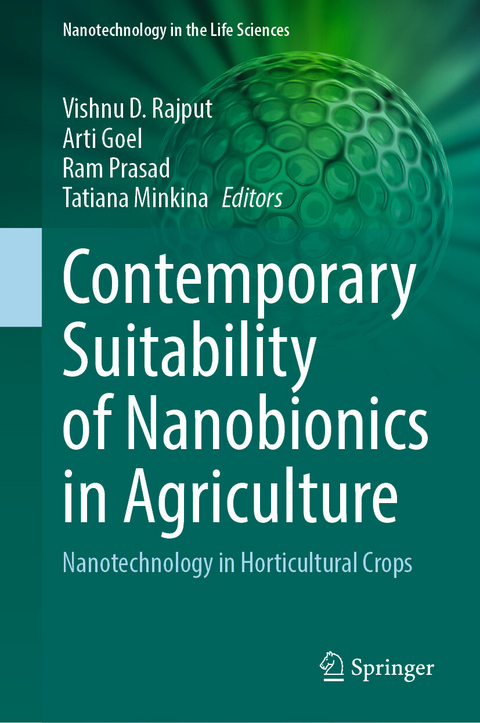
Contemporary Suitability of Nanobionics in Agriculture (eBook)
346 Seiten
Springer Nature Switzerland (Verlag)
978-3-031-82779-2 (ISBN)
Attempts to apply nanotechnology in agriculture began with the growing realization that conventional farming technologies would neither be able to increase productivity any further nor restore ecosystems damaged by existing technologies back to their pristine state; in particular because the long-term effects of farming with “miracle seeds” in conjunction with irrigation, fertilizers, and pesticides, have been questioned both at the scientific and policy levels and must be gradually phased out.
Nanotechnology in agriculture has gained momentum in the last decade with an abundance of public funding, but the pace of development is modest even though many disciplines fall under the umbrella of agriculture. One reason this may be is due to the fact that not much information about the safe use of nanomaterials in agriculture system has been accessible in recent years. "Contemporary Suitability of Nanobionics in Agriculture" provides insight into the uses of nanomaterials in agriculture, which will be of particular use for agriculture personnel & beyond. The book includes an overview of nanobionics in agriculture, while also focusing on specific subjects such as recent advances, future outlook, biosafety & regulatory aspects, etc.
Nanotechnologic intervention in farming has bright prospects for improving the efficiency of nutrient use through nanoformulations of fertilizers, breaking yield barriers through bionanotechnology, surveillance and control of pests and diseases, understanding mechanisms of host-parasite interactions at the molecular level, development of new-generation pesticides and their carriers, preservation and packaging of food and food additives, strengthening of natural fibers, removal of contaminants from soil and water, improving the shelf-life of vegetables and flowers, clay-based nano-resources for precision water management, reclamation of salt-affected soils, and stabilization of erosion prone surfaces, to name a few.
| Erscheint lt. Verlag | 23.4.2025 |
|---|---|
| Reihe/Serie | Nanotechnology in the Life Sciences |
| Zusatzinfo | XII, 346 p. 49 illus., 48 illus. in color. |
| Sprache | englisch |
| Themenwelt | Naturwissenschaften ► Biologie |
| Technik ► Maschinenbau | |
| Schlagworte | Agriculture • conventional farming • nanotechnology • nanotools • Nutrient management |
| ISBN-10 | 3-031-82779-1 / 3031827791 |
| ISBN-13 | 978-3-031-82779-2 / 9783031827792 |
| Informationen gemäß Produktsicherheitsverordnung (GPSR) | |
| Haben Sie eine Frage zum Produkt? |
 PDF (Wasserzeichen)
DRM: Digitales Wasserzeichen
Dieses eBook enthält ein digitales Wasserzeichen und ist damit für Sie personalisiert. Bei einer missbräuchlichen Weitergabe des eBooks an Dritte ist eine Rückverfolgung an die Quelle möglich.
Dateiformat: PDF (Portable Document Format)
Mit einem festen Seitenlayout eignet sich die PDF besonders für Fachbücher mit Spalten, Tabellen und Abbildungen. Eine PDF kann auf fast allen Geräten angezeigt werden, ist aber für kleine Displays (Smartphone, eReader) nur eingeschränkt geeignet.
Systemvoraussetzungen:
PC/Mac: Mit einem PC oder Mac können Sie dieses eBook lesen. Sie benötigen dafür einen PDF-Viewer - z.B. den Adobe Reader oder Adobe Digital Editions.
eReader: Dieses eBook kann mit (fast) allen eBook-Readern gelesen werden. Mit dem amazon-Kindle ist es aber nicht kompatibel.
Smartphone/Tablet: Egal ob Apple oder Android, dieses eBook können Sie lesen. Sie benötigen dafür einen PDF-Viewer - z.B. die kostenlose Adobe Digital Editions-App.
Buying eBooks from abroad
For tax law reasons we can sell eBooks just within Germany and Switzerland. Regrettably we cannot fulfill eBook-orders from other countries.
aus dem Bereich