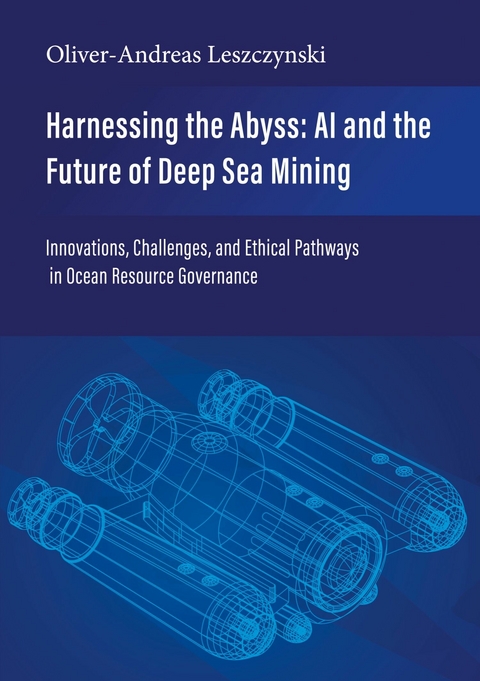
Harnessing the Abyss: AI and the Future of Deep Sea Mining (eBook)
384 Seiten
Books on Demand (Verlag)
978-3-8192-8614-8 (ISBN)
Oliver-Andreas Leszczynski is a global leader in AI-driven industrial transformation, with over 15 years of experience integrating artificial intelligence into essential industries. His academic background in Political Science, Business Management, and Applied AI enables him to bridge economic theory with cutting-edge technology, driving innovation across the maritime and deep-sea mining sectors. As Director for AI at the Institute of Northern-European Economic Research (INER) and a leader in private maritime enterprises, Leszczynski spearheads large-scale AI initiatives that modernize manufacturing and enhance operational efficiencies. A pioneer in AI-supported deep-sea mining, he advocates for the responsible adoption of emerging technologies to strengthen Western economic resilience. A staunch proponent of transatlantic partnerships, he fosters U.S.-European cooperation in AI to maintain global competitiveness and strategic leadership. His vision combines economic liberalism with targeted AI investments, ensuring that digitalization and automation sustain long-term industrial and geopolitical stability. Through his leadership, he is shaping the future of AI in global maritime industries.
1. Introduction and Context
1.1. Historical Overview of Deep Sea Mining
The quest to harvest the riches of the seabed is as old as human curiosity about the mysteries of the ocean. Yet, the formal history of deep sea mining is marked by a blend of scientific exploration, geopolitical ambition, and technological innovation that has unfolded over the past century. It is a history defined by moments of bold ambition, tempered by daunting challenges, and punctuated by groundbreaking technological and legal milestones.
Long before the advent of modern deep sea mining, the ocean was seen as an inexhaustible reservoir of mystery and resources. In the 19th century, oceanographic expeditions, such as the famous HMS Challenger voyage (1872– 1876), revealed the first glimpses of the deep seabed’s potential. Although the mission’s primary focus was scientific exploration, it uncovered vast plains of polymetallic nodules, dark, rock-like deposits rich in manganese, nickel, cobalt, and copper, scattered across the abyssal plains.
These early discoveries hinted at the potential economic value of the deep seabed but remained beyond the technological grasp of the era. Industrial extraction methods were confined to terrestrial mining, and the sheer depth and pressure of the ocean made deep sea resource recovery a theoretical rather than practical pursuit.
The post-World War II period marked a turning point in humankind’s relationship with the ocean. Driven by advances in sonar, underwater robotics, and submarine technology, oceanographers and engineers began to map and explore the seafloor in unprecedented detail. The discovery of hydrothermal vents in the late 1970s, rich with metallic sulfides, provided a new impetus for deep sea mining. These vents, formed by underwater volcanic activity, deposit highly concentrated metals such as gold, silver, and zinc, making them an attractive target for future exploitation.
During this period, industrial players and governments began to see the ocean floor as a potential solution to the growing demand for strategic metals. The Cold War further fueled this interest, as access to rare and strategic minerals became a cornerstone of national security. Nations like the United States and the Soviet Union invested heavily in oceanographic research, spurred not only by economic motives but also by the strategic importance of undersea territory.
The 1960s and 1970s were transformative decades for deep sea mining. For the first time, technological advancements made seabed resource extraction seem achievable. The development of remotely operated vehicles (ROVs) and deep-sea drilling platforms, pioneered by companies like Global Marine and organizations such as the National Oceanic and Atmospheric Administration (NOAA), marked significant milestones.
At the same time, private entities like the multinational consortium Deepsea Ventures began experimental efforts to harvest polymetallic nodules from the Pacific Ocean. Although these attempts were limited in scale and marred by technical and logistical difficulties, they underscored the growing appetite for exploiting deep ocean resources.
In parallel, nations began to grapple with the question of how to govern the resources of the deep seabed. The 1970s saw the birth of the United Nations Convention on the Law of the Sea (UNCLOS), a groundbreaking treaty that sought to establish a legal framework for the world’s oceans, including provisions for deep sea mining. The International Seabed Authority (ISA), established under UNCLOS, was tasked with overseeing mining activities and ensuring that benefits derived from seabed resources were shared equitably among nations.
By the 1980s, enthusiasm for deep sea mining waned. The collapse of metal prices and the technical challenges of working at extreme depths made commercial operations economically unviable. For decades, deep sea mining remained a niche interest, confined to academic research and occasional exploratory missions. The technology required to access deep ocean resources was prohibitively expensive, and terrestrial mining operations continued to dominate the global supply of strategic metals.
However, the turn of the 21st century brought a resurgence of interest. As global population growth and industrialization accelerated, the demand for rare earth elements and other strategic metals surged. These materials, critical for the production of electronics, renewable energy technologies, and advanced weaponry, became a linchpin of modern economies. At the same time, terrestrial reserves of these metals faced depletion, geopolitical instability, and environmental degradation.
The new millennium marked a renaissance for deep sea mining, driven by technological advancements, increasing demand for critical resources, and a shifting geopolitical landscape. The advent of high-resolution satellite imaging, advanced AI-driven geospatial analytics, and autonomous underwater systems revolutionized the exploration and assessment of the seabed.
Private companies like Nautilus Minerals and DeepGreen Metals emerged as pioneers in the field, securing exploration licenses in mineral-rich regions of the Pacific and Indian Oceans. Simultaneously, state-backed entities in China, Russia, and India began ramping up their investments in deep sea mining technologies, recognizing the strategic importance of these resources in securing long-term economic and military advantages.
China, in particular, has become a dominant force in the field, leveraging its expertise in AI, robotics, and manufacturing to develop cutting-edge subsea mining systems. This has sparked concerns in the West, as China’s control over critical supply chains, coupled with its ambitions in the South China Sea, could lead to a new era of resource-driven geopolitical tension.
As of the 2020s, deep sea mining remains a field poised on the brink of largescale commercialization. While some view it as the key to unlocking a sustainable supply of critical minerals, others warn of the potential for irreversible environmental harm and the exacerbation of global inequalities.
What is clear, however, is that the future of deep sea mining will be inextricably linked to advances in technology, particularly artificial intelligence. AI promises to address many of the industry’s longstanding challenges, from improving resource discovery to optimizing extraction methods and mitigating environmental impacts.
1.2. Scope and Challenges
The immense potential of deep sea mining is undeniable, offering access to vast untapped reserves of critical minerals that are essential for the functioning of advanced economies. Yet this promise is intricately intertwined with a web of complex challenges that must be addressed if this emerging industry is to succeed. The following exploration seeks to define the scope of deep sea mining in its entirety, from the extraordinary resources it aims to harness to the technological, economic, regulatory, and environmental hurdles that lie in its path. This is not merely an academic exercise, but an urgent and necessary analysis of an industry poised to redefine global resource dynamics.
.The seabed, covering over 70% of the Earth’s surface, is a vast repository of mineral wealth. Beneath the crushing depths of the oceans lie three primary categories of resources: polymetallic nodules, cobalt-rich ferromanganese crusts, and seafloor massive sulfides (SMS). Each of these presents a unique opportunity and a distinct set of extraction challenges. Polymetallic nodules, scattered across the abyssal plains, are a trove of manganese, nickel, cobalt, and copper. These metals are indispensable for industries ranging from steel production to battery technology, particularly in the context of the accelerating global transition to renewable energy systems. Found at depths of 4,000 to 6,000 meters, such nodules are especially abundant in the Clarion-Clipperton Zone (CCZ) in the Pacific Ocean, a region increasingly viewed as the focal point of future mining operations.
Cobalt-rich ferromanganese crusts, in contrast, are located on underwater ridges and seamounts. These crusts, which adhere to rocky substrates, are rich in cobalt, platinum, and rare earth elements. Their potential economic value is immense, given the demand for rare earths in high-tech applications, yet their attachment to the seabed renders extraction a formidable technical challenge. The third major resource category, seafloor massive sulfides, forms around hydrothermal vents, where volcanic activity has deposited rich concentrations of gold, silver, zinc, and copper. These deposits, often boasting metal grades far superior to terrestrial ores, offer an enticing target for mining operations but carry profound ecological risks due to the fragile and unique ecosystems they host.
Geographically, the resources of the deep sea are concentrated in specific zones of economic and strategic interest. The Pacific Ocean is home not only to the Clarion-Clipperton Zone but also to other resource-rich areas such as the Mid-Pacific Mountains and the East Pacific Rise. The Indian Ocean has similarly attracted attention for its SMS deposits and ferromanganese crusts, while the South Atlantic offers untapped potential with implications for the resource strategies of nations in Africa and South America. These resources are distributed across regions governed by international law, as well as within the exclusive economic zones (EEZs) of coastal states, presenting both opportunities and conflicts as nations seek to assert control over undersea wealth.
Transforming these latent resources...
| Erscheint lt. Verlag | 22.4.2025 |
|---|---|
| Sprache | englisch |
| Themenwelt | Technik |
| ISBN-10 | 3-8192-8614-4 / 3819286144 |
| ISBN-13 | 978-3-8192-8614-8 / 9783819286148 |
| Informationen gemäß Produktsicherheitsverordnung (GPSR) | |
| Haben Sie eine Frage zum Produkt? |
 EPUB (Wasserzeichen)
Größe: 565 KB
DRM: Digitales Wasserzeichen
Dieses eBook enthält ein digitales Wasserzeichen und ist damit für Sie personalisiert. Bei einer missbräuchlichen Weitergabe des eBooks an Dritte ist eine Rückverfolgung an die Quelle möglich.
Dateiformat: EPUB (Electronic Publication)
EPUB ist ein offener Standard für eBooks und eignet sich besonders zur Darstellung von Belletristik und Sachbüchern. Der Fließtext wird dynamisch an die Display- und Schriftgröße angepasst. Auch für mobile Lesegeräte ist EPUB daher gut geeignet.
Systemvoraussetzungen:
PC/Mac: Mit einem PC oder Mac können Sie dieses eBook lesen. Sie benötigen dafür die kostenlose Software Adobe Digital Editions.
eReader: Dieses eBook kann mit (fast) allen eBook-Readern gelesen werden. Mit dem amazon-Kindle ist es aber nicht kompatibel.
Smartphone/Tablet: Egal ob Apple oder Android, dieses eBook können Sie lesen. Sie benötigen dafür eine kostenlose App.
Geräteliste und zusätzliche Hinweise
Buying eBooks from abroad
For tax law reasons we can sell eBooks just within Germany and Switzerland. Regrettably we cannot fulfill eBook-orders from other countries.
aus dem Bereich