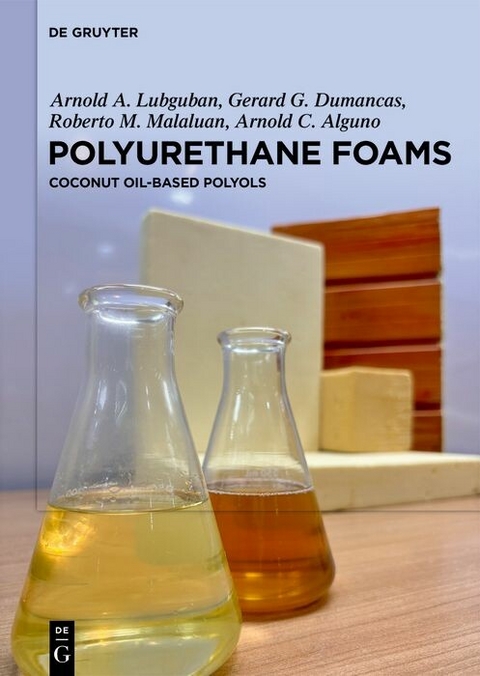
Polyurethane Foams (eBook)
212 Seiten
Walter de Gruyter GmbH & Co.KG (Verlag)
978-3-11-163266-7 (ISBN)
As global priorities shift towards sustainable resources, there is a growing interest in alternatives to petroleum-based raw materials for industrial polyurethane (PU) foam production. Polyurethane foams (PUFs), produced from the reaction between a polyol (a polymer with multiple hydroxyl groups) and a diisocyanate, are widely used for their versatility. They range from flexible foams, like those found in mattresses or furniture, to rigid foams used for home insulation. The market for PU foams is anticipated to grow due to rising demand for comfort. Historically, petroleum-based polyols have been favored for their availability and versatility. However, as petroleum supplies dwindle, with oil reserves projected to be exhausted by around 2052, the pressing need for sustainable alternatives is clear to sustain the PU industry. Bio-based substitutes, such as polyols derived from palm, soybean, castor, and sunflower oils, have been extensively researched to replace the petroleum-based polyol feedstock. This book focuses on applying coconut oil-derived polyols in polyurethane foam production, offering a detailed examination of their potential benefits and associated difficulties. The introductory chapter outlines the critical need for greener alternatives and emphasizes the significant role of coconut oil as a substitute for petroleum-based polyols. Subsequent chapters delve into the chemistry and synthesis of coconut oil-derived polyols and polyurethanes, providing insights into their properties and contributions to polyurethane formulations. This book further provides an overview of how coconut oil's high saturation impacts the polyol production process and explores methods to overcome these challenges. It bridges the gap between raw material science and practical applications using coconut oil in polymer studies. It provides valuable information for researchers and industry professionals aiming to innovate with sustainable polymer materials.
| Erscheint lt. Verlag | 21.4.2025 |
|---|---|
| Sprache | englisch |
| Themenwelt | Naturwissenschaften ► Chemie |
| Technik ► Maschinenbau | |
| ISBN-10 | 3-11-163266-0 / 3111632660 |
| ISBN-13 | 978-3-11-163266-7 / 9783111632667 |
| Informationen gemäß Produktsicherheitsverordnung (GPSR) | |
| Haben Sie eine Frage zum Produkt? |
 PDF (Wasserzeichen)
Größe: 21,0 MB
DRM: Digitales Wasserzeichen
Dieses eBook enthält ein digitales Wasserzeichen und ist damit für Sie personalisiert. Bei einer missbräuchlichen Weitergabe des eBooks an Dritte ist eine Rückverfolgung an die Quelle möglich.
Dateiformat: PDF (Portable Document Format)
Mit einem festen Seitenlayout eignet sich die PDF besonders für Fachbücher mit Spalten, Tabellen und Abbildungen. Eine PDF kann auf fast allen Geräten angezeigt werden, ist aber für kleine Displays (Smartphone, eReader) nur eingeschränkt geeignet.
Systemvoraussetzungen:
PC/Mac: Mit einem PC oder Mac können Sie dieses eBook lesen. Sie benötigen dafür einen PDF-Viewer - z.B. den Adobe Reader oder Adobe Digital Editions.
eReader: Dieses eBook kann mit (fast) allen eBook-Readern gelesen werden. Mit dem amazon-Kindle ist es aber nicht kompatibel.
Smartphone/Tablet: Egal ob Apple oder Android, dieses eBook können Sie lesen. Sie benötigen dafür einen PDF-Viewer - z.B. die kostenlose Adobe Digital Editions-App.
Buying eBooks from abroad
For tax law reasons we can sell eBooks just within Germany and Switzerland. Regrettably we cannot fulfill eBook-orders from other countries.
aus dem Bereich