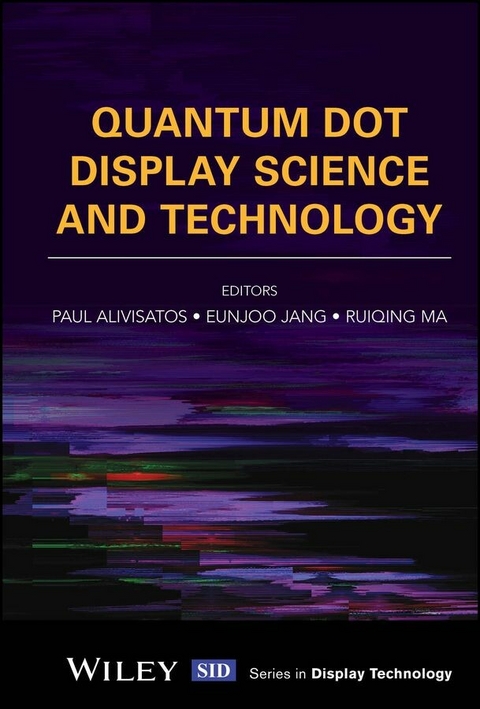
Quantum Dot Display Science and Technology (eBook)
868 Seiten
Wiley (Verlag)
978-1-394-18187-2 (ISBN)
COMPREHENSIVE REFERENCE PRESENTING ALL ASPECTS OF QUANTUM DOT-BASED DISPLAY TECHNOLOGIES IN FOUR PARTS, SUPPORTED WITH PEDAGOGICAL FEATURES
Quantum Dot Display Science and Technology presents all aspects of quantum dot (QD) based display technologies, divided into four general topic areas: the basic science of quantum dots, QD photoluminescent technologies, QD electroluminescent technologies, and other display related QD technologies. Composed of 14 chapters, this book includes a list of pedagogical features such as tables, illustrations, process flow charts, and more to provide active learning for the reader. This book also includes information on future quantum dot displays and the major milestones in the field.
Quantum Dot Display Science and Technology discusses topics including:
- The basic physics and photophysics of QD, explaining why QD can offer better color and higher brightness
- QD material systems and compositional families as well as principles and practices of QD synthesis
- Quantum dot enhancement film and quantum dot color conversion for LCDs, OLEDs, and ?LEDs
- Quantum dot electroluminescent displays and QD-LED panel processes based on ink-jet printing and lithography
- QD for lighting and photodetector applications
- Future outlook for QD displays
Published in partnership with the Society for Information Display (SID), Quantum Dot Display Science and Technology is the perfect resource for updated information on quantum dots and their applications for professionals working in displays, consumer electronics, and product design and development.
PAUL ALIVISATOS is the 14th President of the University of Chicago, USA, where he also holds a faculty appointment as the John D. MacArthur Distinguished Service Professor in the Department of Chemistry, the Pritzker School of Molecular Engineering, and the College.
EUNJOO JANG is a Professor of Sungkyunkwan University, South Korea. She received her Ph.D. in 1998 from the Chemical Engineering Department at Pohang University of Science and Technology (POSTECH). She joined Samsung in 2000 and has been developing various QD materials and optoelectronic devices since 2023.
RUIQING MA is a Fellow of Society for Information Display (SID). He received his Ph.D. in Chemical Physics in 2000 from the Liquid Crystal Institute at Kent State University, USA. Before joining Meta in 2022, he was the Senior Director of R&D at Nanosys.
COMPREHENSIVE REFERENCE PRESENTING ALL ASPECTS OF QUANTUM DOT-BASED DISPLAY TECHNOLOGIES IN FOUR PARTS, SUPPORTED WITH PEDAGOGICAL FEATURES Quantum Dot Display Science and Technology presents all aspects of quantum dot (QD) based display technologies, divided into four general topic areas: the basic science of quantum dots, QD photoluminescent technologies, QD electroluminescent technologies, and other display related QD technologies. Composed of 14 chapters, this book includes a list of pedagogical features such as tables, illustrations, process flow charts, and more to provide active learning for the reader. This book also includes information on future quantum dot displays and the major milestones in the field. Quantum Dot Display Science and Technology discusses topics including: The basic physics and photophysics of QD, explaining why QD can offer better color and higher brightnessQD material systems and compositional families as well as principles and practices of QD synthesisQuantum dot enhancement film and quantum dot color conversion for LCDs, OLEDs, and LEDsQuantum dot electroluminescent displays and QD-LED panel processes based on ink-jet printing and lithographyQD for lighting and photodetector applicationsFuture outlook for QD displays Published in partnership with the Society for Information Display (SID), Quantum Dot Display Science and Technology is the perfect resource for updated information on quantum dots and their applications for professionals working in displays, consumer electronics, and product design and development.
Chapter 1
Physics and Photophysics of Quantum Dots for Display Applications
Einav Scharf, Uri Banin
Institute of Chemistry and the Center for Nanoscience and Nanotechnology, The Hebrew University of Jerusalem, Jerusalem, Israel
1.1 Introduction
Semiconductor quantum dots (QDs) are nanocrystals composed of hundreds to thousands of atoms, forming a lattice of nanometric size. They exhibit highly bright and stable emission, with color tunable via size, composition, and shape, and can achieve fluorescence quantum efficiency approaching unity [1]. These qualities along with their narrow emission linewidth make them prominent building blocks for display applications. The unique characteristics of QDs already enhance the properties of existing display technologies, and with further developments, they are bound to penetrate display device technologies even to greater extent. In this chapter, we will review briefly the fundamental principles governing the optoelectronic characteristics of such QDs, serving as a basis for their utility in displays.
1.2 Quantum Confinement and Band Structure
The electronic structure of semiconductor QDs manifests a manifold of fully occupied valence band (VB) states and a manifold of empty conduction band (CB) states, separated by the bandgap. Excitation of the QD, for example, by the absorption of a photon, promotes an electron to the CB, leaving an electron vacancy, a hole, in the VB. This electron–hole pair, termed as an exciton, is bound by Coulomb attraction, granting a typical exciton binding energy and an exciton Bohr radius [2]. The Bohr radius is analogous to the Bohr radius of an electron orbiting the nucleus of a hydrogen atom. However, in the case of the QD, it is influenced by the dielectric environment and the effective mass of the semiconductor electron and hole charge carriers, resulting in an exciton Bohr radius in the nanometric scale. QDs that are smaller than the exciton Bohr radius of the corresponding semiconductor exhibit strong quantum confinement, which leads to discretization of the energy levels and size-dependent electronic and optical properties (Figure 1.1a) [3]. By varying the size of the QD, for suitable semiconductors such as InP or CdSe, its emission color can thus be tuned from blue for the smallest QDs with a diameter smaller than 2 nm, through the entire visible spectrum and to the near-infrared for large QDs with a radius of 10 nm (Figure 1.1b).
Figure 1.1 (a) Quantum confinement effect in quantum dots (QDs). The electronic structure varies with the size of QD. A bulk semiconductor (in gray) presents a fundamental bandgap between the valence band (VB) and conduction band (CB). Upon formation of QDs, the discrete states arise due to the quantum confinement effect and the bandgap increases from large to small QDs. (b) Emission from a series of CdSe QDs with sizes ranging from smaller than 2–6 nm with colors covering the visible spectrum, from blue to red, respectively, demonstrating the quantum confinement effect. (c) Electronic structure of the first two energy levels in the VB and CB.
The QD behavior can be derived by solving the particle-in-a-spherical-box problem, describing the behavior of an electron and a hole in the QD [4]. This involves solving the Schrödinger equation, in its central potential form (the potential depends only on radius):
where the Hamiltonian has separable radial and angular components. The first two terms are of the kinetic energy. is the square of the angular momentum operator, is the potential energy, and is the wave function. This problem resembles the problem of the hydrogen atom considering it being a central potential that depends on radius, and accordingly the solution for the angular part of the wave functions is similar as well. However, the main difference between the derivation of the hydrogen atom and of the QD is in the actual form of the potential energy. In the hydrogen atom, the electron is attracted to the nucleus by the Coulomb potential, whereas in the case of an electron in a QD, the potential inside the spherical box is zero and, for simplification as a first approximation, is infinite outside the box. In both the hydrogen atom and the QD, the potential depends solely on the radial distance and is independent of the angle. Therefore, in both problems, the angular solution is described by spherical harmonics. In QDs, the spherical solution can be described by spherical Bessel functions. Since the solution of the angular equation is the spherical harmonics, the energy levels are defined by four quantum numbers: the principal quantum number n, the angular momentum quantum number , the angular momentum projection quantum number , and the spin quantum number . In contrast to the hydrogen atom, the condition on the relation between the principal and angular momentum quantum numbers is canceled. Accordingly, the energy levels are denoted as for the electron and for the hole states, with denoted in numbers, and using common notation of for , for , for , etc. The first energy levels in the QD are thus , , for the electron (hole) in the CB (VB; Figure 1.1c) [5]. As in the hydrogen atom, the value of is in the range of to , resulting in a degeneracy of . The energy levels under the strong confinement approximation, for QDs that are smaller than the exciton Bohr radius, are described by:
where is the effective mass of the electron or the hole , is the radius of the QD, and is the allowed solutions arising from demanding that the wave function is 0 on the surface of the QD. For the band edge optical transition (), . The strong confinement approximation allows to treat the electron and hole as uncorrelated, neglecting in the first step the Coulomb interaction [6, 7]. Then, the Coulomb term is reintroduced using perturbation theory. This redshifts the bandgap by adding the weak attractive Coulomb interaction term [8], as approximated by:
where is the bulk bandgap energy, and are the electron and hole effective masses, respectively, is the electron charge, and is the dielectric constant.
The optical transitions, which are typically seen in absorption and emission, are dictated by selection rules [6]. The transition probability is proportional to:
where is the wave function of the electron or the hole , and is the transition dipole moment operator.
Under the envelope function approximation, the electron and hole wave functions are separated into the periodic Bloch part and the envelope part (see Eq. 1.5) [9]. Integration of the Bloch part is related to the bulk crystal lattice, approximated to be unaffected by the QD size ( in Eq. 1.5). Integration of the envelope part yields the overlap term for the electron–hole wave functions, and as the eigenstates of a particle-in-a-sphere are orthonormal, we obtain:
where is the Bloch term of the bulk semiconductor and is the envelope function ( or for electron or hole, respectively). is the oscillator strength in the bulk semiconductor and is the Kronecker delta function. Accordingly, the allowed optical transitions are those that conserve the principal and angular momentum quantum numbers of the electron–hole envelope functions of a particle-in-a-sphere (, ) [9, 10].
According to the similarity to degeneracy of the hydrogen atom energy levels, QDs can be referred to as artificial atoms [11]. This property can be probed by scanning tunneling microscopy, where a voltage is applied on a tip hovering above the QD at a distance of ~1 nm, and the tunneling current is measured. Figure 1.2a shows the tunneling I–V curve of an InAs QD [12]. Plotting the tunneling conductance spectrum reveals the density of states (Figure 1.2b). In the positive bias, the CB energy levels are probed, revealing a doublet of the two electrons in the energy level, separated by a charging energy. After a larger separation, a sextet is resolved to be assigned to the six electrons occupying the energy level. In negative bias, the VB states are slightly more convoluted, as the spacing between the energy levels is smaller. The difference between the VB and CB apparent density of states arises from the typically heavier hole, confining the energy levels closer to the band edge, and from the different orbitals constructing the bands. The CB is typically essentially constructed from the empty atomic s orbitals of the corresponding cationic element composing the semiconductor (i.e. In3+ in the case of InAs), whereas the VB is typically constructed from the atomic p orbitals related to the corresponding anionic element (As3− in the case of InAs). At , the bulk VB has a twofold degeneracy of the heavy hole and light hole p3/2 bands and below them the split-off hole p1/2 band (Figure 1.2c) [13]. This leads to a rich and dense level structure in the VB of such QDs.
Figure 1.2 (a) Tunneling I–V curve of an InAs quantum dot (QD). The QD is linked to a gold substrate and the scanning tunneling microscopy (STM) tip scans it from the top (right inset). The left inset presents a 10 × 10 nm2 STM topographic image of the QD. (b) Tunneling conductance spectrum presenting the density of states in the CB (VB) in positive (negative) bias. is the charging energy.
Source: (a, b) Reproduced from [12]/with permission of Springer...
| Erscheint lt. Verlag | 14.4.2025 |
|---|---|
| Reihe/Serie | Wiley Series in Display Technology |
| Sprache | englisch |
| Themenwelt | Technik ► Elektrotechnik / Energietechnik |
| Schlagworte | Cd-free quantum dot • CdSE-based quantum dot • Colloidal Quantum Dots • Nanocrystals • QD color conversion • QD electroluminescence (QDEL) • QD-LED • QD photoluminescence (QDPL) • quantum confinement • Quantum dot materials • Quantum dot (QD) • quantum dot research |
| ISBN-10 | 1-394-18187-6 / 1394181876 |
| ISBN-13 | 978-1-394-18187-2 / 9781394181872 |
| Informationen gemäß Produktsicherheitsverordnung (GPSR) | |
| Haben Sie eine Frage zum Produkt? |
 EPUB (Adobe DRM)
Kopierschutz: Adobe-DRM
Adobe-DRM ist ein Kopierschutz, der das eBook vor Mißbrauch schützen soll. Dabei wird das eBook bereits beim Download auf Ihre persönliche Adobe-ID autorisiert. Lesen können Sie das eBook dann nur auf den Geräten, welche ebenfalls auf Ihre Adobe-ID registriert sind.
Details zum Adobe-DRM
Dateiformat: EPUB (Electronic Publication)
EPUB ist ein offener Standard für eBooks und eignet sich besonders zur Darstellung von Belletristik und Sachbüchern. Der Fließtext wird dynamisch an die Display- und Schriftgröße angepasst. Auch für mobile Lesegeräte ist EPUB daher gut geeignet.
Systemvoraussetzungen:
PC/Mac: Mit einem PC oder Mac können Sie dieses eBook lesen. Sie benötigen eine
eReader: Dieses eBook kann mit (fast) allen eBook-Readern gelesen werden. Mit dem amazon-Kindle ist es aber nicht kompatibel.
Smartphone/Tablet: Egal ob Apple oder Android, dieses eBook können Sie lesen. Sie benötigen eine
Geräteliste und zusätzliche Hinweise
Buying eBooks from abroad
For tax law reasons we can sell eBooks just within Germany and Switzerland. Regrettably we cannot fulfill eBook-orders from other countries.
aus dem Bereich