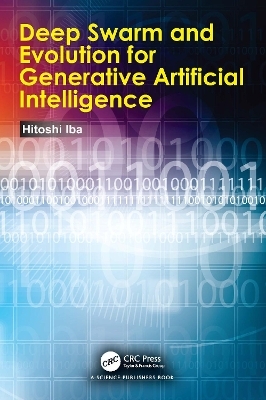
Deep Swarm and Evolution for Generative Artificial Intelligence
CRC Press (Verlag)
978-1-032-81577-0 (ISBN)
This book provides theoretical and practical knowledge about swarm and evolutionary approach of generative AI and Large Language Models (LLMs). The development of such tools contributes to better optimizing methodologies with the integration of several machinelearning and deep learning techniques. In particular, it discusses how the “emergence” concept can contribute to the improvement of AI.The book aims to model human cognitive f unction in terms of “emergence” and to explain the feasibility of AI. To this end, it focuses on human perceptions of “utility.” It describes the emergence of various cognitive errors, and irrational behaviours in the multiobjective situations. It also reviews the cognitive differences and similarities between humans and LLMs. Such studies are important when applying LLMs to real-world tasks that involve human cognition, e.g., financial engineering and market issues.
The book describes the intelligent behaviour of living organisms. This is to clarify how to achieve AI in the direction of artificial life. It describes sexual selection, which is a well-known natural phenomenon that troubled Darwin, i.e., why evolutionarily useless items evolved such as peacock feathers and moose antlers etc. The book shows how sexual selection is extended as “novelty search” for the application of generative AI, i.e., the image generation with diffusion model. Real-world applications are emphasised. Empirical examples from real-world data show how the concept of deep swarm and evolution is successfully applied when addressing tasks from such recent fields as robotics, e-commerce Web Shop and image generation etc.
Hitoshi Iba received a PhD from the University of Tokyo, Japan, in 1990. From 1990 to 1998, he was with the Electro Technical Laboratory (ETL) in Ibaraki, Japan. He is currently a Professor at the Department of Information and Communication Engineering, Graduate School of Information Science and Technology, the University of Tokyo. He has (co-)authored more than 200 papers and authored more than 40 books in English, Japanese, and Chinese. He is also an underwater naturalist and experienced PADI divemaster having completed more than a thousand dives.
Preface. Introduction. Evolutionary Approach to AI. Swarm Intelligence Approach to AI. Emergence in Multiple Objectives. Emergence Applied to Deep Learning and Generative AI. Emergence of Intelligence for AI. Conclusion. Appendix A Software Packages. Appendix B Source Codes Generated by LLMs. Appendix C Example of Interaction with LLMs. References. Index.
| Erscheinungsdatum | 22.05.2025 |
|---|---|
| Zusatzinfo | 31 Tables, black and white; 29 Line drawings, color; 94 Line drawings, black and white; 9 Halftones, color; 14 Halftones, black and white; 38 Illustrations, color; 108 Illustrations, black and white |
| Verlagsort | London |
| Sprache | englisch |
| Maße | 156 x 234 mm |
| Gewicht | 580 g |
| Themenwelt | Informatik ► Theorie / Studium ► Künstliche Intelligenz / Robotik |
| Technik ► Elektrotechnik / Energietechnik | |
| ISBN-10 | 1-032-81577-9 / 1032815779 |
| ISBN-13 | 978-1-032-81577-0 / 9781032815770 |
| Zustand | Neuware |
| Informationen gemäß Produktsicherheitsverordnung (GPSR) | |
| Haben Sie eine Frage zum Produkt? |
aus dem Bereich