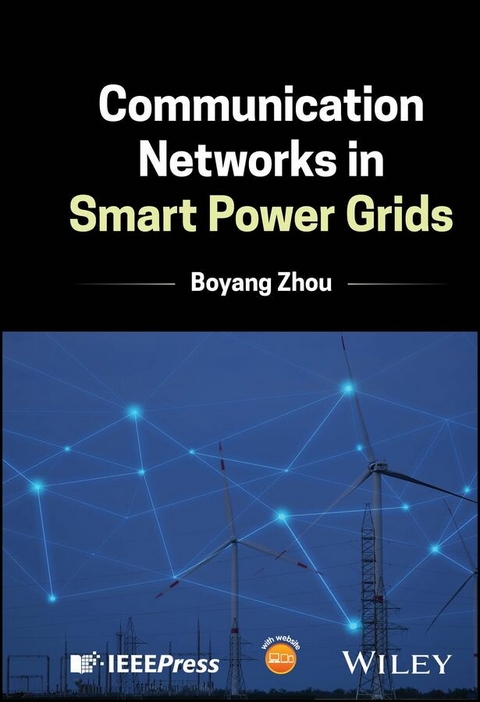
Communication Networks in Smart Power Grids (eBook)
628 Seiten
Wiley-IEEE Press (Verlag)
978-1-394-28510-5 (ISBN)

Presents an up-to-date overview of resilient communication networks for smart electric power grids
Smart electric power grids require reliable communication networks to maintain efficiency, security, and stability. The interconnected nature of these systems creates unique challenges, including cascading failures, natural disasters, and network congestion. Despite the importance of building communication networks to connect the next generation of smart power grids, existing literature is lacking in both depth and relevance. Communication Networks in Smart Power Grids bridges this gap, offering a robust examination of cutting-edge technologies and techniques for ensuring uninterrupted data transmission.
In this authoritative volume, author Boyang Zhou provides a detailed exploration of smart grid communication channels, focusing on Quality of Service (QoS) requirements and the resilience necessary to counter data loss, network failures, and delays. Addressing a wide range of key topics, from Supervisory Control and Data Acquisition (SCADA) systems to high payload packet loss mitigation, the author presents practical strategies and solutions for fortifying data transport layers. Throughout the book, Zhou introduces cutting-edge research techniques to address communication link failures, link flooding attacks (LFAs), cascading grid failures, and other critical issues.
Offering innovative approaches to building the next generation of smart grid communication networks, this essential resource:
- Provides a comprehensive examination of the design and implementation of highly resilient communication networks in smart electric power grids
- Focuses on Quality of Service (QoS) and reliability, ensuring efficient data transmission and reduced packet loss
- Presents real-world strategies for mitigating network congestion, natural disasters, and high payload packet losses
- Features practical insights from a leading expert in smart grid communications, industrial internet security, and network resilience
- Explores data forwarding reliability, transmission control protocols, and routing reliability assurance tailored for smart grids.
Combining insights from communication networks, power grid operations, and advanced network security techniques, Communication Networks in Smart Power Grids is a must-read for advanced researchers and professionals in communication networks, network security, and smart grid systems. It is also an excellent textbook for courses on smart grid technology, network resilience, and industrial IoT in electrical engineering, computer science, and industrial technology programs.
Boyang Zhou, PhD, is a Research Expert at Zhejiang Lab and an Associate Professor at the School of Intelligent Science and Technology, Hangzhou Institute for Advanced Study, University of the Chinese Academy of Sciences (UCAS). With a doctorate in Computer Science from Zhejiang University, Zhou has published more than 40 papers in leading journals and conferences, authored multiple standards, and holds 30 patents. His research focuses on industrial internet security, smart grid communications, network resilience, and high efficiency computing networks.
Presents an up-to-date overview of resilient communication networks for smart electric power grids Smart electric power grids require reliable communication networks to maintain efficiency, security, and stability. The interconnected nature of these systems creates unique challenges, including cascading failures, natural disasters, and network congestion. Despite the importance of building communication networks to connect the next generation of smart power grids, existing literature is lacking in both depth and relevance. Communication Networks in Smart Power Grids bridges this gap, offering a robust examination of cutting-edge technologies and techniques for ensuring uninterrupted data transmission. In this authoritative volume, author Boyang Zhou provides a detailed exploration of smart grid communication channels, focusing on Quality of Service (QoS) requirements and the resilience necessary to counter data loss, network failures, and delays. Addressing a wide range of key topics, from Supervisory Control and Data Acquisition (SCADA) systems to high payload packet loss mitigation, the author presents practical strategies and solutions for fortifying data transport layers. Throughout the book, Zhou introduces cutting-edge research techniques to address communication link failures, link flooding attacks (LFAs), cascading grid failures, and other critical issues. Offering innovative approaches to building the next generation of smart grid communication networks, this essential resource: Provides a comprehensive examination of the design and implementation of highly resilient communication networks in smart electric power gridsFocuses on Quality of Service (QoS) and reliability, ensuring efficient data transmission and reduced packet lossPresents real-world strategies for mitigating network congestion, natural disasters, and high payload packet lossesFeatures practical insights from a leading expert in smart grid communications, industrial internet security, and network resilienceExplores data forwarding reliability, transmission control protocols, and routing reliability assurance tailored for smart grids. Combining insights from communication networks, power grid operations, and advanced network security techniques, Communication Networks in Smart Power Grids is a must-read for advanced researchers and professionals in communication networks, network security, and smart grid systems. It is also an excellent textbook for courses on smart grid technology, network resilience, and industrial IoT in electrical engineering, computer science, and industrial technology programs.
Acronyms
- AC
- Alternating Current
- ACSI
- Abstract Communication Service Interface
- ADCT
- AdaRQ Dynamic Coding Tunnels
- ADSS
- All-Dielectric Self-Supporting Cable
- AFR
- Active Fault Recovery
- APS
- Automatic Protection Switching
- ARED
- Adaptive RaptorQ Encoder and Decoder
- ARFCN
- Absolute Radio Frequency Channel Number
- ARQ
- Automatic Repeat reQuest
- AS
- Autonomous System
- ASIC
- Application-Specific Integrated Circuit
- BCCH
- Broadcast Control Channel
- BEC
- Binary Erasure Channel
- BFS
- Breadth-First Search
- BGP
- Border Gateway Protocol
- BMv2
- Behavioral Model v2
- BPDU
- Bridge Protocol Data Unit
- BRP
- Beacon Redundancy Protocol
- CDF
- Cumulative Probability Distribution Function
- CDT
- Capsule Delivery Time
- CIAT
- Capsule Inter-Arrival Time
- CPN
- Cognitive Packet Network
- CPRF
- Conditional Probability of Retransmission Failure Cases
- CR
- Confidence Ratio
- CRC
- Cyclic Redundancy Check
- CRP
- Cross-Network Redundancy Protocol
- CS
- Content Store
- CSMA
- Carrier Sense Multiple Access
- DANH
- Doubly Attached Node with HSR protocol
- DC
- Direct Current
- DDoS
- Distributed Denial-of-Service
- DNP3
- Distributed Network Protocol
- DPDK
- Data Plane Development Kit
- DPE
- Defense Policy Enforcement
- DPG
- Defense Policy Generation
- DRP
- Distributed Redundancy Protocol
- DRTP
- Disruption-Resilient Transport Protocol
- DSP
- Disjoint Subpath
- DTU
- Distribution Terminal Unit
- EEDT
- End-to-End Payload Packet Delivery Time
- EEFR
- End-to-End Failure Rate in Packet Delivery
- EELR
- End-to-End Packet Loss Rate
- EPON
- Ethernet Passive Optical Network
- EWSSA
- Electric Wireless Security Situational Awareness System
- FCS
- Frame Check Sequence
- FEC
- Forward Error Correction
- FI
- Fragility Index
- FIB
- Forwarding Information Base
- FLP
- Fault Link Percentage
- FPGA
- Field Programmable Gate Array
- FPR
- False Positive Rate
- FRR
- Fast Reroute
- FTU
- Feeder Terminal Unit
- GOOSE
- Generic Object-Oriented Substation Event
- GPON
- Gigabit Passive Optical Network
- GPS
- Global Positioning System
- GSM
- Global System for Mobile Communications
- HARQ
- Hybrid Automatic Repeat-reQuest
- HRRT
- Half Round-Trip Time
- HSR
- High-availability Seamless Redundancy
- ICMP
- Internet Control Message Protocol
- ID
- Identification
- IED
- Intelligent Electronic Device
- IP
- Internet Protocol
- IT
- Information Technology
- ITP
- Internet Transport Protocol
- IoT
- Internet-of-things
- KSP
- K Shortest Paths
- LCLA
- Link Congestion Level Analysis
- LFA
- Link-Flooding Attack
- LLDP
- Link Layer Discovery Protocol
- LLR
- Link Loss Rate in Packets
- LOF
- Local Outlier Factor
- LQI
- Link Quality Indicator
- LRT
- Link Recovery Time
- LSA
- Link State Advertisement
- LSDB
- Link State Database
- LSR
- Label Switch Router
- LTE
- Long-Term Evolution
- LoRa
- Long-Range Radio
- MADSWIP
- Maximally Disjoint Shortest & Widest Paths
- MAR
- Messages in DRTP Arrived at the Router Per Second
- MMS
- Manufacturing Message Specification
- MPLS
- Multiprotocol Label Switching
- MPPS
- Million Packets Per Second
- MPSG
- Multipath Subgraph
- MPSGA
- Multipath Subgraph Generation Algorithm
- MPTCP
- Multipath Transmission Control Protocol
- MRDP
- Mean Rate of Data Flows
- MRP
- Media Redundancy Protocol
- MSR
- Message Sent and Received by Each Router of the PP in Delivering a Capsule
- MSTP
- Multi-Service Transport Platform
- MTD
- Moving Target Defense
- MTTFN
- Mean Time to Failure of Network
- MTTRN
- Mean Time to Repair Network
- MU
- Merging Unit
- NASPI
- North American Synchrophasor Initiative
- NDN
- Named Data Network
- NDPA
- Non-Disjoint Path Aggregation
- NF
- Noise Figure
- NIST
- National Institute of Standards and Technology
- NMN
- Number of Messages Sent Per Node of PP
- NTH
- Non-Threatened Host
- NTP
- Network Time Protocol
- ODPG
- Optimal Disjoint Paths Generation
- OF
- OpenFlow
- OGR
- Observable Grid Ratio
- OOR
- Out-of-Order Rate at the Receiver Side
- OPAM
- OpenFlow-based Non-Disjoint Path Aggregation Mechanism
- OPC-UA
- Open Platform Communications Unified Architecture
- OPGW
- Optical Ground Wire
- OSPF
- Open Shortest Path First
- OT
- Operational Technology
- OTN
- Optical Transport Network
- P4
- Programming Protocol-Independent Packet Processors
- PAFM
- Packet Aggregation and Forwarding Module
- PDC
- Phasor Data Concentrator
- Probability Density Function
- PEGASE
- Pan European Grid Advanced Simulation and State Estimation
- PIAT
- Packet Inter-Arrival Time
- PIT
- Pending Interest Table
- PLC
- Programmable Logic Controller
- PMS
- Production Management System
- PMU
- Phasor Measurement Unit
- PON
- Passive Optical Network
- POR
- Packet Out-of-Order Rate
- PP
- Primary Forwarding Path
- PR
- Persistent Route
- PRDD
- Persistent Route Diversification Defense
- PRF
- Probability of Retransmission Failure Cases
- PROTAG
- Proxy-based Moving Target Architecture
- PRP
- Parallel Redundancy Protocol
- PRT
- Packet Reordering Time at the Consumer
- PTN
- Packet Transport Network
- QSDP
- Qualified Source–Destination Pairs
- QSRP
- Quality of Service in Receiving a Packet
- QoS
- Quality-of-Service
- QuadBox
- Quadruple Port Device
- R2T
- Rapid and Reliable Transport Mechanism
- RFR
- Reroute Failure Rate
- RIP
- Routing Information Protocol
- RNN
- Recurrent Neural Network
- RQ
- RaptorQ
- RRP
- Ring-based Redundancy Protocol
- RRV
- Resilient Route Vector
- RSDD
- Resilient Sensor Data Dissemination
- RSG
- Resilient Subgraph
- RSGA
- RSG Generation Algorithm
- RSGV
- RSG vector
- RSP
- Redundant Sub-Path
- RSSI
- Received Signal Strength Indicator
- RSTP
- Rapid Spanning Tree Protocol
- RTDS
- Real-Time Digital Simulator
- RTT
- Round-Trip Time
- RTU
- Remote Terminal Unit
- RedBox
- Redundant Box
- SC
- South Carolina
- SCADA
- Supervisory Control and Data Acquisition
- SCL
- System Configuration Language
- SCSM
- Specific Communication Service Mapping
- SCTP
- Stream Control Transmission Protocol
- SDATP
- Adaptive Transmission Protocol based on Software-Defined Networking
- SDH
- Synchronous Digital Hierarchy
- SDN
- Software-Defined Networking
- SDR
- Software-Defined Radio
- SE
- State Estimation
- SFH
- States of Forwarding History
- SGCC
- State Grid Corporation of China
- SONET
- Synchronous Optical Networking
- SPT
- Shortest Path Tree
- SRAM
- Static Random-Access Memory
- SRE
- Satisfaction Ratio of EEDT
- SROP
- Recent Out-of-order Packets
- SRRP
- Success Rate of Receiving a Packet
- STD
- Standard Deviation
- STM
- State Transition Machine
- STP
- Spanning Tree Protocol
- SV
- Sampled Values
- TA-FRR
- Traffic-Aware Fast Reroute
- TCP
- Transmission Control Protocol
- TH
- Threatened Host
- TLV
- Type–Length–Value
- TTL
- Time-To-Live
- TTU
- Transformer Terminal Unit
- UDP
- User Datagram Protocol
- VANET
- Vehicle Ad Hoc Network
- WAMS
- Wide-Area...
| Erscheint lt. Verlag | 10.4.2025 |
|---|---|
| Sprache | englisch |
| Themenwelt | Technik ► Elektrotechnik / Energietechnik |
| Schlagworte | Power Grid Stability • SCADA systems • smart grid data transmission • smart grid network resilience • smart grid networks • smart grid quality of service • smart grid research • smart grid resilient data transport • smart power grid network security |
| ISBN-10 | 1-394-28510-8 / 1394285108 |
| ISBN-13 | 978-1-394-28510-5 / 9781394285105 |
| Informationen gemäß Produktsicherheitsverordnung (GPSR) | |
| Haben Sie eine Frage zum Produkt? |
 EPUB (Adobe DRM)
Kopierschutz: Adobe-DRM
Adobe-DRM ist ein Kopierschutz, der das eBook vor Mißbrauch schützen soll. Dabei wird das eBook bereits beim Download auf Ihre persönliche Adobe-ID autorisiert. Lesen können Sie das eBook dann nur auf den Geräten, welche ebenfalls auf Ihre Adobe-ID registriert sind.
Details zum Adobe-DRM
Dateiformat: EPUB (Electronic Publication)
EPUB ist ein offener Standard für eBooks und eignet sich besonders zur Darstellung von Belletristik und Sachbüchern. Der Fließtext wird dynamisch an die Display- und Schriftgröße angepasst. Auch für mobile Lesegeräte ist EPUB daher gut geeignet.
Systemvoraussetzungen:
PC/Mac: Mit einem PC oder Mac können Sie dieses eBook lesen. Sie benötigen eine
eReader: Dieses eBook kann mit (fast) allen eBook-Readern gelesen werden. Mit dem amazon-Kindle ist es aber nicht kompatibel.
Smartphone/Tablet: Egal ob Apple oder Android, dieses eBook können Sie lesen. Sie benötigen eine
Geräteliste und zusätzliche Hinweise
Buying eBooks from abroad
For tax law reasons we can sell eBooks just within Germany and Switzerland. Regrettably we cannot fulfill eBook-orders from other countries.
aus dem Bereich