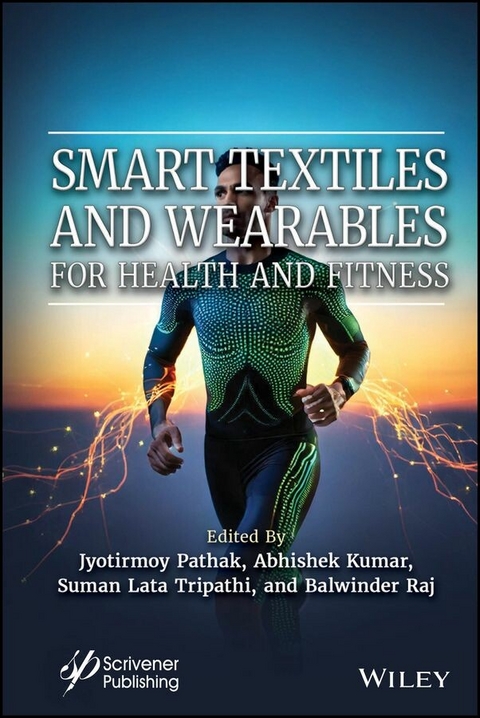
Smart Textiles and Wearables for Health and Fitness (eBook)
654 Seiten
Wiley-Scrivener (Verlag)
978-1-394-30287-1 (ISBN)

Smart Textiles and Wearables for Health and Fitness provides an in-depth exploration of how innovative technologies and materials are reshaping healthcare, making it an essential resource for anyone looking to understand the transformative power of smart textiles and wearables in patient monitoring, diagnosis, and rehabilitation.
Smart Textiles and Wearables for Health and Fitness explores the transformative influence of flexible electronics on the healthcare field. The book's chapters include a broad spectrum of topics, each offering valuable perspectives on the intersection of textiles, wearables, and health technology.
Smart Textiles and Wearables for Health and Fitness delves into the unique technologies and materials driving the flexible electronics revolution, offering insights into their development and applications. The study explores the diverse uses of intelligent textiles and wearable devices in healthcare, encompassing activities such as monitoring patients, diagnosing conditions, aiding rehabilitation, and administering therapeutic interventions. In this volume, we will explore the incorporation of sensors, biometrics, and biomarkers into textiles to showcase their capacity for immediate health monitoring and data collection. Additionally, we will explore the possible uses of smart textiles and wearables in managing chronic conditions, tracking sports and fitness activities, and facilitating human-computer interaction in medical settings. This book promises an engaging journey through the frontiers of technology, offering a comprehensive understanding of the transformative potential of smart textiles and wearables in revolutionizing healthcare delivery and improving patient outcomes.
Jyotirmoy Pathak, PhD, is a professor at Christ University, Bengaluru, India and serves on several editorial review boards. He has authored over 20 research papers, five book chapters, and one book that have been internationally published. His research interests include side channel attack, VLSI design, low power architecture, memory design, data converters, and cryptology.
Abhishek Kumar, PhD, is an associate professor at Lovely Professional University, Punjab, India, and editorial board member for various international journals and conferences. He has published over 30 research papers in referred journals and presented 18 research papers at international conferences. Additionally, he has published five books and 12 book chapters internationally. His areas of expertise include VLSI design, low-power architecture, memory design, data converters, cryptology, and side channel attack.
Suman Lata Tripathi, PhD, is a professor at Lovely Professional University, Punjab, India with over seventeen years of scholarly experience. She has published over 45 research papers in refereed journals and conferences, as well as six books. She has orchestrated several student seminars, summer apprenticeships, and lectures by subject matter experts. Her research interests include modelling and characterization of microelectronics devices, design of low power VLSI circuits, VLSI testing designs, advanced FET designs for the Internet of Things, embedded system design, and biomedical applications.
Balwinder Raj, PhD, is an associate professor in the Electronics and Communication Engineering Department, Dr. B.R. Ambedkar National Institute of Technology Jalandhar, Punjab, India. He has published over 100 research papers in national and international journals and conferences. His areas of interest include nanoscale semiconductor device modeling, sensors design, FinFET- based memory design, and low-power VLSI design.
Smart Textiles and Wearables for Health and Fitness provides an in-depth exploration of how innovative technologies and materials are reshaping healthcare, making it an essential resource for anyone looking to understand the transformative power of smart textiles and wearables in patient monitoring, diagnosis, and rehabilitation. Smart Textiles and Wearables for Health and Fitness explores the transformative influence of flexible electronics on the healthcare field. The book s chapters include a broad spectrum of topics, each offering valuable perspectives on the intersection of textiles, wearables, and health technology. Smart Textiles and Wearables for Health and Fitness delves into the unique technologies and materials driving the flexible electronics revolution, offering insights into their development and applications. The study explores the diverse uses of intelligent textiles and wearable devices in healthcare, encompassing activities such as monitoring patients, diagnosing conditions, aiding rehabilitation, and administering therapeutic interventions. In this volume, we will explore the incorporation of sensors, biometrics, and biomarkers into textiles to showcase their capacity for immediate health monitoring and data collection. Additionally, we will explore the possible uses of smart textiles and wearables in managing chronic conditions, tracking sports and fitness activities, and facilitating human-computer interaction in medical settings. This book promises an engaging journey through the frontiers of technology, offering a comprehensive understanding of the transformative potential of smart textiles and wearables in revolutionizing healthcare delivery and improving patient outcomes.
1
History of Smart Textiles and Wearables
K. Jothimani*, S. Hemalatha, S. Selvaraj and R. Thangarajan
Department of Computer Science and Design, Kongu Engineering College, Tamil Nadu, India
Abstract
Smart textiles and wearables represent a fusion of technology with traditional textiles, revolutionizing various industries such as healthcare, fashion, sports, and the military. This paper provides an abstract of the historical evolution of smart textiles and wearables, tracing their development from early concepts to contemporary innovations. The journey begins with the earliest instances of incorporating technology into textiles. The Industrial Revolution marked a significant shift with the introduction of mechanized textile production, setting the stage for further advancements. The mid-20th century witnessed the emergence of functional textiles, including flame-resistant fabrics and moisture-wicking materials, laying the groundwork for future smart textile applications. The late 20th and early 21st centuries witnessed rapid progress driven by advancements in materials science, nanotechnology, and electronics miniaturization. The development of conductive fabrics, flexible electronics, and sensors led to the creation of interactive textiles capable of sensing, reacting, and adapting to environmental stimuli. Wearable technologies evolved from bulky prototypes to sleek, integrated systems, enhancing user experience and functionality. Key milestones such as the introduction of wearable fitness trackers, smart clothing for medical monitoring, and fashion-tech collaborations are highlighted. Innovations in energy harvesting and power management have also contributed to the autonomy and longevity of smart textiles and wearables, reducing dependence on external power sources. Moreover, advancements in data analytics, artificial intelligence, and connectivity technologies like Internet of Things have further expanded the capabilities of smart textiles and wearables. They now play pivotal roles in health monitoring, performance enhancement, augmented reality experiences, and even environmental sensing. The paper concludes with a discussion of current trends and prospects, emphasizing the potential of smart textiles and wearables to continue transforming industries and enriching human lives. Challenges such as sustainability, scalability, and privacy concerns are also addressed, highlighting areas for further research and innovation in this dynamic field.
Keywords: Smart textiles, wearable technologies, textile innovation, historical development, materials science, flexible electronics, sensors
1.1 Introduction
Smart textiles and wearables refer to innovative materials and clothing items that incorporate advanced technologies to enhance functionality and provide additional features beyond traditional textiles and garments. Smart textiles are fabrics that have been engineered to have capabilities beyond those of conventional textiles, often integrating electronic components or other advanced materials [1]. These textiles can sense and respond to environmental stimuli or user inputs such as changes in temperature, motion, or biometric data. Examples include fabrics with embedded sensors for monitoring vital signs, textile-based displays for information visualization, or fabrics with integrated heating elements for temperature regulation. Wearables, on the other hand, are electronic devices or accessories that can be worn on the body, often in the form of clothing, accessories, or sensors, and are designed to collect data, provide feedback, or perform specific functions. Wearable devices may include fitness trackers, smartwatches, augmented reality (AR) glasses, or even implantable devices [2]. They can range from simple devices that track physical activity to complex systems that monitor health metrics, enable communication, or augment human capabilities. Together, smart textiles and wearables represent the intersection of fashion, technology, and functionality, offering new opportunities for personalized, interactive, and adaptive experiences in various domains including healthcare, sports, fashion, and entertainment. Some of the key importance and applications of smart textiles and wearables in different industries include healthcare, fitness and sports, fashion and apparel, military and defense, industrial manufacturing, entertainment, and media.
1.2 Early Concepts and Historical Background
The concept of smart textiles and wearables has its roots in early human history, where people used natural materials like animal skins and plant fibers for clothing and protection. However, the integration of technology into textiles and garments is a more recent development. Early Innovations: While textiles have been used for millennia, the incorporation of technology into fabrics began to emerge in the late 19th and early 20th centuries. Early innovations included the development of synthetic fibers like nylon and polyester, which offered strength, durability, and elasticity. Applications include military, space exploration, and medical textiles.
1.2.1 Incorporation of Technology in Textiles: Ancient Practices
While the integration of technology into textiles may seem like a recent development, there are historical precedents that demonstrate early forms of incorporating technology into fabric production and design. Here are some examples of ancient practices that involved the incorporation of technology in textiles: The first one is weaving techniques: Weaving, one of the oldest textile production techniques, involves the interlacing of threads or fibers to create fabric. The Egyptians, Mesopotamians, and Chinese developed sophisticated weaving technologies, including looms and spinning wheels, to produce textiles for clothing, household items, and trade. These early weaving techniques can be considered a form of technology that enabled the mass production of textiles. The second one is dyeing and printing: Ancient cultures developed various methods for dyeing and printing textiles to add color, patterns, and decorative motifs to fabrics. Techniques of batik, tie-dyeing, and block printing involved intricate processes and specialized tools to apply dyes and pigments onto textiles. These early methods of textile decoration can be seen as a form of technology that enhanced the aesthetic appeal and value of fabrics. The third one is embroidery and embellishment: Embroidery is another ancient textile technique that involves stitching decorative designs onto fabric using needle and thread. Ancient civilizations across the world, including the Greeks, Romans, Persians, and Chinese, practiced embroidery to embellish clothing, accessories, and ceremonial textiles. Embroidery required skillful craftsmanship and specialized tools, demonstrating an early form of technology in textile ornamentation. Finally, textile reinforcement: In ancient times, textiles were often used for practical purposes beyond clothing, such as for construction, transportation, and protection. Techniques like felting, quilting, and padding were employed to create textiles with enhanced strength, durability, and insulation properties. For example, ancient nomadic cultures used felted wool to construct portable tents and clothing for harsh environments, showcasing the use of textiles as a form of technology for shelter and insulation.
Incorporation Technologies Used:
- Sensors
- Actuators
- Conductive fibers and yarns
- Power supply and storage
- Integrated batteries or energy-harvesting systems
- Microcontrollers and processors
1.2.2 Industrial Revolution and Textile Mechanization
The Industrial Revolution, which began in the late 18th century in Britain and later spread to other parts of the world, had a profound impact on textile production through mechanization and the development of factory systems. Here is an overview of how the Industrial Revolution transformed the textile industry. Mechanization of textile production before the Industrial Revolution, textile production was primarily done by hand using traditional methods such as spinning wheels and hand looms. However, during the late 18th and early 19th centuries, significant advancements were made in textile machinery, leading to the mechanization of various stages of production. The invention of textile machinery that is one of the key inventions of the Industrial Revolution was the spinning jenny, developed by James Hargreaves in 1764 [3]. The spinning jenny allowed for multiple spindles to spin yarn, simultaneously increasing the productivity of spinning and reducing the labor required. This was followed by the invention of the spinning mule by Samuel Crompton in 1779, which combined features of the spinning jenny and the water frame, further improving the efficiency of yarn production. The next introduction of power looms was the development of power looms, which revolutionized the weaving process by automating the weaving of cloth. Power looms used steam power or water power to operate, enabling the mass production of textiles on a much larger scale than was possible with hand looms. The next one is the factory system mechanization of textile production that led to the establishment of large-scale textile factories where machines were powered by steam engines or waterwheels. The adoption of the factory system centralized production in urban areas, leading to the growth of industrial cities’ economic consequences [4]. While it increased the efficiency and output of textile manufacturing, it also led to the displacement of skilled hand...
| Erscheint lt. Verlag | 9.4.2025 |
|---|---|
| Sprache | englisch |
| Themenwelt | Naturwissenschaften ► Chemie |
| Technik ► Maschinenbau | |
| Schlagworte | biomarker detection • Biometric sensors • Chronic Care Management • Data Security • ethical considerations • Fitness Wearable • Flexible electronics • Healthcare innovation • Health Monitoring • Human-Computer interaction • Neurotechnology • Smart Textiles • Textile-based Sensors • wearable technology |
| ISBN-10 | 1-394-30287-8 / 1394302878 |
| ISBN-13 | 978-1-394-30287-1 / 9781394302871 |
| Informationen gemäß Produktsicherheitsverordnung (GPSR) | |
| Haben Sie eine Frage zum Produkt? |
 EPUB (Adobe DRM)
Kopierschutz: Adobe-DRM
Adobe-DRM ist ein Kopierschutz, der das eBook vor Mißbrauch schützen soll. Dabei wird das eBook bereits beim Download auf Ihre persönliche Adobe-ID autorisiert. Lesen können Sie das eBook dann nur auf den Geräten, welche ebenfalls auf Ihre Adobe-ID registriert sind.
Details zum Adobe-DRM
Dateiformat: EPUB (Electronic Publication)
EPUB ist ein offener Standard für eBooks und eignet sich besonders zur Darstellung von Belletristik und Sachbüchern. Der Fließtext wird dynamisch an die Display- und Schriftgröße angepasst. Auch für mobile Lesegeräte ist EPUB daher gut geeignet.
Systemvoraussetzungen:
PC/Mac: Mit einem PC oder Mac können Sie dieses eBook lesen. Sie benötigen eine
eReader: Dieses eBook kann mit (fast) allen eBook-Readern gelesen werden. Mit dem amazon-Kindle ist es aber nicht kompatibel.
Smartphone/Tablet: Egal ob Apple oder Android, dieses eBook können Sie lesen. Sie benötigen eine
Geräteliste und zusätzliche Hinweise
Buying eBooks from abroad
For tax law reasons we can sell eBooks just within Germany and Switzerland. Regrettably we cannot fulfill eBook-orders from other countries.
aus dem Bereich