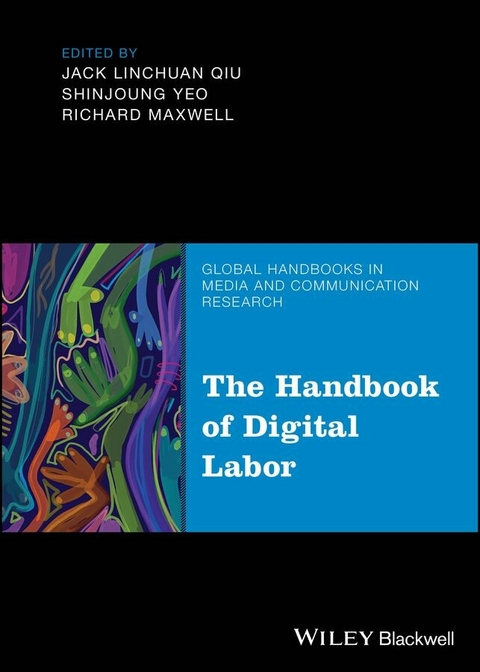
The Handbook of Digital Labor (eBook)
868 Seiten
Wiley-Blackwell (Verlag)
978-1-119-98182-4 (ISBN)
Provides a global perspective on labor and technology, exploring resistance, solidarity, and alternatives in digital capitalism
The Handbook of Digital Labor critically examines how digital technologies are reshaping work and employment around the globe. Bridging historical and contemporary perspectives, this timely volume explores the dynamics of labor within digital capitalism using a critical framework that illuminates the systemic challenges faced by workers across diverse sectors. Dozens of contributing authors address key challenges including surveillance, inequality, and environmental exploitation, while highlighting innovative forms of resistance and organizing.
Organized into four sections???Working-Class Resistance, Digital Capitalism and Alternatives, Laboring under Digital Capitalism, and Theorizing Digital Labor???the Handbook offers a nuanced understanding of how workers navigate the intersection of technological advancement and capitalist development. In-depth chapters cover topics ranging from platform work to AI-driven labor processes???shedding light on the realities of digital labor.
Equipping readers with the tools to critically engage with labor struggles across diverse industries and geographies, the Handbook of Digital Labor:
- Offers interdisciplinary insights from leading scholars in media, communication, labor studies, political economy, as well as unionists, activists, and other on-the-ground practitioners
- Presents both historical and contemporary analyses of labor conditions under digital capitalism
- Advocates for actionable strategies to empower labor movements and build equitable and sustainable alternatives
- Features real-world case studies of worker resistance and solidarity across platforms and industries
Emphasizing both theory and praxis, the Handbook of Digital Labor is ideal for advanced undergraduate and graduate students, junior faculty, and researchers in media studies, labor sociology, and public policy. It is a vital resource for courses on digital labor, political economy, and social change within communications and technology programs. Labor organizers, policymakers, and industry professionals will find it an indispensable guide to navigating the complexities of work in the digital age.
Provides a global perspective on labor and technology, exploring resistance, solidarity, and alternatives in digital capitalism The Handbook of Digital Labor critically examines how digital technologies are reshaping work and employment around the globe. Bridging historical and contemporary perspectives, this timely volume explores the dynamics of labor within digital capitalism using a critical framework that illuminates the systemic challenges faced by workers across diverse sectors. Dozens of contributing authors address key challenges including surveillance, inequality, and environmental exploitation, while highlighting innovative forms of resistance and organizing. Organized into four sections Working-Class Resistance, Digital Capitalism and Alternatives, Laboring under Digital Capitalism, and Theorizing Digital Labor the Handbook offers a nuanced understanding of how workers navigate the intersection of technological advancement and capitalist development. In-depth chapters cover topics ranging from platform work to AI-driven labor processes shedding light on the realities of digital labor. Equipping readers with the tools to critically engage with labor struggles across diverse industries and geographies, the Handbook of Digital Labor: Offers interdisciplinary insights from leading scholars in media, communication, labor studies, political economy, as well as unionists, activists, and other on-the-ground practitioners Presents both historical and contemporary analyses of labor conditions under digital capitalism Advocates for actionable strategies to empower labor movements and build equitable and sustainable alternatives Features real-world case studies of worker resistance and solidarity across platforms and industries Emphasizing both theory and praxis, the Handbook of Digital Labor is ideal for advanced undergraduate and graduate students, junior faculty, and researchers in media studies, labor sociology, and public policy. It is a vital resource for courses on digital labor, political economy, and social change within communications and technology programs. Labor organizers, policymakers, and industry professionals will find it an indispensable guide to navigating the complexities of work in the digital age.
Notes on Contributors
Mark Andrejevic is a professor in the School of Media, Film, and Journalism at Monash University. He writes about digital media, automation, and surveillance and is the author or co‐author of five books and over 100 research articles and book chapters.
Adam Arvidsson is a professor of Sociology at the University of Naples, Federico II (Italy). He has worked on brands, creative cities and professions, and the political economy of digital technologies. His most recent book is Changemakers: The Industrious Future of the Digital Economy (Polity 2019).
Arlen Austin completed his dissertation in the Department of Modern Culture and Media at Brown University in 2024, focusing on the relationship between feminist theories of reproductive labor and the political economy of televisual and digital media. He is co‐editor, with Silvia Federici, of The New York Wages for Housework Committee 1972–1979: History, Theory, and Documents. He is currently completing a new translation, introduction, and annotation of Leopoldina Forunati's classic work L'arcano della riproduzione for Verso Books. He is also co‐editor, with Jaleh Mansoor and Sara Colantuono, of Fillip Foglio G, Gendered Labour and Clitoridean Revolt. Leopoldina Fortunati and Carla Lonzi. His writings have appeared in numerous journals, including GLQ: A Journal of Lesbian and Gay Studies, Viewpoint, differences: A Journal of Feminist Cultural Studies, and TDR: The Drama Review, among others.
Matheus Viana Braz is a social psychologist and assistant professor in the Department of Psychology at Minas Gerais State University (UEMG), Brazil. He is also a professor in the Graduate Program in Psychology at Maringá State University (UEM). He coordinates the Laboratory of Work, Health, and Subjectivation Processes (LATRAPS) and is a Visiting Researcher at the Laboratoire de Changement Social et Politique (LCSP) at Université Paris Cité. His research primarily focuses on the digital platform economy, the role of human labor in the global AI supply chain, digital inequalities, and workers' health, with a particular emphasis on Latin America.
Enda Brophy is an associate professor in the School of Communication and an associate in the Labour Studies Program at Simon Fraser University. He is the author of Language Put to Work: The Making of the Global Call Centre Workforce. He has translated numerous works, including The Production of Living Knowledge: The Crisis of the University and the Transformation of Labor in Europe and North America by Gigi Roggero. He is a co‐founder of Contract Worker Justice @SFU, a coalition of workers, students, faculty, and trade unions organizing to bring cleaning and food services in‐house at Simon Fraser University.
Antonio A. Casilli is a professor of Sociology at Telecom Paris, the telecommunication school of the Polytechnic Institute of Paris, and a researcher at the Interdisciplinary Institute on Innovation (i3). His research focuses on digital labor, data governance, and human rights. He is the author of the award‐winning book En attendant les robots (Editions du Seuil 2019), translated into several languages, and the co‐creator of the documentary mini‐series “Invisibles ‐ The Click Workers” (France Télévisions 2020).
Jenny Chan is an associate professor of Sociology at The Hong Kong Polytechnic University and an International Academic Advisory Board Member of the Work and Equalities Institute at The University of Manchester. She is the co‐author, with Mark Selden and Pun Ngai, of Dying for an iPhone: Apple, Foxconn, and the Lives of China’s Workers (Haymarket Books & Pluto Press 2020), which has been translated into Korean (Narumbooks 2021) and awarded CHOICE’s Outstanding Academic Title in both the China (2022) and Work and Labor (2022) categories. Her recent analyses on coalition building among workers, students, and consumers have appeared in The China Review, The Economic and Labour Relations Review, and Critical Sociology, among others.
Changwen Chen is a critical/cultural scholar interested in the social history of learning and work culture, focusing on its intersections with technology, development, and post‐socialist politics. His work has been published in journals such as the Journal of Cultural Economy, Social Media+Society, Chinese Journal of Communication, and e‐flux Journal. He earned his PhD in Communications and New Media from the National University of Singapore.
Hanlin Chen obtained his BA degree in Communication Studies from the University of Liverpool in 2024. His research interests focus on journalism studies, digital media audiences, and users.
Qinyi Chen comes with an interdisciplinary background with her MPhil degree in Digital Humanities obtained from the University of Cambridge and BA degree in Media and Communication Studies from Xi’an Jiaotong‐Liverpool University. Her research centers on the affective dimensions of contemporary transnational digital culture and aesthetics, as well as the behavioral and emotional responses to media use. Her research interests encompass gender and sexuality studies, subcultural studies, and memory studies. Her master’s thesis focuses on the phenomenon of the prevalence of melancholic elements in Chinese digital culture through the lens of psychoanalysis.
Nicole S. Cohen is an associate professor at the University of Toronto, in the Institute of Communication, Culture, Information, and Technology and the Faculty of Information. She is the author of Writers’ Rights: Freelance Journalism in a Digital Age (McGill‐Queen’s University Press 2016), which received the 2017 Gertrude J. Robinson Book Prize from the Canadian Communication Association, and, with Greig de Peuter, New Media Unions: Organizing Digital Journalists (Routledge 2020).
Maxime Cornet is a PhD researcher at Telecom Paris specializing in the sociology of artificial intelligence, with an emphasis on its impacts on work and employment in a globalized world. His research uses data science and social network analysis approaches.
Kate Crawford is an internationally leading scholar of artificial intelligence and its impacts. She is a research professor at USC Annenberg in Los Angeles, a senior principal researcher at MSR in New York, and was the inaugural Visiting Chair of AI and Justice at the École Normale Supérieure in Paris. Her book, Atlas of AI: Power, Politics and The Planetary Costs of Artificial Intelligence, won multiple awards, including the Sally Hacker Prize, and was named one of the books of the year by New Scientist and the Financial Times. It has been translated into twelve languages.
Greig de Peuter is an associate professor in the Department of Communication Studies at Wilfrid Laurier University in Waterloo, Canada. He is co‐author, with Nicole Cohen, of New Media Unions: Organizing Digital Journalists (Routledge) and, with Nick Dyer‐Witheford, of Games of Empire: Global Capitalism and Video Games (University of Minnesota Press).
Margherita Di Cicco holds a PhD in Sociology and Social Research Methodology from the University of Milan. She is currently a lecturer in New Media and Digital Cultures at the University of Amsterdam. Her research, positioned at the intersection of labor sociology, media studies, and digital ethnography, focuses on sex workers’ experiences in the platform economy, the broader implications of labor platformization, and the evolving landscapes of digital intimacies. Margherita is also a collaborator on the “Generations and Work” project at the University of Milan, which explores shifting imaginaries around work in Italy from a generational perspective, using a combination of in‐depth interviews and qualitative digital methods.
Leopoldina Fortunati is a senior professor of Sociology of Communication and Culture in the Department of Mathematics, Computer Science, and Physics at the University of Udine, Italy. In the last decades, she has carried out several research projects at the international level and written intensively on reproduction labor and digital technologies. She is a member of the Academia Europaea and an ICA Fellow. Her works have been published in twelve languages.
Christian Fuchs is a professor of Media Systems and Media Organization at Paderborn University in Germany. He is a critical theorist of communication, digital media, and society. He is co‐editor of the journal tripleC: Communication, Capitalism & Critique. Fuchs is author of many publications, including the books Social Media: A Critical Introduction (4th edition 2025, earlier ones 2021, 2017, 2014), Media, Economy and Society (2024), Digital Capitalism (2022), Communication and Capitalism: A Critical Theory (2020), Culture and Economy in the Age of Social Media (2015), Digital Labor and Karl Marx (2014), and Internet and Society (2008). For more information on his work, visit his website: https://fuchsc.net
Seamus B. Grayer is an activist and researcher based in Vancouver, BC. In 2020, he received his master's degree from Simon Fraser University for his thesis, which studied a stock photography platform cooperative as an example of worker resistance and self‐organization in Canada's...
| Erscheint lt. Verlag | 9.4.2025 |
|---|---|
| Reihe/Serie | Global Handbooks in Media and Communication Research |
| Sprache | englisch |
| Themenwelt | Sozialwissenschaften ► Kommunikation / Medien ► Allgemeines / Lexika |
| Sozialwissenschaften ► Politik / Verwaltung | |
| Technik ► Elektrotechnik / Energietechnik | |
| Schlagworte | AI and labor • Digital capitalism • digital labor • digital labor exploitation • digital labor organizing • digital labor research • global digital labor movements • labor studies • platform work • political economy of digital labor • Worker resistance |
| ISBN-10 | 1-119-98182-4 / 1119981824 |
| ISBN-13 | 978-1-119-98182-4 / 9781119981824 |
| Informationen gemäß Produktsicherheitsverordnung (GPSR) | |
| Haben Sie eine Frage zum Produkt? |
 EPUB (Adobe DRM)
Kopierschutz: Adobe-DRM
Adobe-DRM ist ein Kopierschutz, der das eBook vor Mißbrauch schützen soll. Dabei wird das eBook bereits beim Download auf Ihre persönliche Adobe-ID autorisiert. Lesen können Sie das eBook dann nur auf den Geräten, welche ebenfalls auf Ihre Adobe-ID registriert sind.
Details zum Adobe-DRM
Dateiformat: EPUB (Electronic Publication)
EPUB ist ein offener Standard für eBooks und eignet sich besonders zur Darstellung von Belletristik und Sachbüchern. Der Fließtext wird dynamisch an die Display- und Schriftgröße angepasst. Auch für mobile Lesegeräte ist EPUB daher gut geeignet.
Systemvoraussetzungen:
PC/Mac: Mit einem PC oder Mac können Sie dieses eBook lesen. Sie benötigen eine
eReader: Dieses eBook kann mit (fast) allen eBook-Readern gelesen werden. Mit dem amazon-Kindle ist es aber nicht kompatibel.
Smartphone/Tablet: Egal ob Apple oder Android, dieses eBook können Sie lesen. Sie benötigen eine
Geräteliste und zusätzliche Hinweise
Buying eBooks from abroad
For tax law reasons we can sell eBooks just within Germany and Switzerland. Regrettably we cannot fulfill eBook-orders from other countries.
aus dem Bereich