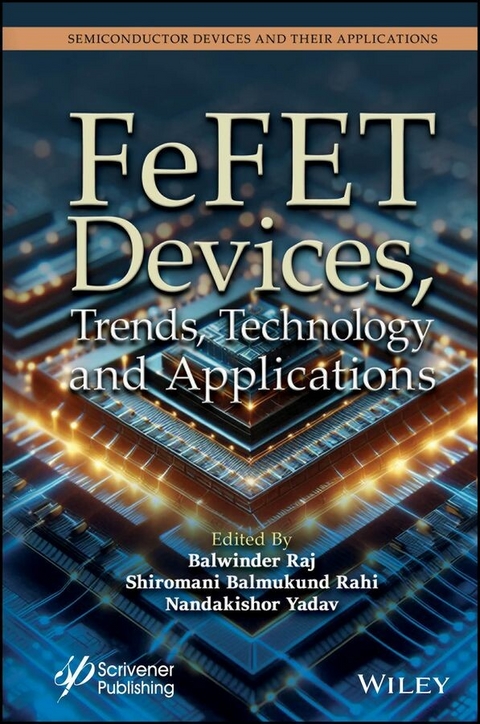
FeFET Devices, Trends, Technology and Applications (eBook)
543 Seiten
Wiley-Scrivener (Verlag)
978-1-394-28728-4 (ISBN)
FeFET Devices, Trends, Technology and Applications is essential for anyone seeking an in-depth understanding of the latest advancements in ferroelectric devices, as it offers comprehensive insights into research techniques, novel materials, and the historical context of semiconductor development.
This book serves as an encyclopedia of knowledge for state-of-the-art research techniques for the miniaturization of ferroelectric devices. This volume explores characteristics, novel materials used, modifications in device structure, and advancements in model FET devices. Though many devices following Moore's Law and More-Moore are proposed, a complete history of existing and proposed semiconductor devices is now available here. This resource focuses on developments and research in emerging ferroelectric FET devices and their applications, providing unique coverage of topics covering recent advancements and novel concepts in the field of miniaturized ferroelectric devices.
Balwinder Raj, PhD, is an associate professor at the National Institute of Technology, Jalandhar, India. He has authored and co-authored five books, 12 book chapters, and over 100 research papers in peer-reviewed national and international journals and conferences. His areas of interest include nanoscale semiconductor device modeling, nanoelectronics and their applications in hardware security, sensors, and circuit design, FinFET-based memory design, low-power very large-scale integrated design, and field programmable gate array implementation.
Shiromani Balmukund Rahi, PhD, is an assistant professor in the School of Information and Communication Technology, Gautam Buddha University, Greater Noida, India. He has published 25 research articles, two conference proceedings, 25 book chapters for various projects, and seven books for reputed internal publishers. He also serves as a reviewer for various national and international journals, conferences, and workshops. His research interests include semiconductor device modeling and simulation, tunnel FETs, NCFETs, and Nanosheet FETs.
Nandakishor Yadav, PhD, is a senior scientist with the Fraunhofer Institute for Photonic Microsystems, Dresden, Germany with over ten years of research and teaching experience. He has published over 50 research articles in peer-reviewed journals and conferences. His research interests include very large-scale interface design, Ferroelectric memory, and peripheral circuit design.
FeFET Devices, Trends, Technology and Applications is essential for anyone seeking an in-depth understanding of the latest advancements in ferroelectric devices, as it offers comprehensive insights into research techniques, novel materials, and the historical context of semiconductor development. This book serves as an encyclopedia of knowledge for state-of-the-art research techniques for the miniaturization of ferroelectric devices. This volume explores characteristics, novel materials used, modifications in device structure, and advancements in model FET devices. Though many devices following Moore s Law and More-Moore are proposed, a complete history of existing and proposed semiconductor devices is now available here. This resource focuses on developments and research in emerging ferroelectric FET devices and their applications, providing unique coverage of topics covering recent advancements and novel concepts in the field of miniaturized ferroelectric devices.
Preface
Ferroelectric materials and devices are essential components of nonvolatile memory systems like FeRAM, wherein their polarization changes are employed for encoding binary information. These are additionally used in a variety of sensors, such as temperature and piezoelectric meters, to take advantage of their outstanding piezoelectric capabilities. Ferroelectric nanowires may be made using processes like chemical vapor deposition and sol-gel procedures, which allow for precise oversight of their diameters. This book explores the characteristics, novel materials used, modification in device structure, and advancement of model FET devices. Even though many devices, following Moore’s law and more than Moore, are proposed and designed, a complete history of the existing and proposed semiconductor devices is not available to the readers. The book focuses on developments and research that is undergone in emerging ferroelectric FET devices and their applications. It also provides unique coverage of topics covering recent advancements and novel concepts in the field of miniaturized ferroelectric devices to motivate young researchers.
The scope of the book is generic and provides an easy-to-understand approach, making it excellent for those who are new to the subject, and hence, it would be for scientists, researchers, and postgraduate students who are interested in learning the latest emerging ferroelectric materials, nanoscale devices, and its properties. The reader of the book is able to get an insight analysis of all the recent developments and developed ferroelectric device structures along with their applications. The properties, characterization, and their relative applications are proposed in a different manner. This book provides the state-of-the-art research techniques available in the field of ferroelectric and its devices research connected to the applications. The students also find the applications of nanoscale semiconductor devices in this book which makes them feel interesting. A brief summary of the chapters is given below:
Chapter 1: The evolution of silicon-based complementary metal-oxide semiconductor (CMOS) technology has been essential in shaping modern semiconductor electronics. In this evolution, the steady scaling of transistors has contributed a lot, and these steady developments of transistors enabled the recent high-performance semiconductor chips. In this book chapter, we are going to explore the historical scaling advancements in CMOS technology, highlighting the challenges faced in the past and present. Past challenges encompassed issues such as short-channel effects and leakage currents, while current challenges revolve around power dissipation and quantum effects at nanoscale dimensions. Looking forward, the chapter also discusses potential future innovations including novel materials, device architectures, and computing paradigms. By addressing these challenges and embracing new technologies, Si-based CMOS is poised to continue its transformative journey in the semiconductor industry. Even though there are still a couple of issues to be overcome, it seems like the CMOS technology is able to keep on improving, with the help of material development and fabrication-equipment development. This chapter has been written to understand the basic principles of semiconductors and the demands for improving scaling and subthreshold swing, which are essential for designing FeFET.
Chapter 2: Ferroelectric polymers in organic field-effect transistors (OFETs) have garnered significant attention as they offer cost-effective means and simplified manufacturing processes based on solution process-ability and flexible memory modules. They can be fabricated by various solution processing techniques such as spin coating, Langmuir-Blodgett, ink-jet printing, and roll-to-roll printing. Organic ferroelectric field-effect transistors (FeFETs) can be used in large electronic applications: flexible displays, sensors, radio frequency identification (RFID) tags, etc. An additional benefit of PVDF copolymers like poly(vinylidene fluoride-trifluoroethylene) [P(VDF-TrFE)] is their ability to rapidly crystallize into the β phase. The β phase shows the maximum dipole moment within various reported polar phases. Ferroelectric polymer material–based devices have shown good memory functionalities which can have great significance for various applications. Particularly, OFET having ferroelectric polymer as a gate dielectric layer has attracted huge interest because of their large potentiality aimed at the growth of nonvolatile memory devices at low cost. This work highlights the diverse applications of FeFETs in advancing nonvolatile memory, artificial synapses, and wearable technologies, leveraging ferroelectric polymers.
Chapter 3: Advancement in next-generation technologies demands multifunctional devices with ultrafast speed, low cost, and smaller size. Therefore, immense efforts are being made to understand the complex and cooperative behavior of current, charge, electric dipole moments, and/or spin degrees of freedom of materials. For example, ferroelectrics (a non-centrosymmetric material with switchable spontaneous polarization) near or below the size of 3.2 nm are appealing to explore their potential application for next-generation devices. Ferroelectric materials are generally used as a tuneable capacitor and data storage devices in various electronic systems such as mobiles, computers, space centers, and satellites. They can also be utilized as crucial electronic components such as a phase shifter, electrocaloric effect-based cooler, memory, and energy harvester in satellites and/or space flight-based advance devices. To improve the functionality of these materials further, extensive studies are required. We briefly present here the basic concept of ferroelectricity, necessities, facile and advanced synthesis techniques, and potential applications of ferroelectric materials in novel devices.
Chapter 4: This chapter introduces a hetero-buried oxide (HBOX)–ferroelectric tunnel FET. Numerous electrical parameters are tuned concerning the silicon and BOX layer thickness adjustment, including ON/OFF-state currents and ION/IOFF ratio. A negative capacitance–based ferroelectric gate stack is also introduced for obtaining the steep subthreshold slope (SS). To ensure compatibility with the typical FET production approach, a ferroelectric (Fe) layer comprised of silicon-doped hafnium oxide is employed at the bottom of the gate. The Fe layer thickness is carefully optimized to improve Analog and DC parameters. A doped pocket (n+) has been imparted within the source in conjunction with the gate overlapping and drain underlapping. In addition to the design features, a pocket improves the electric field around the tunnel junction, making it more likely for the carriers to tunnel toward the channel. The heteroburied oxide is integrated into the silicon-on-insulator material. A high k-BOX remains at the source and a low k-BOX is exploited at the drain sides to minimize the ambipolar properties of the TFET and increase the ON-state current. The proposed structure’s characteristics have been optimized to accommodate changes in its physical dimensions. This arrangement provides a 38.5 mV/dec subthreshold slope and an ION/IOFF ratio of around 109. The Fe HBOX TFET is known to operate at an impressive speed, depending on the capacitances recovered from it. It is suitable for analog/RF applications as it exhibits superior transconductance and a reduced amount of output conductance. The steep subthreshold slope makes it ideal for low-power-demanding applications. The proposed ferroelectric TFET device evaluations are performed with the Sentaurus TCAD 2D software.
Chapter 5: A thorough analysis of ferroelectric materials in cutting-edge nanoelectronics devices is presented here. Ferroelectric material–based FETs describe how mitigating the problem arises in conventional CMOS. A ferroelectric polarization field is injected into a field-effect transistor (FET) to control semiconductor carriers, resulting in a ferroelectric field-effect transistor (FeFET). This article compares several ferroelectric materials’ characteristics, such as HfO2, PZT, and other 2D materials, and shows how ferroelectricity varies with temperature. After outlining the distinct electrical and physical characteristics of ferroelectric materials, we concentrate on different structures of field-effect transistors with ferroelectric materials based on 2D and 3D structures. FeFET’s different architectures, such as MFS and MFIS, and applications based on these structures are also given. The various FeFET structures are compared to each other in terms of performances and limitations to the real world. The other structures of field-effect transistors are proposed based on ferroelectric materials for various applications such as memory and sensors. To pique the attention of scientists interested in the continued development of this rapidly developing field of study, this article thoroughly analyzes the current and upcoming challenges in ferroelectric-based nanoelectronics. FeFETs are appealing for cutting-edge electrical and optoelectronic applications, such as developing memory, artificial neural networks, high-performance photodetectors, and intelligent sensors due to their ferroelectric and semiconductor flexible interaction. In this review, we also covered the potential applications of FeFET in the future for better device operation and which ferroelectric materials have the best FeFET structure and can retain ferroelectricity up to 1-nm technology.
Chapter 6: This chapter...
| Erscheint lt. Verlag | 9.4.2025 |
|---|---|
| Sprache | englisch |
| Themenwelt | Technik ► Elektrotechnik / Energietechnik |
| ISBN-10 | 1-394-28728-3 / 1394287283 |
| ISBN-13 | 978-1-394-28728-4 / 9781394287284 |
| Informationen gemäß Produktsicherheitsverordnung (GPSR) | |
| Haben Sie eine Frage zum Produkt? |
 EPUB (Adobe DRM)
Kopierschutz: Adobe-DRM
Adobe-DRM ist ein Kopierschutz, der das eBook vor Mißbrauch schützen soll. Dabei wird das eBook bereits beim Download auf Ihre persönliche Adobe-ID autorisiert. Lesen können Sie das eBook dann nur auf den Geräten, welche ebenfalls auf Ihre Adobe-ID registriert sind.
Details zum Adobe-DRM
Dateiformat: EPUB (Electronic Publication)
EPUB ist ein offener Standard für eBooks und eignet sich besonders zur Darstellung von Belletristik und Sachbüchern. Der Fließtext wird dynamisch an die Display- und Schriftgröße angepasst. Auch für mobile Lesegeräte ist EPUB daher gut geeignet.
Systemvoraussetzungen:
PC/Mac: Mit einem PC oder Mac können Sie dieses eBook lesen. Sie benötigen eine
eReader: Dieses eBook kann mit (fast) allen eBook-Readern gelesen werden. Mit dem amazon-Kindle ist es aber nicht kompatibel.
Smartphone/Tablet: Egal ob Apple oder Android, dieses eBook können Sie lesen. Sie benötigen eine
Geräteliste und zusätzliche Hinweise
Buying eBooks from abroad
For tax law reasons we can sell eBooks just within Germany and Switzerland. Regrettably we cannot fulfill eBook-orders from other countries.
aus dem Bereich