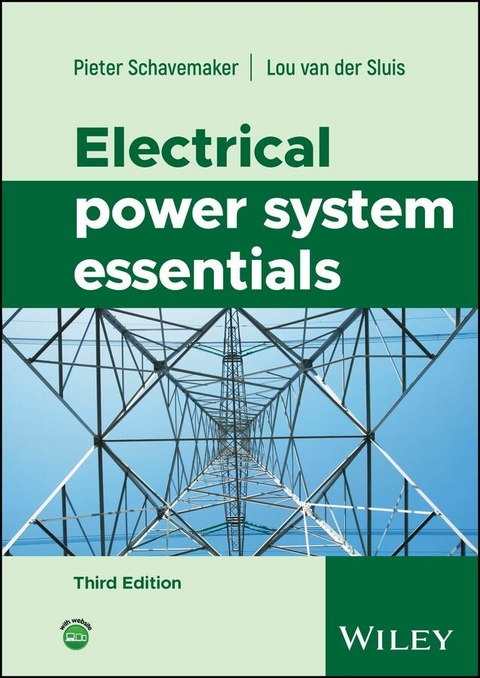
Electrical Power System Essentials (eBook)
755 Seiten
Wiley (Verlag)
978-1-394-27609-7 (ISBN)
A highly accessible resource covering the basics of the design and operation of electrical power systems with minimal technical background required
Electrical Power System Essentials delivers a thorough introduction to the electrical power system and its functioning, and the changes that come with the worldwide energy transition process. This revised and updated Third Edition includes new material on HVDC developments, electricity markets, capacity calculation (NTC and flow-based), power system protection, and energy storage. Discussions on how renewable sources play a more dominant role in the generation of electrical energy and the effects they have on the control and operation of the grid and electricity markets are also included.
Written in the accessible style that has made previous editions so popular with readers, this book restricts math content to the Appendix in order to maintain an easy reading experience of the main text while still providing complete coverage. A companion website includes downloadable teaching materials, and accessory videos are viewable on the Wiley website (www.wiley.com/go/powersystem3e) and YouTube (https://www.youtube.com/playlist?list=PLvaU1SY38TUV8JTwkf1taN-w_bQbCD0Ad).
Topics discussed in the book include:
- Generation of electric energy, covering nuclear fission, wind energy and wind turbine concepts, hydropower and pumped storage, and solar power
- Electricity markets, covering gas scarcity, its influence on the marginal price of electricity, and negative energy prices
- Future power systems, covering higher harmonics, increased use of cables instead of overhead transmission lines, distributed generation and power-electronic interfaces
- Transmission of electric energy, covering DC circuit breakers, wide area measurement systems, and distribution networks
Electrical Power System Essentials is a perfect textbook for second- and third-year undergraduate electrical engineering students who need an accessible course text introducing concepts in power system engineering. The text is also valuable for other students and professionals who require an up-to-date reference on power systems technology.
Pieter Schavemaker, Managing Director of E-Bridge Consulting B.V., has worked in the energy sector for more than 25 years. Pieter has a varied experience as assistant professor at the Delft University of Technology, with a large manufacturer of power system equipment (ABB), with a Transmission System Operator (Tennet TSO), and as a consultant.
Lou van der Sluis worked as researcher and test engineer at KEMA's High-Power and High-Voltage Laboratories. From 1992 until his retirement in 2015 he held the chair of full-time Professor in Electrical Power Systems in the Electrical Sustainable Energy department of the Delft University of Technology. Prof. van der Sluis is a life-senior member of IEEE.
A highly accessible resource covering the basics of the design and operation of electrical power systems with minimal technical background required Electrical Power System Essentials delivers a thorough introduction to the electrical power system and its functioning, and the changes that come with the worldwide energy transition process. This revised and updated Third Edition includes new material on HVDC developments, electricity markets, capacity calculation (NTC and flow-based), power system protection, and energy storage. Discussions on how renewable sources play a more dominant role in the generation of electrical energy and the effects they have on the control and operation of the grid and electricity markets are also included. Written in the accessible style that has made previous editions so popular with readers, this book restricts math content to the Appendix in order to maintain an easy reading experience of the main text while still providing complete coverage. A companion website includes downloadable teaching materials, and accessory videos are viewable on the Wiley website (www.wiley.com/go/powersystem3e) and YouTube (https://www.youtube.com/playlist?list=PLvaU1SY38TUV8JTwkf1taN-w_bQbCD0Ad). Topics discussed in the book include: Generation of electric energy, covering nuclear fission, wind energy and wind turbine concepts, hydropower and pumped storage, and solar powerElectricity markets, covering gas scarcity, its influence on the marginal price of electricity, and negative energy pricesFuture power systems, covering higher harmonics, increased use of cables instead of overhead transmission lines, distributed generation and power-electronic interfacesTransmission of electric energy, covering DC circuit breakers, wide area measurement systems, and distribution networks Electrical Power System Essentials is a perfect textbook for second- and third-year undergraduate electrical engineering students who need an accessible course text introducing concepts in power system engineering. The text is also valuable for other students and professionals who require an up-to-date reference on power systems technology.
Preface
In the field of power system analysis, an extensive amount of high-quality literature is available. Most of these textbooks follow more or less the same line and cover the same topics. This book differs from existing materials because the (steady-state) modeling of the power system components is covered in appendices. Therefore, the focus in the chapters itself is not on the modeling, but on the structure, functioning, and organization of the power system. The appendices contribute to the book by offering material that is not an integral part of the main text, but supports and enhances it and, as such, is an integral part of the book. The book contains a large number of problems, of which extensive solutions are presented in a separate chapter.
The following is a short summary of the contents of the chapters and the appendices.
Chapter 1 (Introduction to Power System Analysis)
This first chapter describes the scope of the material and is an introduction to the steady-state analysis of power systems. Questions, such as “why AC,” “why 50 or 60 Hz,” “why sinusoidally shaped AC,” and “why a three-phase system,” are addressed. The basics for a steady-state analysis of balanced three-phase power systems are outlined, such as phasors, single-line diagrams, active power, reactive power, complex power, power factor, and per-unit normalization.
Chapter 2 (Generation of Electric Energy)
The conversion from a primary source of energy to electrical energy is the topic of Chapter 2. The primary source of energy can be fossil fuels, such as gas, oil, and coal or uranium, but can come from renewable sources as well: wind energy, hydropower, solar power, or geothermal power. In order to understand the nature of a thermal power plant, which is still the main source of power in the system, the principles of thermodynamics are briefly discussed. The final conversion from mechanical energy to electrical energy is achieved by the synchronous machine. The coupling of the machine with the grid and the actual power injection are analyzed.
Chapter 3 (The Transmission of Electric Energy)
The transmission and distribution network is formed by overhead lines, underground cables, transformers, and substations between the points of power injection and power consumption. Various substation concepts are presented, together with substation components and protection installed. The transformers, overhead transmission lines, underground cables, gas-insulated transmission lines, protective relay operating principles, surge arresters, fuses, and circuit breakers are then considered in more detail. The transformer design, possible phase shift, and specific properties due to the magnetic core are highlighted. As overhead transmission lines are the most visible part of the power system, they are discussed from the point of view of what may be seen and why it is like that. The underground cables are also considered, contrasting them with overhead transmission. The chapter ends with the principles of high-voltage direct current (HVDC) transmission.
Chapter 4 (The Utilization of Electric Energy)
The power system is designed and arranged in such a way that demand may be fulfilled: consumers are supplied with the requested amount of active and reactive power at a constant frequency and at a constant voltage. A load actually transforms the AC electrical energy into another form of energy. The focus in this chapter is on the various types of loads that transform the AC electrical energy into mechanical energy (synchronous and induction motors), light, heat, DC electrical energy (rectifiers), and chemical energy. After that, the individual loads in the system are clustered and classified as grid users according to three categories: residential loads (mostly single-phase loads), commercial and industrial loads (often three-phase loads), and electric railways (either DC or single-phase AC).
Chapter 5 (Power System Control)
Continuous control actions are necessary in the system for the control of the voltage, to maintain the balance between the amount of generated and consumed electricity, and to keep the system frequency at either 50 or 60 Hz. It is demonstrated that, in transmission networks, there is more or less a “decoupling” between the active power and the voltage angles on one side and the reactive power and voltage magnitudes on the other, which is the basis for the control. The power balance is maintained (primary control), and the system frequency deviation is minimized (secondary control) by controlling the active power output of the generators. Voltage is controlled locally either at generator buses by adjusting the generator voltage control or at fixed points in the system where tap-changing transformers, capacitor banks, or other reactive power consumers/producers are connected. Flexible AC transmission systems (FACTS) devices are large power-electronic devices; they are operated in a shunt configuration for reactive power and voltage control, or they are connected in series to control the power flow.
Chapter 6 (Energy Management Systems)
In the control center, the transmission and distribution of electrical energy are monitored, coordinated, and controlled. The energy management system (EMS) is the interface between the operator and the actual power system. The supervisory control and data acquisition (SCADA) system collects real-time measured data from the system and presents it to the computer screen of the operator, and it sends control signals from the control center to the actual components in the network. The EMS is in fact an extension of the basic functionality of the SCADA system and includes tools for the analysis and the optimal operation of the power system. The state estimator serves as a “filter” for the collected measurement data; it determines the state of the power system that matches best with the available measurements. This is a necessary input for other analysis programs in the EMS, such as the load flow or power flow and the optimal power flow. The load flow computation is one of the most important power system computations, giving us insight into the steady-state behavior of the power system. Therefore, besides the well-known Newton–Raphson load flow, a decoupled load flow and the DC load flow are also presented.
Chapter 7 (Electricity Markets)
At a broad conceptual level, there exists such a thing as a “common market model” that provides for both spot market trading coordinated by a grid/market operator and for bilateral contract arrangements scheduled through the same entity. The spot market is based on a two-sided auction model: both the supply and demand bids are sent to the power exchange. Market equilibrium occurs when the economic balance among all participants is satisfied and the benefits for society, called “social welfare,” are at their maximum value. The power system is a large interconnected system, so that multiple market areas are physically interconnected with each other: this facilitates the export of electricity from low-price areas to high-price areas. In the capacity calculation process, the grid limitations that may restrict the imports and exports in the various market areas are assessed.
Chapter 8 (Future Power Systems)
In this chapter, some developments originating from the complex technological, ecological, sociological, and political playing field and their possible consequences on the power system are highlighted. A large-scale implementation of electricity generation based on renewable sources, for example, will cause structural changes in the existing distribution and transmission networks. Many of these units are decentralized generation units, rather small-scale units that are connected to the distribution networks often by means of a power-electronic interface. A transition from the current “vertically operated power system” into a “horizontally operated power system” in the future is not unlikely. Energy storage can be applied to level out large power fluctuations when the power is generated by renewable energy sources, driven by intermittent primary energy. The complexity of the system increases because of the use of FACTS devices, power-electronic interfaces, intermittent power production, and so on. Chaotic phenomena are likely to occur in the near future, and large system blackouts will probably happen more often. Wide area monitoring for protection and control with phasor measurement units uses system-wide information to counter the propagation of large system disturbances.
Appendix A (Maxwell’s Laws)
Circuit theory can be regarded as describing a restricted class of solutions of Maxwell’s equations. In this appendix, power series approximations will be applied to describe the electromagnetic field. It is shown that the zero and first-order terms in these approximations (i.e., the quasi-static fields) form the basis for the lumped-circuit theory. By means of the second-order terms, the validity of the lumped-circuit theory at various frequencies can be estimated. It is the electrical size of the structure–its size in terms of the minimum wavelength of interest in the bandwidth over which the model must be valid – that dictates the sophistication and complexity of the required model. A criterion is derived that relates the dimensions of the electromagnetic structure to the smallest wavelength under consideration so that the validity of the lumped-element model can be verified.
Appendix B...
| Erscheint lt. Verlag | 4.4.2025 |
|---|---|
| Sprache | englisch |
| Themenwelt | Technik ► Elektrotechnik / Energietechnik |
| Schlagworte | AC and HVDC power systems • Distribution Networks • electricity markets • Grid Control • Grid Operation • power system energy storage • Power system protection • power systems renewable sources • power systems technology • power systems textbook |
| ISBN-10 | 1-394-27609-5 / 1394276095 |
| ISBN-13 | 978-1-394-27609-7 / 9781394276097 |
| Informationen gemäß Produktsicherheitsverordnung (GPSR) | |
| Haben Sie eine Frage zum Produkt? |
 EPUB (Adobe DRM)
Kopierschutz: Adobe-DRM
Adobe-DRM ist ein Kopierschutz, der das eBook vor Mißbrauch schützen soll. Dabei wird das eBook bereits beim Download auf Ihre persönliche Adobe-ID autorisiert. Lesen können Sie das eBook dann nur auf den Geräten, welche ebenfalls auf Ihre Adobe-ID registriert sind.
Details zum Adobe-DRM
Dateiformat: EPUB (Electronic Publication)
EPUB ist ein offener Standard für eBooks und eignet sich besonders zur Darstellung von Belletristik und Sachbüchern. Der Fließtext wird dynamisch an die Display- und Schriftgröße angepasst. Auch für mobile Lesegeräte ist EPUB daher gut geeignet.
Systemvoraussetzungen:
PC/Mac: Mit einem PC oder Mac können Sie dieses eBook lesen. Sie benötigen eine
eReader: Dieses eBook kann mit (fast) allen eBook-Readern gelesen werden. Mit dem amazon-Kindle ist es aber nicht kompatibel.
Smartphone/Tablet: Egal ob Apple oder Android, dieses eBook können Sie lesen. Sie benötigen eine
Geräteliste und zusätzliche Hinweise
Buying eBooks from abroad
For tax law reasons we can sell eBooks just within Germany and Switzerland. Regrettably we cannot fulfill eBook-orders from other countries.
aus dem Bereich