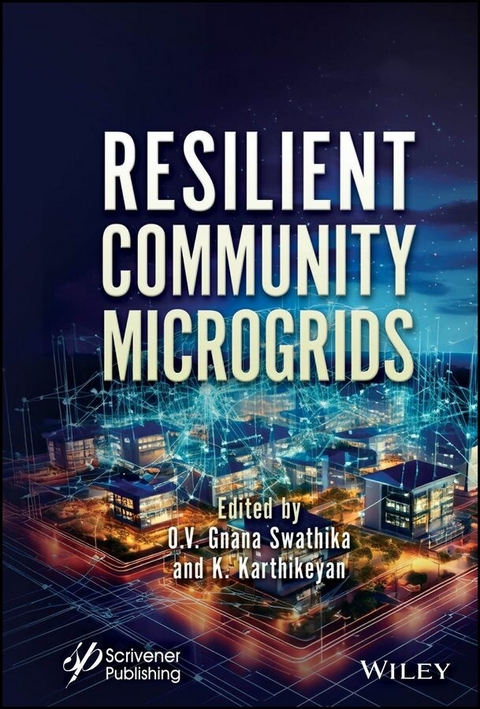
Resilient Community Microgrids (eBook)
851 Seiten
Wiley-Scrivener (Verlag)
978-1-394-27252-5 (ISBN)
O.V. Gnana Swathika, PhD, is a professor at the Vellore Institute of Technology, Chennai, India. She completed her post-doctoral work in 2019 at the University of Moratuwa, Sri Lanka and is a senior member of the Institute for Electrical and Electronics Engineers. Her research interests include microgrid protection, power system optimization, embedded systems, and photovoltaic systems. She has edited numerous books for Scrivener Publishing.
K. Karthikeyan is the Chief Engineering Manager of Electrical Designs for Larsen & Toubro Construction, an Indian multinational Engineering Procurement Construction contracting company with over two decades of experience in electrical design. Through his work, he has immensely contributed to the building services sector in areas including airports, Information Technology Office Spaces (ITOS), tall statues, railway stations and depots, hospitals, educational institutional buildings, residential buildings, hotels, steel plants, and automobile plants in India and abroad.
Discover how to empower your community with sustainable energy solutions with Resilient Community Microgrids, a comprehensive guide that explores the integration of innovative technologies and distributed energy resources to enhance local energy independence and resilience. Resilient Community Microgrids emphasizes opportunities to incorporate distributed energy resources and communication networks to build a cyber-physical community microgrid system by modelling photovoltaics, energy storage units, micro-turbines, and wind energy. The microgrid proves itself as a sustainable archetype to improve the resilience and reliability of power distribution networks. High-distributed energy resources penetrate communities, unlocking the potential to build the resilience of microgrids. Neighborhoods, villages, towns, and cities can meet their local energy needs by utilizing community microgrids. Community microgrids are being considered as a possibility even in locations where a bigger grid already exists, primarily as a means of boosting local energy independence and resilience. The fundamentals of community microgrids are covered in this book, along with an outline of how to join one and the factors contributing to their rising popularity. Novel technologies arrive with the potential to integrate with the physical microgrid to realize the next generation in cyber-physical microgrid systems, which can be used as a prototype to demonstrate and promote the development of next-generation microgrids. Resilient Community Microgrids will clarify the ways to enhance a cyber-physical system's resilience that significantly contributes to realizing innovative and sustainable development in the energy sector.
1
AI-Based Virtual Advisor for Smart Climate Farming
S. Ramanan1, Mekala Sujan1, Swati Kumari1 and O.V. Gnana Swathika2*
1School of Computer Science Engineering, Vellore Institute of Technology, Chennai, India
2Centre for Smart Grid Technologies, Vellore Institute of Technology, Chennai, India
Abstract
The following content includes the research and reviews of 96 articles, along with their citations and descriptions. Smart climate farming involves different techniques, such as agroforestry, vertical farming, sustainable water management, and precision agriculture. In simple terms, anything that benefits the production and income of individuals involved in the agricultural sector by using emerging technology is known as smart climate farming. With the help of smart farming, the agricultural industry can undergo transformative change. Smart climate farming is not only focused on technology development but also involves far-reaching impacts, such as livelihoods, food security, and ecological balance. Moreover, smart climate farming reduces greenhouse gases emitted when compared to traditional agriculture. Below are some of the content and advantages of smart climate farming.
Keywords: IoT in agriculture, smart agriculture, sensors, sustainable agriculture, climate, resilience
1.1 Introduction
Smart farming can also be called precision agriculture. Big data plays a major role in developing agriculture due to its extraordinary capabilities; it allows for the usage of various tools to provide farmers with rainfall patterns, helping them decide whether they can plant a particular crop or not, as well as outlining the water cycles to be used by the farmer. Heterogeneity and the plethora of agricultural data remove the challenges in classifying existing resources; without big data, collecting this information becomes difficult for future generations [1].
Satellite sensors have the capability to capture imagery from a distance, covering vast areas. The same procedure has been used with high-level drones to take aerial shots. Such defects include the canopy chlorophyll content (CCC) in wheat; the satellite sensors can detect red-colored edges in wheat and inform farmers that this wheat is not suitable for sale. The same applies to canopy nitrogen content (CNC) in rice. By using this method, we can enhance the efficiency of available materials and labor [2].
Unmanned farms represent the technology we will be able to see in the near future. In the 21st century, we observe that most people are interested in production but not in farming, so to create innovative ideas, unmanned farms have emerged. Gradually, we will transition into unmanned farms, and in the upcoming 50 years, we may see AI completely handling production tasks. However, this may not be as efficient as human labor due to unreliable robots and unstable sensors [3].
This paper presents a comprehensive review of smart technology applications in agriculture, focusing on artificial intelligence, machine learning, cloud computing, and the Internet of Things (IoT). It discusses how these technologies are used in crop and animal production, as well as post-harvest processes. Additionally, the paper addresses the impact of climate change on agriculture. It highlights challenges and gaps in current research related to smart farming using IoT and provides recommendations for further study to increase global food production, management, and sustainability [4].
The rapid digitalization of data has led to an overwhelming influx of information across various industries, including data-driven enterprises. This surge has been further intensified by the rise of machine-to-machine (M2M) processing of digital data. As a result, digital crop management applications have emerged, utilizing ICT (information and communication technology) to assist both farmers and customers and bring technical solutions to rural areas. Despite the difficulties it might present, this research examines ICT’s potential for traditional agriculture. It explores subjects like robots, IoT devices, machine learning, artificial intelligence, and agricultural sensors. It also discusses how to maximize yield and monitor crops using drones. The paper also highlights global IoT-based platforms and farming systems and reviews recent literature in these domains. Ultimately, it concludes by presenting artificial intelligence (AI) trends for the present and future while identifying research challenges in AI for agriculture, drawing from this comprehensive assessment [5].
Artificial intelligence, particularly deep learning, time series analysis, and machine learning, plays a vital role in addressing today’s sustainability challenges in agriculture. These technologies are employed for tasks such as crop selection, yield forecasting, soil compatibility evaluation, and water management. Time series analysis is essential for forecasting crop demand, commodity pricing, and yield production. Machine learning assists with crop selection and management, while deep learning simplifies crop forecasting. With these techniques, crop selection is based on factors such as soil quality. With the global population increasing, accurate crop production forecasting is essential to combat food shortages. This article provides a comprehensive overview of how artificial intelligence and deep learning methods can be utilized in agriculture, leveraging crop data sets for tasks like soil fertility classification and crop selection. Time series analysis is also explored, offering insights into future crop production, ultimately helping alleviate food scarcity by making informed crop recommendations based on yield estimation [6].
Smart farming is crucial in addressing challenges related to feeding a growing population and ensuring food safety. It combines agriculture with information and communication technologies. A potential idea in smart farming is the Multiponics Vertical Farming (MVF) system, which offers space and financial savings. Advanced technologies can manage complex data, enhancing accuracy and efficiency. Artificial intelligence (AI) is instrumental in solving dynamic and intricate agricultural problems. This study covers tasks like categorization, detection, and forecasting as it examines AI’s role in soil management and MVF. We explore neural network (NN), support vector machine (SVM), and decision tree (DT), which are three widely used AI and machine learning techniques. The abstract also touches on future prospects for urban farming [7].
Agribusiness is fundamental to India’s economy, directly or indirectly employing a significant portion of the population. The introduction of technology, particularly smart farming, holds great promise for improving agricultural outcomes. This shift from traditional methods is driven by the need to meet a 55% increase in global demand for agricultural products by 2050 while reducing the reliance on fertilizers and optimizing water use. Smart farming has become more energy-efficient due to factors like continuous cropping, increased fertilizer and chemical use, and advanced farm mechanization. The Internet of Things (IoT), data analytics, and satellite technology all contribute to the rapid expansion of smart farming. IoT-based precision agriculture involves real-time monitoring of agricultural parameters using sensors for soil, temperature, humidity, air quality, and drones equipped with cameras. AI is leveraged for analyzing images to detect crop health and pest/ disease outbreaks. This chapter explores how IoT and AI can enhance agricultural productivity and sustainability, focusing on their benefits and applications in farming processes and energy optimization [8].
Precision agriculture, with its advanced technologies like AI-driven equipment and robotic farm workers, is praised for its potential to enhance yields from crops, food security, economic development, and poverty alleviation. However, there’s growing concern about the biases and power dynamics ingrained in these technologies. While they may create opportunities for small-scale female farmers in East Africa, they also risk becoming tools of control over their labor and knowledge. Moreover, these technologies tend to view plants solely as objects to be optimized, overlooking their unique characteristics and ways of interacting with the environment. This essay examines how smart farming and precision agriculture might reinforce hierarchies and ignore indigenous viewpoints and expertise. It promotes a decolonial approach to governing these technologies to ensure greater inclusivity and respect for diverse ways of knowing and being [9].
Smart agriculture practices have gained significant attention among farmers due to the accessibility of cost-effective IoT-based wireless sensors for monitoring field conditions, climate, and crops. These sensors help manage resources efficiently, such as reducing water usage and minimizing pesticide application. Additionally, the surge in artificial intelligence (AI) enables the deployment of autonomous farming machinery and improved predictive capabilities to prevent crop diseases and pest infestations. These technologies have transformed traditional agriculture.
This survey study provides: (a) an in-depth lesson on developments in smart agriculture using IoT and AI, (b) a critical examination of these technologies and a discussion of obstacles to their general implementation, and (c) a detailed analysis of current trends, considering both technological and societal factors as smart agriculture becomes the norm among...
| Erscheint lt. Verlag | 2.4.2025 |
|---|---|
| Sprache | englisch |
| Themenwelt | Technik ► Elektrotechnik / Energietechnik |
| ISBN-10 | 1-394-27252-9 / 1394272529 |
| ISBN-13 | 978-1-394-27252-5 / 9781394272525 |
| Informationen gemäß Produktsicherheitsverordnung (GPSR) | |
| Haben Sie eine Frage zum Produkt? |
 EPUB (Adobe DRM)
Kopierschutz: Adobe-DRM
Adobe-DRM ist ein Kopierschutz, der das eBook vor Mißbrauch schützen soll. Dabei wird das eBook bereits beim Download auf Ihre persönliche Adobe-ID autorisiert. Lesen können Sie das eBook dann nur auf den Geräten, welche ebenfalls auf Ihre Adobe-ID registriert sind.
Details zum Adobe-DRM
Dateiformat: EPUB (Electronic Publication)
EPUB ist ein offener Standard für eBooks und eignet sich besonders zur Darstellung von Belletristik und Sachbüchern. Der Fließtext wird dynamisch an die Display- und Schriftgröße angepasst. Auch für mobile Lesegeräte ist EPUB daher gut geeignet.
Systemvoraussetzungen:
PC/Mac: Mit einem PC oder Mac können Sie dieses eBook lesen. Sie benötigen eine
eReader: Dieses eBook kann mit (fast) allen eBook-Readern gelesen werden. Mit dem amazon-Kindle ist es aber nicht kompatibel.
Smartphone/Tablet: Egal ob Apple oder Android, dieses eBook können Sie lesen. Sie benötigen eine
Geräteliste und zusätzliche Hinweise
Buying eBooks from abroad
For tax law reasons we can sell eBooks just within Germany and Switzerland. Regrettably we cannot fulfill eBook-orders from other countries.
aus dem Bereich