Bring Your Own Device Security Policy Compliance Framework (eBook)
196 Seiten
Springer Nature Switzerland (Verlag)
978-3-031-86801-6 (ISBN)
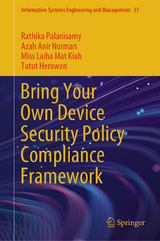
Proliferation of Bring Your Own Device (BYOD) has instigated a widespread change, fast outpacing the security strategies deployed by organizations. The influx of these devices has created information security challenges within organizations, further exacerbated with employees’ inconsistent adherence with BYOD security policy. To prevent information security breaches, compliance with BYOD security policy and procedures is vital. This book aims to investigate the factors that determine employees' BYOD security policy compliance by using mixed methods approach. Security policy compliance factors, BYOD practices and security risks were identified following a systematic review approach. Building on Organizational Control Theory, Security Culture and Social Cognitive Theory, a research framework positing a set of plausible factors determining BYOD security policy compliance was developed. Next, with a purposive sample of eight information security experts from selected public sector organizations, interviews and BYOD risk assessments analysis were performed to furnish in-depth insights into BYOD risks, its impact on organizations and recommend control measures to overcome them. This led to the suggestion of four control measures to mitigate critical BYOD security risks such as Security Training and Awareness (SETA), policy, top management commitment and technical countermeasures. The control measures were mapped into the research framework to be tested in the following quantitative phase. The proposed research framework was tested using survey results from 346 employees of three Critical National Information Infrastructure (CNII) agencies. Using Partial Least Squares – Structural Equation Modelling (PLS-SEM), the framework's validity and reliability were evaluated, and hypotheses were tested. Findings show that perceived mandatoriness, self-efficacy and psychological ownership are influential in predicting employees’ BYOD security policy compliance. Specification of security policy is associated with perceived mandatoriness, while BYOD IT support and SETA are significant towards self-efficacy. Unexpectedly, security culture has been found to have no significant relationship to BYOD security policy compliance. Theoretical, practical, and methodological contributions were discussed and suggestions for future research were recommended. The analysis led to a number of insightful findings that contribute to the literature and the management, which are predominantly centered on traditional computing. In view of the ever-increasing BYOD threats to the security of government information, it is imperative that IT managers establish and implement effective policies to protect vital information assets. Consequently, the findings of this study may benefit policymakers, particularly in the public sector, in their efforts to increase BYOD security policy compliance among employees.
| Erscheint lt. Verlag | 29.3.2025 |
|---|---|
| Reihe/Serie | Information Systems Engineering and Management |
| Zusatzinfo | XXII, 196 p. 26 illus., 13 illus. in color. |
| Sprache | englisch |
| Themenwelt | Informatik ► Netzwerke ► Sicherheit / Firewall |
| Technik ► Bauwesen | |
| Schlagworte | Bring your own device • Computational Intelligence • Organizational control theory • Security Culture • Security Policy Compliance • social cognitive theory |
| ISBN-10 | 3-031-86801-3 / 3031868013 |
| ISBN-13 | 978-3-031-86801-6 / 9783031868016 |
| Informationen gemäß Produktsicherheitsverordnung (GPSR) | |
| Haben Sie eine Frage zum Produkt? |
 PDF (Wasserzeichen)
DRM: Digitales Wasserzeichen
Dieses eBook enthält ein digitales Wasserzeichen und ist damit für Sie personalisiert. Bei einer missbräuchlichen Weitergabe des eBooks an Dritte ist eine Rückverfolgung an die Quelle möglich.
Dateiformat: PDF (Portable Document Format)
Mit einem festen Seitenlayout eignet sich die PDF besonders für Fachbücher mit Spalten, Tabellen und Abbildungen. Eine PDF kann auf fast allen Geräten angezeigt werden, ist aber für kleine Displays (Smartphone, eReader) nur eingeschränkt geeignet.
Systemvoraussetzungen:
PC/Mac: Mit einem PC oder Mac können Sie dieses eBook lesen. Sie benötigen dafür einen PDF-Viewer - z.B. den Adobe Reader oder Adobe Digital Editions.
eReader: Dieses eBook kann mit (fast) allen eBook-Readern gelesen werden. Mit dem amazon-Kindle ist es aber nicht kompatibel.
Smartphone/Tablet: Egal ob Apple oder Android, dieses eBook können Sie lesen. Sie benötigen dafür einen PDF-Viewer - z.B. die kostenlose Adobe Digital Editions-App.
Buying eBooks from abroad
For tax law reasons we can sell eBooks just within Germany and Switzerland. Regrettably we cannot fulfill eBook-orders from other countries.
aus dem Bereich