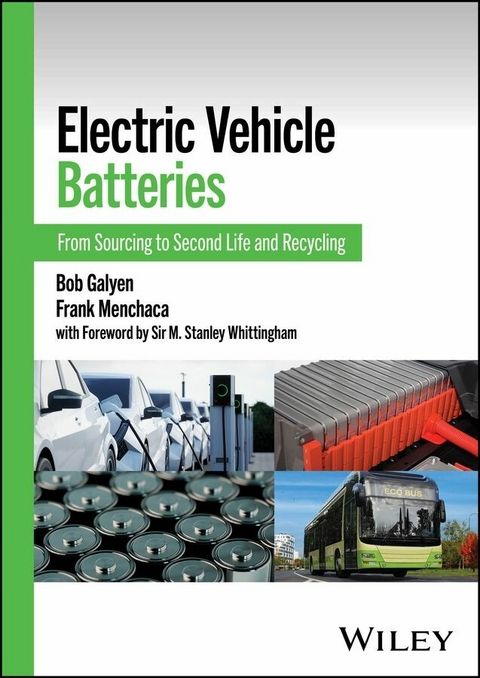
Electric Vehicle Batteries (eBook)
476 Seiten
Wiley (Verlag)
978-1-394-26212-0 (ISBN)
Understand the batteries that will power the sustainable transition from innovators who are making it happen
The transition from fossil-fuel based energy sources to electricity is one of the most crucial technological milestones in the world today. The surge of electric vehicle production will require hundreds of millions of electric vehicle batteries, the creation of which have environmental impacts of their own. There is an urgent need for resources which analyze these impacts, their role in the life cycle of a battery, and the broader challenges and opportunities of this electric transition.
Electric Vehicle Batteries: From Sourcing to Second Life and Recycling meets this need with a thorough, accessible overview of batteries: how they are made, used, and re-used. Balancing theory and practice, and with coverage of all relevant vehicle types, it's a crucial resource for engineers, scientists, students, and instructors. Created by some of the leading experts in the mobility industry, Electric Vehicle Batteries is a decisive contribution to the fight for a sustainable future.
In Electric Vehicle Batteries: From Sourcing to Second Life and Recycling, readers will find:
- A programmatic structure for creating new engineering practices and teams that support them
- A safety-first approach to handling volatile materials
- An authorial and editorial team with extensive experience in both engineering and management
Electric Vehicle Batteries: From Sourcing to Second Life and Recycling is ideal for reskilling engineers, undergraduate students, and other new entrants into the rapidly expanding field of electric vehicle production.
Bob Galyen is recognized as one of the top executives in the battery energy storage world and within science/engineering-based communities. His positions as Chief Technology Officer of CATL (the world's largest battery manufacturer), Chairman of SAE International's Battery Standards Steering Committee, and as an SAE Fellow, Chairman Emeritus and CTO of NAATbatt International, provide him a unique leadership perspective in the global battery industry. He holds multiple patents. His manufacturing experience qualifies him as one of the top Lithium-Ion Battery producers (CATL) and Lead Acid Battery producers (Delco Remy Division of GM) in the world.
Frank Menchaca is Founder and CEO of Auzolan, a sustainble mobility company specializing in technical information and work force development in energy storage, electric vehicle charging, and recycling. Frank incubated SAE's sustainability program. Frank holds degrees from New York University, Yale University and Chief Sustainability Officer certification from MIT.
Understand the batteries that will power the sustainable transition from innovators who are making it happen The transition from fossil-fuel based energy sources to electricity is one of the most crucial technological milestones in the world today. The surge of electric vehicle production will require hundreds of millions of electric vehicle batteries, the creation of which have environmental impacts of their own. There is an urgent need for resources which analyze these impacts, their role in the life cycle of a battery, and the broader challenges and opportunities of this electric transition. Electric Vehicle Batteries: From Sourcing to Second Life and Recycling meets this need with a thorough, accessible overview of batteries: how they are made, used, and re-used. Balancing theory and practice, and with coverage of all relevant vehicle types, it s a crucial resource for engineers, scientists, students, and instructors. Created by some of the leading experts in the mobility industry, Electric Vehicle Batteries is a decisive contribution to the fight for a sustainable future. In Electric Vehicle Batteries: From Sourcing to Second Life and Recycling, readers will find: A programmatic structure for creating new engineering practices and teams that support them A safety-first approach to handling volatile materials An authorial and editorial team with extensive experience in both engineering and management Electric Vehicle Batteries: From Sourcing to Second Life and Recycling is ideal for reskilling engineers, undergraduate students, and other new entrants into the rapidly expanding field of electric vehicle production.
Introduction
Bob Galyen
Galyen Energy LLC, Noblesville, IN, USA
Frank Menchaca
Auzolan LLC, Pittsburg, PA, USA
What You Will Learn in This Chapter
This chapter introduces you to this book: why we wrote it and what sustainability has to do with engineering and batteries.
In this chapter:
- We describe the problems the book sets out to address and how we organize our approach.
- We explore the drivers of sustainability in transportation.
- We examine how those drivers affect the development of vehicles and the engineering practices that support them.
- We include terms to know, information on jobs that relate to the topics at hand, and resources for learning more.
- We use a real‐world case study to illustrate our points, as with most topics in this book.
Case Study: Circular Economy for EV Batteries in Australia
In 2021, a team of researchers at the University of Melbourne set out to study the impact of reusing electric vehicle (EV) batteries.1 Some projections had EVs accounting for 30 % of vehicles on Australia's roads by 2035. This growth was important to decarbonatization of transportation and to achieving net zero emissions, but it would not be consequence free for the environment.
While EVs produce no tailpipe emissions, their batteries require impactful processes such as mining to reach underground reservoirs of brine and other materials. Refining brine produces lithium, a chemical element critical to power in EV batteries. This involves large quantities of pumped water, which also means producing wastewater. Besides, emissions associated with mining equipment, transportation, and manufacturing and EV batteries threaten to neutralize the gains made by the vehicles they power.
Research has already established that an EV battery, once it serves the vehicle's 8 to 10‐year average lifespan, could retain as much as 80% of its capacity. Harnessing that capacity without dismantling the battery and interacting with its potentially toxic contents, known as black mass, became the goal of the Melbourne team and to achieve it, they conducted what is referred to as a Lifecycle Assessment (LCA). An LCA is the study of a product or procedure's environmental impact – a codification of the steps that go into manufacturing something and quantification of their consequences: the energy they use, the emissions they produce, and more. LCAs constitute a critical tool in identifying where environmental tolls are heaviest and how to reduce them.
The researchers defined and assessed not only the creation of EV batteries but, just as important, their use as storage devices when their service in the EV ended, known as their second life. This meant mapping out any remanufacturing and transportation, assessing their impact, and establishing how much energy the repurposed batteries could store as offset.
This EV battery lifecycle consists of five phases in two cases of reuse, one as a home energy storage system (HESS) and one as home energy battery pack (HEBP):
- Minerals extraction and manufacture, in which lithium and other natural materials are mined and refined, occurring in China and the Rest of the World (ROW).
- EV use, in which the battery powers the car over its 8‐ to 10‐year life span.
- Repurposing, in which the battery is remanufactured so that it can be reused. Because the study assumes the battery was produced with the intention of being reused, it allocated 25% of the emissions generated in its production to reuse. In the study, as in other LCAs, energy use and emissions must always be accounted for; in this case, allocation was done over the period of initial use and reuse.
- Use, in which the battery is put to reuse in a HESS and HEBP.
- End of Life, in which the battery is dismantled and its constituent units are recycled.
By assessing each step in the repurposed EV battery's initial and second life, the Melbourne team was able to draw some important conclusions about the environmental benefit of recycling – or creating a circular economy – for batteries and their contents. “The repurposed battery has a smaller footprint across all eight environmental impact categories, provided it operates for a minimum of six years2,” they wrote. The environmental categories on which the team studied the battery's impact included:
- Global warming potential (GWP)
- Terrestrial acidification potential (TAP)
- Surplus ore potential (SOP)
- Fossil resource scarcity potential (FFP)
- Water consumption (WCP)
These are important areas that directly affect human health, biodiversity, and the economy, among other things. Understanding the impact of manufacturing on these areas, and finding means of limiting that impact constitutes the essence of a sustainable engineering practice. That is the focus of this book.
A New Age in Engineering
The Melbourne case illustrates several important transformations the field of mobility engineering is undergoing. One is a commitment to sustainability. A term used frequently and in a wide variety of contexts, sustainability can seem general and vague. Our use of the term derives from the 1987 United Nations Brundtland Commission's definition: “meeting the needs of the present without compromising the ability of future generations to meet their own needs.”3 Natural resources are finite, says this definition, and we must use them in a way that does not damage the world and its people and prevent future generations from enjoying their benefits, thriving, and leading prosperous lives.
Sustainability has become critical to mobility because transportation accounts for an estimated 20% of global greenhouse gas (GHG) emissions – second only to electricity generation.4 These are the emissions, produced by burning fossil fuels burned in cars, airplanes, ships, and other forms of transportation. Their accumulation in the atmosphere causes global warming. Governments and businesses throughout the mobility industry have committed to transfer to electric and renewable energy sources as a means of reducing GHGs. For many, this is to comply with the Paris Agreement,5 a 2015 international agreement to limit global warming to less than two degrees centigrade by 2050 – a threshold at which climate scientists project the impact of climate change to be manageable – by reaching net zero GHG emissions.
This energy transfer that supports this goal constitutes one of the largest – perhaps the largest – changes transportation has undergone since its beginning. Batteries play a central role. Let us examine how:
- Princeton University's Net Zero America study comprehensively calculates what will be required for the United States to achieve net zero emissions by 2050. It presents five scenarios and the backbone for all is a shift from fossil fuel‐powered vehicles to EVs. The study projects a future in which electric vehicles replace internal combustion engine vehicles (ICEVs) in a vertiginous climb: 49 million in 2030, 204 million in 2040, and 328 million by 2050.6 All of these vehicles will likely require batteries.
- In 2022, the United States passed the Inflation Reduction Act (IRA). Through a series of tax credits to businesses and individuals, the IRA is intended to attract EV buyers and accelerate battery production in the United States. The bill was accompanied by federal investments such as in 2023, when the U.S. Department of Energy loaned Ford Motor Company and Korean battery producer SK $9.5 Billion to build, among other things, a series of battery factories.7 This enabled the automaker to make the largest financial investment in its history – in batteries.
- In 2023, the European Union (EU) adopted a sweeping new regulation governing the production of batteries and the tracking of battery materials. Scheduled to go into effect in 2026, the legislation addresses the entire battery lifecycle. The law states:
- In view of the strategic importance of batteries, to provide legal certainty to all operators involved and to avoid discrimination, barriers to trade, and distortions in the market for batteries, it is necessary to set out rules on the sustainability, performance, safety, collection, recycling, and second life of batteries as well as on information about batteries for end users and economic operators. It is necessary to create a harmonized regulatory framework for dealing with the entire life cycle of batteries that are placed on the market in the Union.8
- By the end of the 21st century's first decade, China had established itself as the global leader in both battery and EV manufacturing. Between 2009 and 2022, the Chinese government invested over 200 billion RMB, or $29 billion USD9 in battery and EV technologies, with one Chinese company (CATL) emerging as the largest battery manufacturer in the world.
These are just a few examples of the centrality that batteries have attained within industry and government worldwide. This ecosystem is vast and dynamic. The Melbourne case study illustrates that this transition is complex and multifaceted and requires executives, engineers, designers, and technicians to do their work differently. Designing for reuse and understanding the impact of sourcing and production through LCAs are just a few of the many practices mobility...
| Erscheint lt. Verlag | 27.3.2025 |
|---|---|
| Vorwort | M. Stanley Whittingham |
| Sprache | englisch |
| Themenwelt | Technik ► Maschinenbau |
| Schlagworte | battery passport • circular economy • Engineering • EV • EV batteries • Industry 4.0 • lifecycle analysis • lifecycle inventory • lithium ion batteries • Recycling • Second Life • Sir M. Stanley Whittingham • Solid State Batteries • sustainable manufacturing • workforce development |
| ISBN-10 | 1-394-26212-4 / 1394262124 |
| ISBN-13 | 978-1-394-26212-0 / 9781394262120 |
| Informationen gemäß Produktsicherheitsverordnung (GPSR) | |
| Haben Sie eine Frage zum Produkt? |
 EPUB (Adobe DRM)
Kopierschutz: Adobe-DRM
Adobe-DRM ist ein Kopierschutz, der das eBook vor Mißbrauch schützen soll. Dabei wird das eBook bereits beim Download auf Ihre persönliche Adobe-ID autorisiert. Lesen können Sie das eBook dann nur auf den Geräten, welche ebenfalls auf Ihre Adobe-ID registriert sind.
Details zum Adobe-DRM
Dateiformat: EPUB (Electronic Publication)
EPUB ist ein offener Standard für eBooks und eignet sich besonders zur Darstellung von Belletristik und Sachbüchern. Der Fließtext wird dynamisch an die Display- und Schriftgröße angepasst. Auch für mobile Lesegeräte ist EPUB daher gut geeignet.
Systemvoraussetzungen:
PC/Mac: Mit einem PC oder Mac können Sie dieses eBook lesen. Sie benötigen eine
eReader: Dieses eBook kann mit (fast) allen eBook-Readern gelesen werden. Mit dem amazon-Kindle ist es aber nicht kompatibel.
Smartphone/Tablet: Egal ob Apple oder Android, dieses eBook können Sie lesen. Sie benötigen eine
Geräteliste und zusätzliche Hinweise
Buying eBooks from abroad
For tax law reasons we can sell eBooks just within Germany and Switzerland. Regrettably we cannot fulfill eBook-orders from other countries.
aus dem Bereich